
While the Serbian Ministry of Health and the Dr Milan Jovanović Batut Institute of Public Health present polished strategies for fighing Healthcare-Associated Infections (HAIs) and present national action plans at conferences, the reality inside Serbian hospitals tells a vastly different story.
A strategy that is neither monitored nor enforced is not a strategy—it is window dressing for negligence and avoiding responsibility.
That distinction is critical. Unenforced strategy isn’t just ineffective governance; in regulated or high-stakes environments, it creates active legal, operational, and ethical exposure.
When the government formulates policy or strategy without establishing accountability mechanisms, it often leads to predictable points of failure:
- Plausible Deniability vs. Liability: Drafting a compliant strategy allows organizations to tick boxes for auditors or public relations. However, when a crisis occurs, regulators and courts increasingly view the absence of monitoring as reckless disregard rather than mere oversight.
- Organizational Cynicism: Hospital employees quickly recognize when published values or mandates lack enforcement. This erodes institutional trust and creates a culture where compliance is viewed as optional.
- The “Paper Safety” Trap: In medical settings, relying on written protocols without field audits creates a false sense of security while operational risks compound unnoticed.
For a strategy to function as an operational roadmap rather than mere posturing, it requires three foundational legs:
- Explicit Metrics (KPIs/KRIs): Measurable parameters that define compliance, progress, and failure thresholds.
- Active Telemetry & Auditing: Continuous or regular verification mechanisms (data tracking, third-party audits, inspection cycles) to confirm execution.
- Enforcement & Consequences: Clear escalation paths and consequences when execution diverges from strategy, regardless of seniority.
Without internal controls and enforcement pipelines, strategic documentation serves primarily as documentation of what the government knew should have been done and for offering vast amount of excuses for denying liability and shifting blame when things go wrong.
Despite existing guidelines, the reality on the ground remains unaddressed:
- ZERO Real Transparency: Official reporting on hospital-acquired infections (HAIs) and multidrug-resistant (MDR) or extensively drug-resistant (XDR) pathogens remains opaque. There are no published, reliable epidemiological models estimating the true burden of infection.
- NO Accountability: Not a single hospital administration or physician has been held publicly accountable for non-compliance with infection control protocols.
- COSMETIC Inspections: Sanitary and health inspections act as formal bureaucratic checkboxes (“putting lipstick on a pig”) rather than enforcing strict hygiene standards or imposing sanctions.
The Human Toll: From Routine Admission to Fatal Sepsis
You don’t need leaked Ministry of Health data to see a system in collapse. Just walk into any hospital, talk to patients who caught infections on the ward, or listen to the heartbreakingly similar stories from their families.
A standard procedure like catheterization— frequently performed without strict medical justification, often simply for staff convenience—becomes a game of Russian roulette:
- High Risk of MDR/XDR CAUTI: In environments saturated with resistant strains, catheter-associated urinary tract infections (CAUTIs) involving pathogens like Klebsiella pneumoniae carry extraordinarily high infection rates. As highlighted in The Silent Pandemic in Emergency Rooms and Inside the ER Protocols, baseline hygiene breaches during catheter insertion and maintenance create immediate pathways for colonisation.
- Systemic Cover-Ups: When an infection takes hold, hospitals often attempt to mask the systemic nature of the problem, discharging patients as “cured” or “stable” while they continue to harbor active, resistant infections (Hidden Behind Discharge Papers).
- The 30-to-45-Day Fatal Window: Discharged home without appropriate follow-up or clear diagnostic alerts, without giving warning to patients and families about serious life-threatening risks, discharged patients frequently develop secondary bacteremia and septic shock. Many succumb within 30 to 45 days after release, their deaths uncounted in official hospital infection statistics (The True Cost After Discharge).
The Gaps in Antibiotic Access and Knowledge
The crisis is compounded by structural failures in treatment options and a severe knowledge gap among front-line medical staff:
- Lack of Modern Reserve Antibiotics: Novel beta-lactamase inhibitor combinations—such as Ceftazidime-Avibactam combined with Aztreonam (essential for treating Metallo-Beta-Lactamase / NDM-producing Klebsiella)—remain largely inaccessible or restricted due to prohibitive costs and procurement hurdles (Access to Advanced Antimicrobials in Serbia).
- Misunderstanding Klebsiella Dynamics: As explored in Basic Microbiology vs. Clinical Reality and The Resistance Mechanism Misconception, many clinicians treat Klebsiella as merely a “harmless gut commensal” without recognizing how hypervirulent, plasmid-mediated MDR/XDR strains operate in a hospital ecology. Without adequate training in modern clinical microbiology, front-line staff fail to recognize early signs of treatment failure or understand horizontal gene transfer in hospital wards.
Global Data vs. Local Silence
While Serbian authorities fail to publish comprehensive epidemiological burden studies, international data underlines the severity of this crisis:
- According to the ECDC (European Centre for Disease Prevention and Control), Serbia and the Balkan region report some of the highest rates of carbapenem resistance in Klebsiella pneumoniae in Europe, often exceeding 50% to 70% resistance rates in invasive isolates.
- The WHO Global Antimicrobial Resistance and Use Surveillance System (GLASS) highlights that untreated or improperly managed Gram-negative bacteremia carries a mortality rate of up to 40–50%, a risk that spikes dramatically when first- and second-line reserve antibiotics are unavailable.
How is the Batut Institute Epidemiologic Surveillance for Hospital-Acquired Infections in Serbia Supposed to work?
Epidemiologic surveillance for hospital-acquired infections (HAI / bolničke infekcije) in Serbia is structured through a pyramid framework governed by the Ministry of Health and coordinated nationally by the Institute of Public Health of Serbia “Dr Milan Jovanović Batut”.
The system operates across three tiers—institutional, regional, and national—combining routine reporting, point-prevalence surveys, and standardized case definitions.
1. Multi-Tier Governance Structure
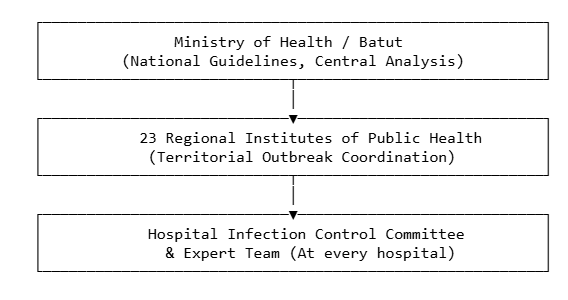
- Hospital Level (In-House Execution):
- Hospital Infection Control Committee (Komisija za bolničke infekcije): A multidisciplinary body that adopts the annual infection control plan, sets institutional procedures, and reviews infection metrics. Each hospital should have the Control Committe.
- Expert Infection Control Team (Tim / Služba za intrahospitalne infekcije): Composed of epidemiologists, clinical microbiologists, and specialized infection control nurses. They conduct daily surveillance, inspect wards, audit hygiene standards, and manage needle-stick injuries or local outbreaks. It is unclear who the Control Teams are.
- Association for the Prevention of Hospital Infections of Serbia (UPBIS) Professional Association UPBIS serves to connect “professionals” and improve prevention standards in the country.
- University Clinical Center of Serbia (UKCS): Features the Service for Hospital Epidemiology and Nutritional Hygiene, which includes the Department for the Prevention and Control of Hospital Infections.
- Military Medical Academy (VMA): Includes a Section for the Prevention and Control of Hospital Infections.
- Institute of Public Health of Serbia “Dr Milan Jovanović Batut” coordinates national-level surveillance of hospital infections in cooperation with the network of district public health institutes. How do they “coordinate” HAI surveillance if public health institutions do not report infections to Batut, while Batut has no authority to hold them accountable, remains unclear.
- Regional Level (Monitoring & Outbreaks):
- Regional Public Health Institutes (Zavodi za javno zdravlje): Collect monthly surveillance data from hospitals in their territory, assist during outbreak investigations, and perform laboratory/environmental audits.
- National Level (Batut Institute):
- Aggregates country-wide epidemiological data, establishes national clinical case definitions, conducts national point-prevalence studies, and provides guidelines aligned with ECDC (European Centre for Disease Prevention and Control) standards.
2. Core Surveillance Methodologies
Batut structures epidemiological monitoring using two primary modes:
- Targeted Continuous Surveillance:
- Active monitoring focuses on high-risk departments (e.g., ICUs, neonatal units, surgical units) and high-risk procedures (e.g., central venous catheters, urinary catheters, mechanical ventilation, surgical procedures).
- Reports are submitted via the national Public Health Service Portal (Servis javnog zdravlja – SJZ).
- National Point Prevalence Surveys (PPS):
- Batut coordinates periodic nationwide prevalence studies across acute care hospitals. These snapshot audits evaluate overall HAI rates, anatomical sites of infection, microbial etiologies, and hospital antimicrobial usage patterns.
3. Standardization & Mandatory Reporting
Surveillance rests on standardized diagnostic criteria and mandatory legal thresholds:
- Standard Case Definitions: Batut issues standardized case definitions (e.g., blood stream infections, catheter-associated UTIs, surgical site infections) based on ECDC/CDC guidelines.
- 48-Hour Rule: Symptoms manifesting on or after the 3rd calendar day of admission (or within specific windows post-discharge for surgical sites/implants) trigger classification as a hospital-acquired infection.
- Mandatory Outbreak Notification: Whenever an epidemiological outbreak occurs (an unusual cluster of infections linked by pathogen, unit, or procedure), hospitals are legally required to notify the regional institute and Batut immediately.
Links to Serbian 2022 HAI Regulation
- Pravilnik o sprečavanju, ranom otkrivanju i suzbijanju bolničkih infekcija — The primary legal act enacted by the Ministry of Health governing the prevention, detection, and control of hospital-acquired infections, as well as the mandate for healthcare institutions to adopt institutional programs and plans.
Batut HAI Documents
- Priručnik za bolničke infekcije – Definicije (Batut) — Official manual containing standard case definitions and criteria used for epidemiologic surveillance of hospital-acquired infections across healthcare institutions in Serbia.
- Nacionalne studije prevalencije bolničkih infekcija (Batut) — National methodology and reports on hospital infection prevalence and antibiotic usage surveillance focusing on post Covid-19, conducted by Batut.
Batut Is Seeing Evidence of HAI Every Day, But It Is Unable To Control Them – Here Is Why!
The systematic breakdown in healthcare-acquired infection (HAI) containment in Serbia points to a stark disconnect between Batut’s formal surveillance mandates and the reality inside hospital wards. While official protocol demands strict criteria for device placement and mandatory outbreak reporting, clinical practice frequently relies on unindicated indwelling catheterizations, unmonitored catheter duration, and empirical antibiotic coverage—classic drivers for multidrug-resistant (MDR) selection.
When patients develop healthcare-associated urinary tract infections, discharge summaries often omit these secondary complications and prior antimicrobial exposures to evade legal exposure, sending individuals home without clear warnings or continuity of care.
Despite Batut’s central reference laboratories processing the very cultures from the patients that yield pan-resistant or carbapenemase-producing isolates (such as NDM-1, OXA-48, or MDR Pseudomonas), there is virtually no active epidemiological feedback loop to trace these signals back to origin units or audit hospital discharge practices.
By failing to cross-reference positive community and post-discharge microbiologic profiles with recent hospitalizations, Batut’s oversight remains largely passive—functioning as an archive for surveillance data rather than an active enforcement mechanism against clinical negligence.
Batut’s official diagnostic criteria and surveillance guidelines for catheter-associated urinary tract infections (CAUTI)
The Institute of Public Health of Serbia “Dr Milan Jovanović Batut” establishes its official diagnostic criteria and surveillance protocols for healthcare-associated infections (HAIs) in the publication Bolničke infekcije – definicije (updated to align with European Centre for Disease Prevention and Control [ECDC] standards).
1. Official Definition of CAUTI (IMS-U)
Batut defines a Catheter-Associated Urinary Tract Infection (CAUTI) — coded in national surveillance as UTI-A / IMS-U (Infekcija mokraćnog sistema povezana sa urinarnim kateterom) — based on specific exposure timelines and diagnostic criteria:
- The Exposure Criterion: The patient must have an indwelling urinary catheter in place at the time of onset, or had the catheter removed within the 48 hours prior to symptom onset or specimen collection.
- The Time Window: Symptoms appear on or after the 3rd calendar day of admission (with admission day counted as Day 1), OR within 48 hours of discharge from an acute care facility.
2. Diagnostic Criteria (Categorization)
Batut categorizes catheter-associated UTIs into two main diagnostic types depending on laboratory confirmation:
Category A: Microbiologically Confirmed Symptomatic UTI (IMS-A / UTI-A)
To meet the criteria for a microbiologically confirmed CAUTI, the case must meet both clinical and microbiological thresholds:
- Clinical Symptoms (at least ONE of the following):
- Fever (>38.0∘C) with no other recognized cause.
- Suprapubic tenderness or pain.
- Costovertebral angle pain or tenderness (flank pain).
- Dysuria, urgency, or frequency (if the catheter has been recently removed).
- Microbiological Criteria:
- A urine culture yielding ≥105 CFU/mL of no more than 2 species of microorganisms (uropathogens).
- Urine must be collected correctly (e.g., aspirated aseptically from the sampling port, not from the drainage bag). HeMED
Category B: Non-Microbiologically Confirmed / Clinical UTI (IMS-B / UTI-B)
Used when a patient has clear clinical symptoms of a UTI and an indwelling catheter, but urine culture is either unavailable, incomplete, or confounded by antimicrobial administration prior to testing.
Asymptomatic Bacteriuria Note: In accordance with ECDC standards, Batut’s active surveillance protocols exclude asymptomatic bacteriuria (positive urine culture without systemic or localized clinical symptoms) from official CAUTI rate counts to discourage unnecessary treatment with broad-spectrum antimicrobials.
3. Surveillance Methodology & Metrics
Batut structures CAUTI monitoring across acute care facilities using standard epidemiological metrics:
- Incidence Density Rate:CAUTI Rate=(Total Number of Urinary Catheter-Days in that periodNumber of CAUTIs in a given period)×1,000
- Device Utilization Ratio (DUR):Urinary Catheter Utilization=Total Patient-DaysTotal Urinary Catheter-Days
- DUR is tracked per department (e.g., Medical ICU, Surgical ICU, Urology) to evaluate whether catheters are being overused or kept in place longer than medically necessary.
4. Reporting Protocols
- Routine Active Surveillance: Hospital Infection Control Teams (Timovi za bolničke infekcije) are mandated to track catheter-days and CAUTI cases daily in high-risk wards (ICUs, surgical units, urology wards).
- Monthly/Quarterly Submissions: Aggregated incidence rates and pathogen antibiograms (monitoring ESBL, carbapenemases like OXA-48/NDM-1, and MDR Pseudomonas) are submitted to regional public health institutes and uploaded to the national Public Health Service Portal (Servis javnog zdravlja – SJZ) managed by Batut.
- Outbreak Thresholds: A cluster of 2 or more epidemiologically linked CAUTI cases caused by the same pathogen/strain in a single unit constitutes a healthcare outbreak, triggering mandatory immediate notification to Batut.
Batut’s Guidelines and Protocols for Preventing the Spread of Multidrug-Resistant Organisms (MDRO) in Serbian Hospitals
The Institute of Public Health of Serbia “Dr Milan Jovanović Batut”, operating under the Ministry of Health, aligns its guidelines for multidrug-resistant organism (MDRO) containment with European Centre for Disease Prevention and Control (ECDC) and World Health Organization (WHO) standards.
Batut’s MDRO prevention framework focuses on six core operational pillars designed to break transmission chains in clinical settings:
1. Active Microbiological Screening & Surveillance
- Target Pathogens: Priority surveillance covers “ESKAPE” pathogens—specifically carbapenem-resistant Acinetobacter baumannii, carbapenemase-producing Enterobacteriaceae (e.g., KPC, NDM-1, OXA-48), multidrug/extensively drug-resistant (MDR/XDR) Pseudomonas aeruginosa, Methicillin-Resistant Staphylococcus aureus (MRSA), and Vancomycin-Resistant Enterococci (VRE).
- Admission Screening: High-risk admissions—patients transferred from other acute facilities, nursing homes, foreign healthcare centers, or those re-admitted with prior ICU stays—are subject to rectal swabbing (for Gram-negative MDROs) or nasal swabbing (for MRSA).
- Early Preemptive Isolation: While awaiting screening results, high-risk transfer patients are placed under preemptive contact precautions.
2. Standardized Patient Isolation Protocols
Once an MDRO is identified in a clinical or screening sample, hospitals must implement tiered isolation levels:
- Cohort or Single-Room Isolation: MDRO-positive patients must be housed in single rooms with dedicated sanitary facilities or cohort-isolated with patients harboring the same pathogen.
- Contact Precautions: Direct healthcare personnel must wear dedicated single-use gloves and long-sleeved fluid-resistant gowns upon room entry. Equipment (stethoscopes, blood pressure cuffs, thermometers) must remain dedicated strictly to the isolated patient.
- Alert Labeling: Patient charts, beds, and electronic health records are flagged with clear biological risk indicators to alert all attending staff and transport teams.
3. Infection Control & Hygiene Standards
- Hand Hygiene Bundles: Adherence to the WHO 5 Moments for Hand Hygiene using alcohol-based hand rubs (ABHR) before and after patient contact.
- Environmental Disinfection: Units harboring MDRO cases undergo double-clean protocols using sporicidal or high-level disinfectant agents (e.g., hydrogen peroxide vaporization, chlorine-releasing agents).
- Equipment Sterilization: Strict reprocessing workflows for invasive medical devices (ventilator circuits, endoscopes, hemodialysis machines).
4. Antimicrobial Stewardship (AMS)
To reduce selective pressure that breeds MDROs, Batut integrates hospital stewardship programs through local Antimicrobial Stewardship Committees:
- Restricted Antibiotic Lists: Broad-spectrum “reserve” antibiotics (e.g., Colistin, Tigecycline, Ceftazidime-Avibactam, Carbapenems) require pre-authorization by an infectious disease specialist or clinical pharmacologist.
- Antibiogram-Guided Therapy: Empirical antibiotic choices must be de-escalated within 48 to 72 hours based on definitive laboratory microbiology and susceptibility testing (EUCAST standards). scindeks-clanci.ceon.rs
5. Outbreak Containment & Mandatory Reporting
- Immediate Escalation: Detection of single cases of pan-drug resistant (PDR) strains or clusters of two or more epidemiologically linked MDRO infections constitutes a hospital outbreak.
- Root Cause Investigation: The hospital’s Infection Control Team (Tim za bolničke infekcije) must perform outbreak tracing, environmental sampling, hand hygiene audits, and report findings directly to the territorial Institute of Public Health and Batut via the National Public Health Service Portal (Servis javnog zdravlja – SJZ).
The main requirements and obligations for hospitals under the Serbian Rulebook on Hospital-Acquired Infections
The Rulebook on the Prevention, Early Detection, and Suppression of Hospital-Acquired Infections (Pravilnik o sprečavanju, ranom otkrivanju i suzbijanju bolničkih infekcija) enacted by the Ministry of Health establishes the statutory obligations for all healthcare institutions in Serbia.
The legally mandated requirements for Serbian hospitals fall under four primary areas:
1. Mandatory Institutional Governance
Every inpatient facility is legally required to establish a dedicated governance structure for infection control:
- Infection Control Committee (Komisija za bolničke infekcije):
- An expert body chaired by a physician and comprising clinical leads, epidemiologists, microbiologists, and nursing heads.
- Obligations: Responsible for adopting, reviewing, and evaluating the hospital’s long-term Program and annual Plan for infection control. They must also analyze antibiotic consumption patterns and establish localized infection control protocols. Opšta bolnica Petrovac na Mlavi+ 1
- Infection Control Team / Department (Organizaciona jedinica za bolničke infekcije):
- Consists of dedicated specialist epidemiologists and trained infection control nurses, with staffing ratios tied to total hospital bed capacity.
- Obligations: Responsible for daily ward walk-throughs, continuous epidemiological surveillance, auditing sterilization/hygiene practices, and reviewing daily microbiology laboratory reports.
2. Mandatory Program, Plan, and Standard Operating Procedures (SOPs)
Hospitals must formally draft, update, and enforce three key operational documents by December 31 for the upcoming calendar year:
- The Program (Program): Outlines long-term strategies, resource allocations, risk priorities, and monitoring methodology. Institut za neonatologiju, Beograd
- The Annual Plan (Godišnji plan): Specifies actionable targets, scheduled internal audits, and staff training milestones for the year. Institut za neonatologiju, Beograd
- Clinical Procedure Protocols: Written SOPs that all clinical staff must follow regarding:
- Aseptic technique for invasive procedures (catheterization, central lines, surgical site care). Institut za neonatologiju, Beograd
- Hand hygiene protocols and personal protective equipment (PPE) usage. Institut za neonatologiju, Beograd
- Decontamination, disinfection, and sterilization quality controls.
- Hazardous medical waste management.
3. Active Epidemiological Surveillance & Mandatory Reporting
Hospitals are legally required to maintain continuous active surveillance rather than relying on passive observation:
- Case Definition Application: Hospitals must use standard clinical/microbiological case definitions issued by the Institute of Public Health of Serbia “Dr Milan Jovanović Batut”.
- 24-Hour Individual Reporting: When an HAI or multi-drug resistant organism (MDRO) is diagnosed or suspected, the attending physician or infection control team must formally document and log the case. Institut za neonatologiju, Beograd
- Immediate Outbreak Notification: If a cluster or outbreak occurs (e.g., 2 or more epidemiologically linked cases in a ward), the hospital is legally required to notify the regional Institute of Public Health (Zavod za javno zdravlje) and Batut immediately.
- Periodic National Audits: Hospitals are legally bound to participate in periodic National Point Prevalence Surveys (PPS) organized every five years by Batut.
4. Mandatory Containment & Hygiene Measures
Under Article 24 of the Rulebook, hospital management and clinical staff share statutory responsibility to enforce:
- Patient Triage & Isolation: Mandatory clinical and microbiological screening at admission for high-risk patients, alongside isolation protocols (single room or cohorting) for patients harboring MDROs or contagious pathogens. Institut za neonatologiju, Beograd
- Environmental & Air Quality Controls: Regular biological and chemical monitoring of sterilization equipment, ventilation/air quality standards in operating theaters, and pest control.
- Staff Education: Mandatory continuous medical education (CME) on infection control principles for all healthcare and support staff upon hiring and periodically thereafter.
- Occupational Safety: Managing needle-stick injuries, bloodborne exposure protocols, and staff immunizations.
What Structural or Legal Reasons Contribute to the Underreporting of Hospital-Acquired Infections in Serbian Healthcare Institutions?
The discrepancy between official hospital-acquired infection (HAI) surveillance protocols and actual reporting levels in Serbian healthcare institutions stems from structural, legal, and operational factors. While national guidelines mandate strict active surveillance, these systemic issues create disincentives to report HAIs and multidrug-resistant organisms (MDROs).
1. Legal Liability & Institutional Self-Preservation
Under Serbian civil and criminal law (as well as healthcare liability regulations), proving a hospital-acquired infection can expose healthcare institutions and attending physicians to medical malpractice claims, financial compensation demands, and disciplinary actions. Because the burden of proof in civil litigation often evaluates whether standard infection control protocols were violated, hospitals face a strong institutional incentive to avoid generating official paper trails. Classifying a secondary complication as a pre-existing condition, a community-acquired infection, or an “unavoidable underlying risk” protects the facility from legal exposure and reputational damage.
2. Disincentives in Hospital Discharge Reporting
Discharge summaries (otpusne liste) serve as the definitive legal and medical record of a patient’s stay. If a patient contracts an MDRO or CAUTI during hospitalization, documenting the infection, pathogen identity, or broad-spectrum antibiotic course explicitly acknowledges an in-house complication. Omitting secondary antibiotic regimens or microbiology findings from final discharge summaries allows hospitals to shift administrative oversight away from the inpatient stay, transferring the burden to primary care physicians or outpatient care without triggering institutional infection counts.
3. Fear of Punitive Administrative Measures
Under the Ministry of Health’s Rulebook on Hospital Infections, reporting an outbreak or elevated rate of MDROs triggers mandatory sanitary inspections, potential ward shutdowns, or public health audits. Instead of fostering a non-punitive “safety culture” where reporting leads to quality improvement, the system is often perceived as punitive. Consequently, hospital management and clinical leads may downplay or internally handle localized clusters to avoid administrative sanctions or reduced resource allocations.
4. Structural Disconnect in Public Health Data Integration
Although the Institute of Public Health of Serbia (“Dr Milan Jovanović Batut”) operates central reference laboratories and receives data via the Public Health Service Portal (SJZ), the system relies heavily on passive institutional self-reporting for surveillance metrics. Central microbiology databases that identify high-risk isolates (e.g., OXA-48, NDM-1, or MDR Pseudomonas) from outpatient urinocultures or post-discharge swabs are rarely cross-referenced automatically with recent acute-care hospital admissions. Without an automated, mandatory linkage between laboratory-confirmed resistance genes and hospital admission registries, post-discharge HAIs bypass hospital reporting statistics entirely.
5. Staffing Deficits and Resource Constraints
Active, daily surveillance requires dedicated infection control epidemiologists and specialized nurses working without clinical overload. In many regional hospitals and non-intensive wards, infection control teams are understaffed, underfunded, or tasked with dual clinical duties. When faced with heavy patient loads, routine documentation of device-days (e.g., catheter-days), active surveillance swabs, and individual HAI reporting forms are frequently deprioritized in favor of direct clinical emergencies.
Conclusion
A national health strategy is measured by patient outcomes and saving lives, not PowerPoint slides presented at medical congresses. Right now, Serbia’s strategy against HAIs and MDR is a “self-licking ice cream cone”—a self-serving bureaucracy that protects itself while unchecked patient suffering continues to escalate.

Until health inspections carry a real authority, clinical protocols are strictly enforced, advanced antibiotics become accessible, and hospital staff are properly educated on MDR pathogens, patients in Serbian hospitals will continue to pay for systemic negligence with their lives.
Links:
- The Silent Pandemic in Emergency Rooms – Contextualizing hygiene breaches at entry points.
- Inside the ER Protocols – Unnecessary catheterizations and staff convenience.
- Access to Advanced Antimicrobials in Serbia – The absence/cost of Ceftazidime-Avibactam + Aztreonam.
- Hidden Behind Discharge Papers – Cover-ups and premature discharges.
- The True Cost After Discharge – Sepsis and mortality within 30–45 days post-release.
- Basic Microbiology vs. Clinical Reality – Misconceptions surrounding gut flora vs. MDR strains.
- The Resistance Mechanism Misconception – Lack of physician education regarding carbapenemases and Klebsiella virulence.