
The evolution of Multidrug-Resistant (MDR) and Extensively Drug-Resistant (XDR) Klebsiella pneumoniae in Serbia presents one of the most acute public health challenges in the Western Balkans. K. pneumoniae—a bacterium capable of causing severe hospital-acquired pneumonia, bloodstream infections, and sepsis—has transformed over the last two decades from a manageable opportunistic pathogen into an international superbug threat.
Timeline of the Outbreak in Serbia

Phase 1: The Emergence of ESBL Resistance (2000s)
Like much of Southern and Eastern Europe, Serbian tertiary healthcare centers began documenting a rapid rise in extended-spectrum β-lactamase (ESBL)-producing K. pneumoniae during the mid-to-late 2000s. These strains conferred resistance to primary treatments such as third-generation cephalosporins, forcing clinicians to rely heavily on carbapenems as first-line therapy.
Phase 2: The Carbapenemase Explosion & Colistin Resistance (2013–2016)
The overuse of carbapenems created intense selective pressure. Between 2013 and 2016, Serbian hospitals experienced a major epidemiological shift marked by the co-circulation of carbapenemases:
- NDM-1 (New Delhi metallo-β-lactamase-1) and OXA-48 lineages expanded rapidly.
- Genomic studies revealed a heavy concentration of the ST101 clone—a high-risk, epidemic sequence type carrying novel plasmid structures and mutated mgrB genes, which conferred resistance to colistin (the absolute last-resort polymyxin antibiotic) (Palmieri et al., 2020).
- By 2016, 63% of human K. pneumoniae infections in Serbia were classified as MDR, with 35% showing resistance to carbapenems (WHO, 2017).
Phase 3: Pandemic Amplification & Present Status (2020–Present)
During the COVID-19 pandemic, heavy antibiotic utilization and prolonged ICU stays accelerated the spread of XDR and Pandrug-Resistant (PDR) strains:
- Studies from tertiary care institutions, such as the University Clinical Center Kragujevac, showed that K. pneumoniae accounted for a substantial portion of bloodstream infections, with 76% to 91% classified as MDR and up to 30% displaying XDR profiles (Zornic et al., 2022).
- High mortality rates (exceeding 36% to 70% in vulnerable cohorts, such as hematology or ICU patients) continue to be reported for colistin- and carbapenem-resistant strains (Trajković et al., 2025).
Verifiable Statistics
| Indicator | Serbian Prevalence Data | Comparative Reference / Context | Source |
| MDR Rate (Overall) | ~63% of all clinical K. pneumoniae isolates | Significantly higher than the Northern/Western EU average (<20%) | WHO Regional Office for Europe / (Palmieri et al., 2020) |
| Carbapenem Resistance | 35% – 50%+ depending on ICU setting | EU/EEA Average: 10.9% (2022) | ECDC EARS-Net Surveillance |
| Colistin Resistance | High prevalence among carbapenemase producers (notably clone ST101) | Rare in Northern Europe (<1%) | (Palmieri et al., 2020) |
| Bloodstream XDR Rates | ~29.9% of blood culture isolates classified as XDR | Matches hyper-endemic regions (Greece, Italy, Romania) | (Zornic et al., 2022) |
How Serbia Compares Internationally
To visualize Serbia’s position relative to global and regional trends, consider the resistance profile gradient across Europe:

- Top Tier for Infection Severity in Europe: Serbia consistently ranks among the countries with the highest resistance rates in the European region, alongside Greece, Italy, and Romania.
- The Colistin Resistance Threshold: While many Western European countries report carbapenem resistance in under 5% of isolates, Serbia’s widespread emergence of colistin resistance in combination with carbapenemases (NDM-1 + OXA-48) places it in a category where clinicians face near-zero effective therapeutic options.
- Cross-Border Transmission: Due to medical travel and migration, Serbian XDR K. pneumoniae strains (such as ST101 and ST307) have been identified in patients transferred to hospitals in Germany, Switzerland, and Scandinavia, drawing international epidemiological surveillance from bodies like the ECDC (Haller et al., 2019).
Key Drivers Behind the High Rates
- Antimicrobial Stewardship Deficits: Historically high community and hospital consumption of broad-spectrum antibiotics (cephalosporins and fluoroquinolones).
- Infection Prevention & Control (IPC) Pressure: High patient-to-nurse ratios and overcrowded ICUs facilitate horizontal transmission via medical equipment and healthcare worker hands.
- Plasmid Mobility: High prevalence of mobile genetic elements carrying multiple resistance genes (blaNDM, blaOXA-48, blaCTX-M-15) simultaneously on single plasmids.
Key Research & Literature
- Genomic Architecture & Colistin Resistance: Palmieri, M., D’Andrea, M. M., Pelegrin, A. C., et al. (2020). Genomic Epidemiology of Carbapenem- and Colistin-Resistant Klebsiella pneumoniae Isolates From Serbia: Predominance of ST101 Strains Carrying a Novel OXA-48 Plasmid. Frontiers in Microbiology, 11, 294.
- Cross-Border Outbreaks Linked to Regional Strains: Haller, S., Kramer, R., Becker, K., et al. (2019). Extensively drug-resistant Klebsiella pneumoniae ST307 outbreak, north-eastern Germany, June to October 2019. Eurosurveillance, 24(50).
- Hospital-Acquired Strain Distribution: Zornic, S., Lukovic, B., Petrovic, I., & Jencic, A. (2022). Prevalence of multidrug-resistant Gram-negative bacteria from blood cultures and rapid detection of beta-lactamase-encoding genes. Germs, 12(4), 434–443.
- Regional AMR Surveillance Standards: European Centre for Disease Prevention and Control (ECDC). Antimicrobial resistance surveillance in Europe. ECDC EARS-Net Reports.
Detailed comparison of multidrug-resistant bacterial rates between Serbia and its neighboring Balkan countries (e.g., Greece, Croatia, Romania, Hungary)
According to joint data from the WHO European Region (CAESAR network) and the ECDC (EARS-Net network), Europe exhibits a pronounced North-to-South and West-to-East gradient in antimicrobial resistance (AMR). Serbia and its Balkan neighbours occupy the highest tier of resistance severity on the continent.
The document is the Executive Summary of the report titled “Surveillance of Antimicrobial Resistance in Europe, 2023 Data,” published jointly by the European Centre for Disease Prevention and Control (ECDC) and the World Health Organization (WHO) Regional Office for Europe (2024).
It summarizes the findings on antimicrobial resistance (AMR) across 45 countries in the European region, using invasive isolate data collected by two networks:
- EARS-Net (30 EU/EEA countries)
- CAESAR (15 non-EU/EEA countries in Central Asia and Eastern Europe)
Key Resistance Indicators: Country-by-Country Comparison

Data derived from invasive blood and cerebrospinal fluid isolates (EARS-Net / CAESAR surveillance reports) illustrates where Serbia stands relative to neighboring nations:
| Country | Carbapenem-Resistant Klebsiella pneumoniae (CRKP) | Carbapenem-Resistant Acinetobacter spp. (CRA) | 3rd-Gen Cephalosporin-Resistant K. pneumoniae | MRSA Rate (S. aureus) |
| Greece | >60% (Highest in EU) | >85%–90% | >70% | 35% – 40% |
| Serbia | 35% – 50% | >85% | >65% – 75% | 20% – 25% |
| Romania | 45% – 55% | 70% – 80% | 65% – 70% | 40% – 45% |
| Croatia | 20% – 30% | 75% – 85% | 45% – 55% | 15% – 20% |
| Hungary | 15% – 25% | 40% – 50% | 35% – 45% | 20% – 25% |
Analytical Insights & Regional Dynamics
1. The Carbapenemase Landscape
- Greece remains the regional epicenter for carbapenem-resistant Enterobacterales, largely driven by endemic KPC- and VIM-producing strains, followed closely by NDM and OXA-48 variants.
- Serbia and Romania follow closely behind Greece. In Serbia, carbapenem resistance in K. pneumoniae is overwhelmingly driven by NDM-1 and OXA-48 co-producers, combined with high colistin resistance rates in epidemic clones such as ST101.
- Croatia and Hungary show lower carbapenem resistance in Klebsiella compared to Serbia, though Croatia still faces significant challenges with Acinetobacter baumannii.
2. Acinetobacter baumannii (CRA): Universal Endemicity Across the Balkans
While Klebsiella rates vary between 20% and 60% across the region, Carbapenem-resistant Acinetobacter is exceptionally high across almost the entire Balkan corridor (Serbia, Greece, Romania, and Croatia all report CRA rates exceeding 75%–85%). This reflects severe hospital environment persistence and horizontal transfer in intensive care units (ICUs) throughout Southeastern Europe.
3. Drivers of Differences Between Neighbors
- Stewardship & Outpatient Antibiotic Use: Hungary and Croatia enforce tighter community outpatient prescription controls compared to non-EU or Eastern EU border regions, contributing to lower baseline Gram-negative resistance.
- Infection Control Infrastructure: Differences in ICU bed spacing, nurse-to-patient ratios, and single-room isolation capacity account for lower cross-transmission rates in Central European hospitals (e.g., Hungary) versus Southern Balkan institutions.
Compared mortality rates from Klebsiella pneumonia across the countries?
Comparing mortality rates from Klebsiella pneumoniae infections across Serbia and its neighbors requires distinguishing between two primary metrics: attributable/all-cause clinical mortality (the percentage of infected individual patients who die) and population-level mortality (the number of deaths per 100,000 residents).
Invasive Klebsiella infections—particularly blood culture isolates (bacteremia/sepsis) and ventilator-associated pneumonia (VAP)—show a direct, steep escalation in mortality as resistance profiles move from susceptible to Multidrug-Resistant (MDR) and Carbapenem-Resistant (CRKP) / Extensively Drug-Resistant (XDR).
Patient-Level Clinical Mortality Rates
When analyzing clinical outcomes in Intensive Care Units (ICUs) and high-dependency wards across the region, crude and 30-day mortality rates closely track resistance phenotypes:
| Country | Susceptible / ESBL K. pneumoniae Mortality | Carbapenem-Resistant K. pneumoniae (CRKP) Mortality | XDR / Pandrug-Resistant (PDR with Colistin Resistance) Mortality | Key Regional Observational Findings |
| Greece | 15% – 25% | 40% – 55% | >60% | High baseline ICU mortality due to longstanding endemicity of KPC, NDM, and VIM strains. |
| Serbia | 18% – 25% | 42% – 58% | 55% – 70%+ | High mortality linked to bloodstream and post-operative ICU infections involving NDM-1 + OXA-48 co-producers. |
| Romania | 20% – 28% | 45% – 60% | 60% – 75% | High mortality rates reported in bacteremic patients across emergency and tertiary centers. |
| Croatia | 12% – 20% | 35% – 48% | 50% – 60% | Slightly lower overall patient mortality due to earlier introduction of combination therapies (e.g., Ceftazidime-Avibactam). |
| Hungary | 10% – 18% | 30% – 45% | 45% – 55% | Lower absolute mortality driven by lower overall prevalence of CRKP and better containment. |
Population-Level Mortality Burden
At the population level (measured in deaths per 100,000 population), the impact of K. pneumoniae AMR becomes stark, as reported in European Centre for Disease Prevention and Control (ECDC) and Global Burden of Disease (GBD) studies:
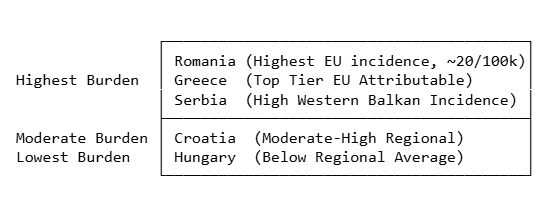
- Romania & Greece (Highest Population Mortality in the EU):
- Romania recorded one of the highest rates of bloodstream infections and population-level mortality from resistant K. pneumoniae in Southern/Eastern Europe, reaching up to ~20 deaths per 100,000 population in recent surveillance years.
- Greece consistently reports the highest attributable mortality per capita in the EU/EEA for carbapenem-resistant Gram-negative bacteria, driven by high hospital transmission rates in ICUs.
- Serbia (High Non-EU Balkan Burden):
- Surveillance through the WHO CAESAR network shows that Serbia’s CRKP rates in blood cultures climbed significantly over the past decade.
- As a result, population mortality linked to Gram-negative sepsis in ICUs matches the high-burden profiles of Romania and Greece.
- Croatia & Hungary (Controlled Burden):
- Croatia maintains lower population-level mortality from Klebsiella than Serbia or Greece, primarily because CRKP accounts for a smaller fraction (20%–30%) of overall Klebsiella infections, even though its Acinetobacter mortality remains elevated.
- Hungary experiences substantially fewer per-capita deaths from resistant Klebsiella due to lower invasive infection rates (CRKP ~15%–25%).
Primary Drivers of Mortality Differences
- Therapeutic Options & Novel Antibiotics: In countries like Greece and Croatia, earlier routine access to novel β-lactam/β-lactamase inhibitor combinations (such as Ceftazidime-Avibactam, Meropenem-Vaborbactam, and Cefiderocol) helped reduce mortality for KPC and OXA-48 producers. In settings where NDM-1 (a metallo-β-lactamase) predominates—such as Serbia—these newer drugs are ineffective on their own unless combined with Aztreonam, leaving clinicians with older, more toxic regimes (e.g., Colistin + Fosfomycin) that carry higher failure rates.
- Comorbidities & ICU Patient Profiles: In Balkan tertiary care centers, mortality is heavily concentrated among elderly patients, mechanically ventilated patients, and individuals with underlying malignancies or organ failure.
- Secondary Sepsis & Delay in Effective Therapy: Studies across Serbia, Greece, and Romania indicate that delayed initiation of appropriate targeted antimicrobial therapy (beyond 24–48 hours from septic onset) increases 30-day mortality by 2x to 3x in CRKP bacteremia cases.
Cinical evidence and dosage regimens for combining Aztreonam with Ceftazidime-Avibactam to treat NDM-1 producing Klebsiella pneumoniae.
The combination of Ceftazidime-Avibactam (CZA) and Aztreonam (ATM) has emerged as a frontline therapeutic strategy to treat infections caused by metallo-β-lactamase (MBL)-producing pathogens, such as NDM-1-producing Klebsiella pneumoniae.
Mechanism of Synergy
NDM-1 is a zinc-dependent Class B metallo-β-lactamase that hydrolyzes nearly all β-lactams (including carbapenems and newer β-lactamase inhibitors like avibactam), but does not hydrolyze monobactams (Aztreonam).
However, NDM-producing K. pneumoniae strains almost universally co-express serine-β-lactamases (such as CTX-M ESBLs, AmpC, or KPC enzymes), which degrade Aztreonam on their own.
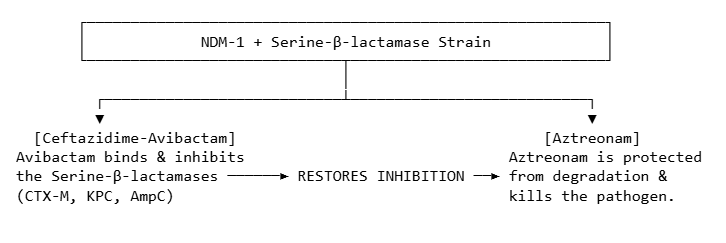
By adding Avibactam (via CZA), the serine-β-lactamases are inhibited, shielding Aztreonam so it can freely reach its target (PBP3) and exert bactericidal activity.
Standard Dosage Regimens & Administration
Because CZA and ATM are administered as two separate intravenous drugs, optimization relies on
achieving adequate free drug time above MIC (fT>MIC) for both agents simultaneously.
1. Standard Intermittent Infusion (Normal Renal Function: CrCl≥50 mL/min)
- Ceftazidime-Avibactam: 2.5 g (2.0 g Ceftazidime / 0.5 g Avibactam) IV every 8 hours, infused over 2 hours.
- Aztreonam: 2.0 g IV every 6 to 8 hours, infused over 2 hours.
- Key Practice Rule: Simultaneous infusion is superior to staggered dosing. Giving both drugs concurrently ensures that peak Avibactam concentrations in tissue overlap with Aztreonam.
2. Extended or Continuous Infusion (Critically Ill / ICU Patients)
Hollow-fiber pharmacodynamic models and ICU clinical trials demonstrate that continuous or extended infusions maximize bacterial killing and prevent resistance emergence.
- Ceftazidime-Avibactam: 2.5 g IV loading dose over 2 hours, followed by 7.5 g per day as continuous IV infusion (or 2.5 g over 3 to 4 hours q8h).
- Aztreonam: 2.0 g IV loading dose, followed by 6 g to 8 g per day as continuous IV infusion.
3. Dose Adjustments for Renal Impairment
Both agents are cleared renally, requiring parallel dose reductions based on estimated creatinine clearance (CrCl):
| Creatinine Clearance (CrCl) | Ceftazidime-Avibactam Regimen | Aztreonam Regimen |
| 50–31 mL/min | 1.25 g IV q8h (over 2h) | 1.0 g–2.0 g IV q8h |
| 30–16 mL/min | 0.94 g IV q12h (over 2h) | 1.0 g IV q12h |
| ≤15 mL/min / ESRD | 0.94 g IV q24h (post-dialysis on HD days) | 500 mg IV q12h (or 1.0 g loading, then 500 mg q12h) |
Summary of Clinical Evidence
Observational Cohorts & Comparative Studies
- The Falcone et al. Prospective Cohort Study (2021):
- Evaluated 102 patients with bloodstream infections caused by MBL-producing Enterobacterales (predominantly NDM-producing K. pneumoniae).
- Outcome: Patients treated with CZA + ATM had significantly lower 30-day mortality (19.2%) compared to those treated with other active regimens such as colistin- or tigecycline-based combinations (44%, p=0.007).
- Reduced clinical failure rate and lower rate of acute kidney injury (AKI) compared to polymyxin-based therapies.
- Real-World Experience in High-Endemic Regions (Greece, Italy, India):
- Multiple multicenter observational studies demonstrate clinical cure rates of 65% to 80% in critically ill patients presenting with ventilator-associated pneumonia (VAP) or bacteremia caused by NDM-1 or dual NDM+KPC producers.
- In Vitro & Hollow-Fiber Infection Models (HFIM):
- Studies by Tsuji et al. confirmed that CZA + ATM regimens using 8 g/day of Aztreonam achieved sustained bacterial eradication and suppressed drug-resistant subpopulations over 168 hours, whereas lower dosing yielded partial regrowth.
Therapeutic Drug Monitoring (TDM) & Testing Considerations
- Synergy Testing in the Lab: Standard automated susceptibility panels (e.g., VITEK 2, Phoenix) will report NDM producers as Resistant to both CZA and ATM individually. Microbiology labs must perform in vitro synergy testing (such as strip placement crossing, disk stacking, or broth microdilution with fixed 4 mg/L Avibactam) to confirm the MIC drops into the susceptible range (≤8 mg/L).
- Fixed-Dose Single Agents: A co-formulated drug (Aztreonam-Avibactam) has undergone global Phase III clinical development (REVISIT and ASSEMBLE trials) to eliminate the logistical requirement of administering two separate infusions simultaneously. However, where fixed-dose products are unavailable, co-administering separate CZA and ATM infusions remains the standard recommendation in IDSA and ESCMID guidelines.
Surveillance of antimicrobial resistance in Europe, 2023 data (Executive summary)