
An epidemic resulting in an estimated 20,000 annual deaths related to Healthcare-Associated Infections (HAIs) in a country like Serbia—particularly driven by hyper-virulent, multi-drug resistant (MDR/XDR) strains such as Klebsiella pneumoniae over protracted hospital stays—represents a catastrophic, multi-system crisis.
While a “diabolical” superficial fiscal analysis might suggest that deaths among elderly pensioners yield a net reduction in state pension liabilities, this narrow single-item accounting perspective (fiscal myopia) disintegrates when evaluated against macroeconomic, demographic, and health system realities.
The 20,000 HAI-Related Deaths Model
In Serbia, approximately 100,000 people die each year.
According to data from the Statistical Office of the Republic of Serbia (SORS):
- Annual Total: Around 100,000 annual deaths (recorded post-pandemic).
- Daily Average: Approximately 270 people per day across the country.
- Crude Death Rate: Roughly 15 deaths per 1,000 people annually.
Of these total deaths, the primary reported underlying causes are:
- Cardiovascular/Circulatory Diseases: ~46,000 deaths/year
- Cancers (Neoplasms): ~24,000 deaths/year
- Respiratory Diseases: ~6,000 deaths/year
- All Other Causes (injuries, metabolic, digestive, infectious): ~24,000 deaths/year
Standard epidemiological models by the World Health Organization (WHO) and the European Centre for Disease Prevention and Control (ECDC) estimate that healthcare-associated infections (HAIs) directly cause or contribute to “only” roughly 1,500 to 3,500 deaths per year in Serbia.
Hospital Mortality Context
- Total Hospital Deaths in Serbia: Roughly 50,000 people die in hospitals each year in Serbia (with the remainder occurring at home, in nursing homes, or in emergency settings).
- Catheter Exposure: Out of the total patients who die in hospitals or long-term care settings, an estimated 25,000 (50%) will have an indwelling urinary catheter placed at some point.
Hypothesized Infection Risk & Underreporting
Even if an infection initially presents as asymptomatic, we argue that the probability of it progressing to a multidrug-resistant (MDR) or extensively drug-resistant (XDR) strain—and ultimately resulting in fatal urosepsis—exceeds 70%. This elevated risk is driven by hypervirulent bacterial strains endemic to most clinical environments, compounded by systemic underreporting of healthcare-associated infections (HAIs) and MDR pathogens. The crisis is further exacerbated by substandard hygiene practices, chronic medical understaffing, hospital overcrowding, and widespread gaps in professional education regarding MDR/XDR infectious disease protocols.
Under this model, anyone receiving an indwelling urinary catheter in the Serbian healthcare system faces a significant risk of developing MDR/XDR Catheter-Associated Urinary Tract Infections (CAUTI) with high mortality rates and limited treatment options—potentially as high as 70%.
While a figure of 20,000 HAI-related deaths may seem high, and WHO/ECDC estimates appear conservatively low, real-world clinical observation suggests that HAIs and MDR strains are routinely underreported as hospital staff seek to avoid liability and institutional scrutiny.
1. Demographic Breakdown of Mortality: A Dual Structural Crisis
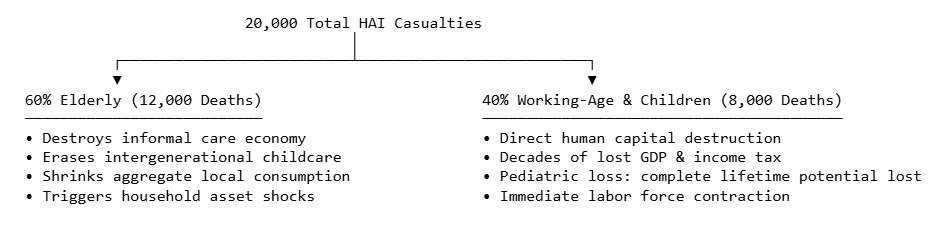
The impact of 20,000 preventable deaths splits into two distinct economic and social disasters:
2. The “Pension Saving” Fallacy myth vs. Macroeconomic Realities (60% Elderly Cohort)
Viewing 12,000 senior casualties solely as a reduction in pension outlays is a classic fallacy of composition: assuming that reducing a single line item in a government ledger benefits the overall national economy.
- Consumption & Tax Revenue Contraction: Elderly individuals are active economic consumers. They pay indirect taxes (VAT, property taxes, municipal tariffs) and support local service economies, small retail, and community businesses. Removing 12,000 senior consumers directly depresses aggregate local demand and shrinks state tax receipts.
- Collapse of the Informal Care Economy: Senior citizens provide a vital economic foundation through unpaid social labor—primarily intergenerational childcare and home care for dependent relatives. Losing this support network forces adult children to reduce working hours or leave the formal labor force entirely, increasing childcare strain, reducing income tax yields, and raising welfare expenditures.
- Asset Liquidation & Wealth Transfer Shocks: Premature, cluster-based mortality among seniors triggers sudden household financial shocks, forced asset liquidations, probate delays, and immediate financial dependency for surviving spouses who then require emergency state income support.
3. Direct Human Capital Loss & Economic Collapse (40% Working-Age & Pediatric Cohort)
The loss of 8,000 working-age individuals and children represents an unrecoverable destruction of human capital that directly impairs the national economy’s long-term growth trajectory.
Working-Age Adults (Productive Labor Force)
- Permanent GDP Contraction: The premature death of workers in their prime productive years causes a permanent drop in Gross Domestic Product (GDP) and decades of uncollected payroll, income, and consumption taxes.
- Valuation via VSL & DALYs: Using standard health economics metrics—the Value of a Statistical Life (VSL) or Disability-Adjusted Life Years (DALYs)—the economic value of losing 8,000 productive lives equals tens of billions of dollars in cumulative lifetime output.
- Enterprise Disruption: Protracted hospitalizations prior to death lead to prolonged sick leave, lost corporate productivity, high recruitment/training turnover costs, and critical losses in specialized technical knowledge.
Children & Neonates (Pediatric Casualties)
- Total Lifetime Loss: Pediatric deaths in neonatal intensive care units (NICUs) or pediatric wards represent the maximum possible loss of potential human life and future economic output (60+ prospective productive years lost per child).
- Demographic Depletion: In countries facing demographic decline or low fertility rates, the loss of children to preventable hospital superbugs compounds existing population contraction trends and accelerates long-term workforce shrinkage.
4. Direct Healthcare Costs & The Economics of Prolonged Clinical Failure
When a patient suffers from a persistent, treatment-resistant strain like Klebsiella pneumoniae for 30 to 180 days before dying, the healthcare system incurs maximum operational and financial expenditure for zero clinical return.
| Cost Category | Operational & Financial Mechanism | Socioeconomic & Structural Footprint |
| Extended ICU & Bed Stay | ICU beds cost $2,000–$5,000+ per day. Unsuccessful treatments over repeated hospital stays accumulates $100,000 to $500,000+ per patient. | Bed blockage causes severe operational bottlenecks, forcing cancellation of elective surgeries and worsening non-HAI patient outcomes system-wide. |
| Escalated Pharmacology | MDR/XDR K. pneumoniae requires expensive reserve-tier antibiotics (ceftazidime-avibactam, cefiderocol, colistin, high-dose carbapenem combinations). | Exhausts hospital pharmaceutical budgets on high-cost therapeutics without achieving cure; complete loss of pharmaceutical capital. |
| Diagnostic & Support Overhead | Continuous blood/urine cultures, CT imaging, continuous renal replacement therapy (CRRT), and prolonged mechanical ventilation. | Rapid depletion of laboratory capacity, diagnostic bandwidth, and critical consumable stocks. |
| Isolation & Decontamination | Implementing dynamic isolation, dedicated nursing staff, and continuous environmental bio-decontamination. | Drastically degrades hospital throughput efficiency and escalates unit operating overhead across non-infected wards. |
Aggregate Direct Impact: Across 20,000 cases, direct hospital and therapeutic expenditures alone easily accumulate between $3 billion and $8 billion, representing an unrecoverable drain on public health financing.
5. Systemic Collapse & The Reservoir Effect
The ultimate hazard of an uncontained MDR Klebsiella epidemic is not merely individual hospital bills—it is the irreversible degradation of the healthcare delivery system itself.
- Institutionalization of Superbugs: Prolonged, unsuccessful treatment cycles act as selective evolutionary pressure, turning hospitals into permanent bio-reservoirs for pan-drug resistant (PDR) superbugs.
- Erosion of Essential Surgical Safety: When HAI rates spike uncontrollably, standard procedures (oncological resections, joint replacements, organ transplants, neonatal care) become unacceptably high-risk, eroding public trust and rendering modern medicine functionally ineffective.
- Moral Injury & Staff Attrition: Physicians and nurses forced to manage predictable, preventable deaths due to lack of basic hygiene compliance or structural oversight suffer severe moral burnout, leading to mass resignations and severe brain drain.
Policy Action Plan: Bridging Paper Safety to Enforced Control
To stop treating preventable deaths as acceptable baseline noise and prevent systemic financial collapse, healthcare regulators must move from paper protocols to enforceable accountability:
- Mandatory Public HAI & Antibiogram Reporting: Mandate real-time, unit-level public disclosure of infection rates and resistance patterns to eliminate administrative concealment.
- Ring-Fenced Infection Control Budgets: Legally bind hospital administrations to allocate dedicated funds for hygiene infrastructure (HEPA filtration, automated decontamination systems, single-use catheter sets).
- Independent Hygiene Auditing & Sanctions: Institute unannounced third-party audits with direct administrative and financial penalties for non-compliant hospital management.
- Antibiotic Stewardship Laws: Restrict empiric broad-spectrum antibiotic use and fund rapid diagnostic technologies to shorten pathogen identification times from days to hours.
Conclusion
Diabolical concept of “pension savings” through hospital mortality is an accounting myth. When weighed against multi-billion-dollar direct medical expenditures, lost informal labor, destroyed future human capital from working-age adults and children, household impoverishment, and the collapse of hospital safety, unenforced infection control is not a cost-saving measure in the national balance sheet—it is an economic and humanitarian disaster.