
The concept of a “Bacterial Internet” is not just a colorful metaphor—it is a precise functional analog to how decentralized computer networks, routing protocols, and distributed data hubs operate.
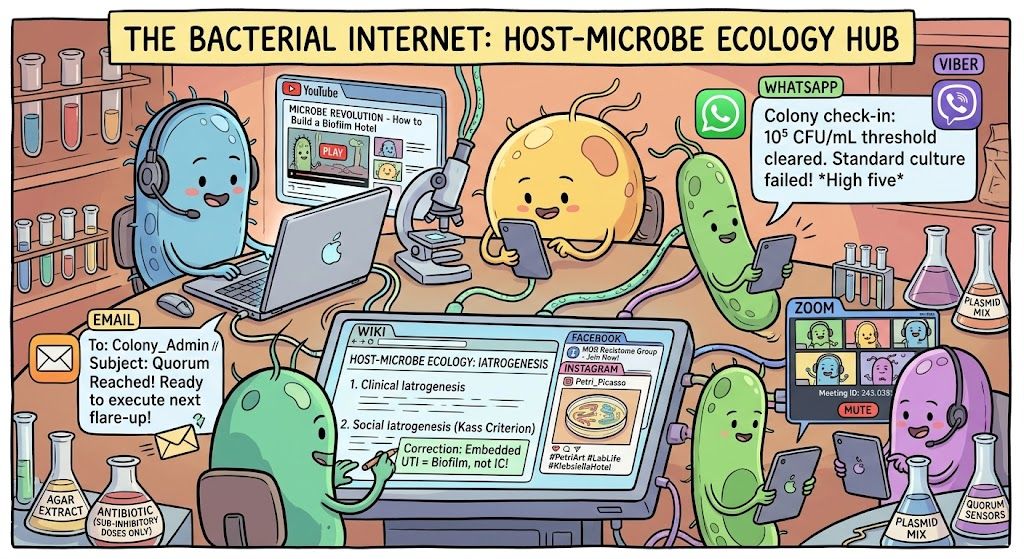
At its core, an internet is a system of independent nodes that exchange standardized packets of information across a shared medium to coordinate behavior, balance resources, and survive hostile environments. Microbial biosignaling—anchored by Quorum Sensing (QS), metabolic cross-feeding, and horizontal gene transfer—functions as an biological network.
1. Protocols and Signal Packets: Autoinducers as Network Packets
In digital networking, computers communicate by sending standardized data packets (e.g., via TCP/IP) containing a header (metadata) and a payload. In the microbial world, autoinducers are the physical signal packets:
- Local Area Networks (Intraspecies Signaling): Gram-negative bacteria use Acyl-Homoserine Lactones (AHLs) and Gram-positive bacteria use Autoinducing Peptides (AIPs). These act like proprietary, local network protocols—allowing members of the same species (e.g., a localized strain of Klebsiella pneumoniae) to communicate privately without outside interference.
- The Universal Web Protocol (Inter-species Signaling): Bacteria also utilize Autoinducer-2 (AI-2), a signal produced via the LuxS enzyme pathway. AI-2 acts as the “HTTP/HTML” of the microbial world—a universal, species-agnostic protocol that allows diverse bacteria (E. coli, Proteus, Pseudomonas, and Klebsiella) inside a polymicrobial biofilm to read shared environmental metrics and coordinate collective action.
2. Bandwidth, Routing, and Noise: Matrix vs. Fluid Diffusion
How a signal travels depends on the physical network infrastructure:
- Planktonic “Packet Loss”: In free-flowing liquid (like active urine or blood), secreted autoinducers diffuse away rapidly. The signal-to-noise ratio is too low, resulting in “dropped packets.” The network remains in a low-density, uncoordinated state.
- Biofilm as Fiber-Optic Cable: Inside an Extracellular Polymeric Substance (EPS) matrix, autoinducers are trapped and concentrated within micro-channels. The EPS matrix functions like physical network cabling, routing chemical signals directly between adjacent cells with minimal signal degradation and high “bandwidth.”
3. Distributed Computing: Reaching the “Quorum”
Single bacteria have limited processing capacity. However, when connected via Quorum Sensing, thousands of individual cells act as a distributed computing cluster:

Distributed Sensing: Each bacterial cell continually samples its immediate environment and emits a baseline level of signal packets (autoinducers).
- Threshold Aggregation: As cell density increases, signal concentration rises. Once the local concentration hits a critical threshold (the quorum), it triggers a synchronized “if/then” conditional execution across millions of cells simultaneously.
- Synchronized Action: Instead of one cell launching a premature, weak attack that host defenses can easily neutralize, the network waits until it has sufficient numbers. Once the quorum is reached, the entire population executes coordinated tasks—such as launching virulence factors, building struvite mineral shelters, or pumping out matrix-degrading dispersion enzymes.
4. File Sharing and P2P Networks: Horizontal Gene Transfer (HGT)
If Quorum Sensing is the messaging network, Horizontal Gene Transfer (HGT) is the microbial Peer-to-Peer (P2P) file-sharing network.
- Downloading “Patches”: Bacteria do not need to wait generations for random Darwinian mutations to adapt to a threat. When an antibiotic enters the environment, bacteria share resistance genes via mobile genetic elements (plasmids, transposons, and integrons).
- Bacterial Conjugation: Cells construct physical bridges (sex pili) to directly transfer “executable files” (resistance plasmids like KPC or NDM-1) to neighboring cells—even across different species.
- The Dark Web of the Biofilm: Sheltered inside polymicrobial biofilms, bacteria continuously swap resistance mechanisms, virulence factors, and metabolic pathways, essentially updating their survival software in real time to defeat host defenses and pharmaceutical interventions.
5. Cybersecurity and Hacking: Quorum Quenching and Signal Jamming
Just as human computer networks are vulnerable to distributed denial-of-service (DDoS) attacks, packet interception, and signal jamming, the bacterial internet can be exploited:
- Quorum Quenching (QQ): Host immune systems and competing organisms produce enzymes (e.g., AHL-lactonases and acylases) that cut autoinducer molecules, destroying the signal packet before it reaches its destination.
- Competitive Signal Blockade: Phytochemicals and targeted therapeutics can act as “spoofed packets”—binding to bacterial signal receptors without activating them, blocking real messages from docking and effectively taking the network offline.
Summary
The “bacterial internet” is an evolutionary architecture that turns isolated single-celled organisms into a highly organized, resilient multicellular web. By using autoinducers as data protocols, the EPS matrix as physical infrastructure, and conjugation as peer-to-peer file sharing, microbes coordinate survival, withstand extreme chemical stress, and maintain permanent residency inside host ecosystems.