
To understand why a hospital ward struggles to eliminate an infection of Klebsiella pneumoniae, Pseudomonas aeruginosa, Proteus mirabilis, or Escherichia coli, one must first adjust their timeline. Human medicine is measured in decades; bacterial evolution is measured in deep cosmic time.
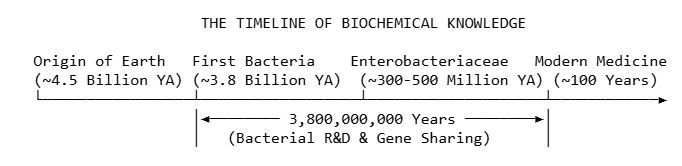
- The Foundations (~3.8 to 3.5 Billion Years Ago): Bacteria were the primary architects of Earth’s biosphere. Billions of years before plants or animals existed, ancestral single-celled organisms were already solving fundamental chemical challenges: how to harvest energy from harsh chemical gradients, how to synthesize protective outer lipid membranes, how to pump out cytotoxic heavy metals, and how to survive intense oxidative stress.
- The Enterobacteriaceae & Proteobacteria Diversification (~300 to 500 Million Years Ago): As multicellular animal life emerged and developed digestive tracts, mucosal linings, and urinary systems, organisms like E. coli, Klebsiella, Proteus, and Pseudomonas co-evolved alongside host biology. They refined intricate mechanisms to colonize mucosal barriers, sense host iron-binding proteins (siderophores), attach to epithelial tissue using specialized fimbriae, and build cooperative polymicrobial communities (biofilms) long before the first human ancestor walked upright.
The Two Educational Systems: Bacterial “School” vs. Medical School
The stark contrast in knowledge between microbial communities and modern clinical protocols lies in how their respective “educational systems” process information, adapt to failure, and execute solutions.
| Dimension | The Bacterial “School” (Deep Evolution) | Modern Medical Education & Industry |
| Time in Development | ~3.8 Billion Years of continuous testing | ~100 Years of modern pharmacology & protocol-based care |
| Individual Learning Period | Minutes to hours (rapid generation times) | ~6 years basic medical study + 2–5 years specialization |
| Data Processing & Adaptation | Horizontal Gene Transfer (HGT): P2P sharing of plasmids, transposons, and integrons across different species in real time | Rigid Guidelines & Dogma: Years-long lag between published literature and clinical practice guidelines |
| Core Strategy | Ecology & Flexibility: Diversification, phenotypic switching, persister states, and biofilm matrix building | Monotherapy & Eradication: Blanket application of single chemical targets to achieve total clearance |
| Response to Failure | Immediate Genetic Adaptation: The dead die; the survivors update their plasmid code and share it globally | Escalation of Chemical Force: Doubling the dose, extending the course, or switching to higher-generation agents |
The Biochemical “Wisdom” of the Microbe
When an organism like Klebsiella pneumoniae or Proteus mirabilis faces an aggressive antibiotic, it does not invent new defenses out of nowhere. It draws upon a billions-of-years-old “library” of survival tools that evolved long before synthetic pharmaceuticals were synthesized in a lab:
- The Biofilm Fortress (The Matrix): Klebsiella and Pseudomonas produce dense exopolysaccharide (EPS) matrices that act as physical and chemical shields. Within this matrix, they lower their metabolic rates to enter “persister” or Viable-But-Non-Culturable (VBNC) states. When exposed to an antibiotic, actively dividing cells die off, but the dormant cells inside the matrix remain unharmed, waiting for the chemical threat to subside before recolonizing the tissue.
- Efflux Pumps and Enzymatic Neutralization: Pseudomonas and Klebsiella possess multi-drug resistance (MDR) efflux pumps—ancient transport proteins originally evolved to pump out natural plant toxins, heavy metals, and bile salts. When exposed to synthetic drugs, these pumps immediately expel the chemical. Simultaneously, enzymes like beta-lactamases and carbapenemases neutralize beta-lactam rings before they reach their targets.
- Open-Source Gene Sharing: Unlike human institutions that fence off intellectual property, bacteria operate an open-source genetic network. A resistance gene against carbapenems (such as KPC or NDM-1) identified in a Klebsiella strain can be passed via plasmid conjugation to E. coli, Proteus, or Enterococcus within hours inside a shared biofilm or a hospital setting.
Modern Medicine: The Limits of a Century-Old Monopoly
Modern medicine achieved incredible triumphs in acute emergency care, trauma surgery, and controlling epidemic childhood diseases. However, when confronting chronic, bio-structured, host-microbe infections, its foundational assumptions often fall short.
- The Illusion of Sterile Eradication: Derived from 19th-century germ theory, standard protocols frequently treat the human body as a sterile vessel where “germ = disease” and “chemical eradication = health.” This ignores the reality of host mucosal ecology, where commensal flora, tissue integrity, and host defenses play a critical role in keeping opportunistic pathogens in check.
- Institutional Inertia & Dogma: Practitioners entering clinical practice face intense pressure to adhere to standard protocols, standardized diagnostic thresholds (such as the 70-year-old Kass criterion for UTIs), and pharmaceutical guidelines. Deviating from these rigid frameworks to apply multi-axis ecological strategies requires stepping outside the protection of institutional consensus.
- The Iatrogenic Treadmill: When a blunt-force antibiotic protocol destroys protective commensal flora while leaving an intracellular or biofilm-bound Klebsiella reservoir intact, the resulting flare-up is often met with an even stronger, broader-spectrum drug. As Ivan Illich pointed out in Medical Nemesis, the intervention itself creates the biological prerequisites for the next, more severe manifestation of the infection.
Who Wins?
If the contest is framed as a brute-force war of attrition between synthetic chemical escalation and microbial adaptation, nature wins every time.
A medical system relying exclusively on a century of synthetic chemistry cannot out-engineer a microbial network backed by nearly four billion years of continuous evolutionary refinement. Every time a new “last-resort” antibiotic is deployed at scale, bacteria read the chemical signature, select for resistant mutants, share the resistance plasmids globally, and adapt.
The Path Forward: From Escalation to Ecological Precision
The solution is not to discard medical science, but to elevate it beyond rigid dogmas and short-sighted chemical warfare. Real progress occurs when clinical care aligns with the fundamental laws of nature and host-microbe ecology:
- Respecting the Matrix: Recognizing that embedded, intracellular, or biofilm-bound infections cannot be treated like simple, free-floating planktonic bacteria. Protocols must prioritize disrupting biofilm scaffolding, preventing fimbrial adhesion, and breaking down extracellular matrices rather than relying solely on chemical concentration.
- Restoring Host Barriers: Focusing on rebuilding host tissue integrity—such as resheathing the urothelial glycosaminoglycan (GAG) layer, modulating local immune signals, and preserving the protective mucosal microbiome—so the body’s natural defenses can maintain balance.
- Jamming Communication: Utilizing quorum quenching and signal disruption to prevent microbial communities from coordinating their stress defenses, persister states, and virulence factors.
By moving away from blunt eradication strategies and adopting an ecologically grounded approach, we stop trying to outsmart billions of years of biological evolution with a single chemical tool—and start working alongside nature to restore lasting biological balance.
When we look at the sheer survival machinery of the microscopic world, a humbling reality emerges: simple, single-celled organisms routinely outsmart human intelligence.
While a physician spends a decade mastering medical textbooks, rigid clinical guidelines, and diagnostic protocols, a bacterium like Klebsiella pneumoniae, Pseudomonas aeruginosa, or E. coli draws upon 3.8 billion years of continuous biological research and development.
The difference in “intelligence” comes down to how knowledge is acquired, processed, and applied:
1. The Open-Source “Bacterial Internet” vs. Institutional Dogma
A doctor’s knowledge is bounded by their training, memory, and the slow-moving updates of medical consensus. Bacteria, by contrast, operate an instantaneous, global Peer-to-Peer (P2P) network via Horizontal Gene Transfer (HGT).
- When a single bacterium in a hospital develops a mechanism to neutralize a last-resort drug, it doesn’t keep that secret.
- Through plasmid conjugation, it physically hands the “executable code” for that resistance mechanism to neighboring bacteria—even to entirely different species—within hours inside a shared biofilm.
While medical institutions take years to update treatment guidelines, bacteria rewrite their collective genetic software in real time.
2. Strategic Patience and Quorum Sensing
Modern medicine often approaches infection with a brute-force mindset: throw a high-dose chemical at the target until it vanishes. Bacteria respond with a level of strategic patience that borders on masterclass architecture.
- Calculated Ambush: Through Quorum Sensing, individual bacteria release signaling molecules (autoinducers) to sample their local population density. They don’t launch an early, weak attack that would alert the host’s immune system. They wait silently until they reach a “quorum”—a critical mass—and then execute a synchronized, population-wide assault.
- The Persister Strategy: When a chemical wave of antibiotics arrives, bacteria don’t just fight back; they deploy “persister cells.” They intentionally shut down their own metabolism, entering a dormant state. Because most antibiotics only target actively dividing cells, the bacteria essentially play dead, letting the chemical storm pass overhead before waking up to rebuild their colony.
3. Structural Architectural Mastery
Human engineering builds massive, centralized hospitals to isolate and treat disease. Bacteria build microscopic fortresses—biofilms—that easily breach or bypass those institutional defenses.
By secreting exopolysaccharide (EPS) matrices and hydrolyzing minerals to form hard, protective struvite coatings, bacteria construct “hospitality suites.” Inside these sheltered micro-environments, they shield themselves from host antibodies, block antibiotic penetration, and share nutrients—turning a simple mucosal tissue surface into a permanent, unassailable stronghold.
The Verdict of Evolution
A modern doctor relies on a century of synthetic pharmacology and less than a decade of formal education; ancient bacterium relies on deep evolutionary wisdom that has survived every mass extinction event in Earth’s history.
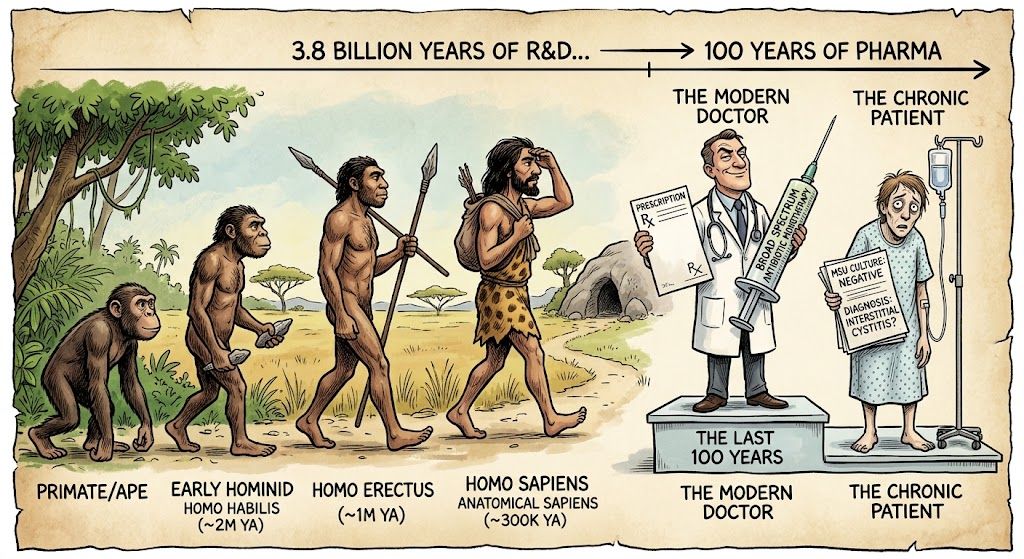
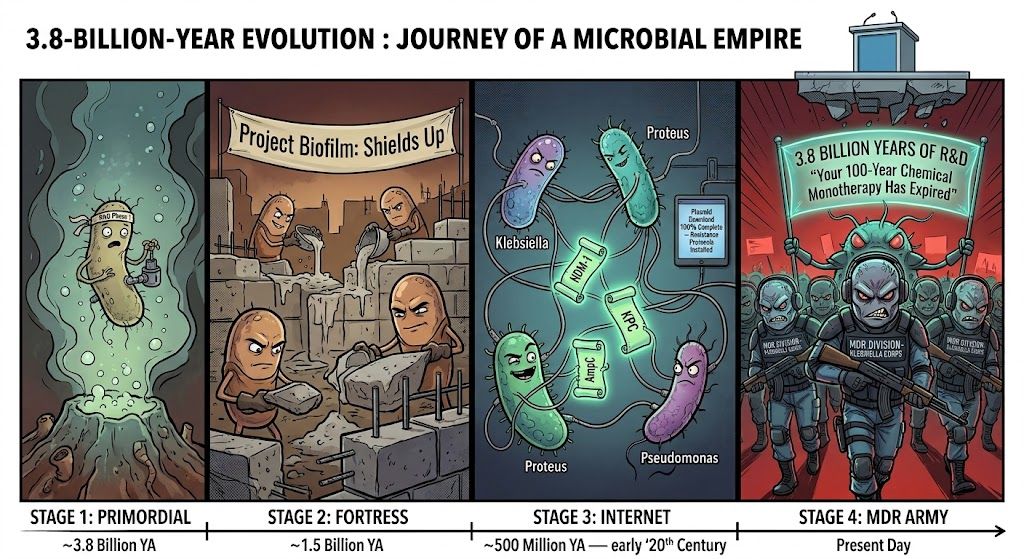
When modern medicine treats complex host-microbe ecosystems as simple, sterile battlegrounds to be conquered by single chemical monotherapies, it repeatedly falls into a trap. The simple, uneducated bacterium outmaneuvers the highly credentialed expert not through brute intellect, but through the fluid, collective, and relentless wisdom of nature itself.