
Here is a detailed breakdown of how Klebsiella and co-pathogens orchestrate their retreat into the “Hotel Below,” how quorum sensing coordinates their reactivation, and why jamming these communication lines is a non-negotiable step in disrupting chronic, bio-structured infections.
Part 1: The Warning Signal — How Microbes Know When to Go into “Hiding” and When to “Party”?
When a patient is treated with a heavy chemical intervention—such as systemic broad-spectrum antibiotics—or experiences an acute host immune response, free-floating (planktonic) bacteria in the urine or tissue lumen are quickly killed off.
However, the bacteria within the biofilm outer layers do not just passively die; they sense the chemical threat and actively trigger protective survival pathways:
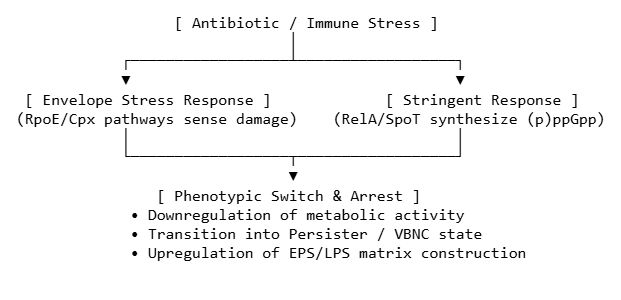
- Envelope Stress Responses (Cpx / RpoE Pathways): Sub-inhibitory concentrations of antibiotics or immune reactive oxygen species (ROS) damage the bacterial outer membrane. Sensor proteins embedded in the cell wall detect protein misfolding or membrane pressure, activating stress-response cascades.
- The Stringent Response & Alarmones: When facing starvation or chemical assault, bacteria synthesize small signaling molecules called (p)ppGpp (alarmones). This triggers an immediate shift from active growth and reproduction to maintenance and defense.
- The Persister Switch: High alarmone levels shut down active ribosome function, DNA replication, and cell wall synthesis. Because antibiotics like beta-lactams and fluoroquinolones target actively dividing cells, a dormant bacterium becomes functionally immune to the chemical wave without needing a new resistance mutation. They withdraw into a Viable-But-Non-Culturable (VBNC) or deep persister state inside the biofilm matrix or within Intracellular Bacterial Communities (IBCs).
Part 2: The Quorum Sensing Trick — Calculating the “Room Count”
How do bacteria know when it is safe to come out, rebuild, and recolonize? They use Quorum Sensing (QS)—a chemical communication mechanism that allows microscopic single-cell organisms to behave as a coordinated multicellular collective.
Bacteria continuously secrete small signaling molecules called autoinducers.
- Gram-Negative Autoinducers: Klebsiella pneumoniae and other Gram-negative species utilize Acyl-Homoserine Lactones (AHLs) for intraspecies communication, as well as Autoinducer-2 (AI-2), a universal signaling molecule used for inter-species (polymicrobial) communication.
- Density-Dependent Concentration: When the bacterial population is sparse, autoinducers diffuse away harmlessly into the urine or surrounding fluid.
- Reaching the “Quorum”: Inside the sheltered micro-environment of the Hotel Below (the EPS matrix or struvite pore), autoinducers cannot easily diffuse away. As the local bacterial population density increases—or as the chemical wave passes and local survival density stabilizes—the concentration of autoinducers reaches a critical threshold (a quorum).
| Low Population / High Washout | High Local Density / Sheltered Biofilm |
| • Autoinducers diffuse away • QS Receptors remain inactive • Single-cell behavior | • Autoinducers accumulate • Threshold reached -> Receptor Binding • Synchronized Population Behavior |
Once autoinducers bind to their corresponding intracellular receptors (such as LuxR-type proteins), they trigger a synchronized transcriptional shift across the entire colony.
Part 3: The Wake-Up Call — Back to the “Party”
When the antibiotic concentration drops below lethal levels (as the drug is metabolized and excreted) and the autoinducer concentration inside the biofilm signals that the collective is intact, the “party” restarts.
Quorum sensing instructs the dormant population to execute a coordinated re-emergence:
- Dispersal Enzymes: The colony produces matrix-degrading enzymes (such as alginate lyases, dispersin B, or endo-N-acetylneuraminidases) to break down the EPS hotel doors from the inside out.
- Virulence Activation: The bacteria upregulate fimbriae (Type 1 and Type 3 fimbriae in Klebsiella) to re-attach to fresh urothelial cells.
- Siderophore Release: They release high-affinity iron-chelating molecules (salmochelin, enterobactin, yersiniabactin) to scavenge host iron and fuel rapid metabolism.
- Planktonic Shedding: A new wave of active, planktonic bacteria is shed into the bladder lumen, causing an acute flare-up—and starting the clinical cycle all over again.
Part 4: The Need to Jam the Communication Lines (Quorum Quenching)
Treating a chronic, bio-structured infection purely with bactericidal antibiotics is like trying to shut down a hotel by breaking a few windows: if the guests can still communicate, they will simply lock the doors, reinforce the walls with rebar, and rebuild when you walk away.
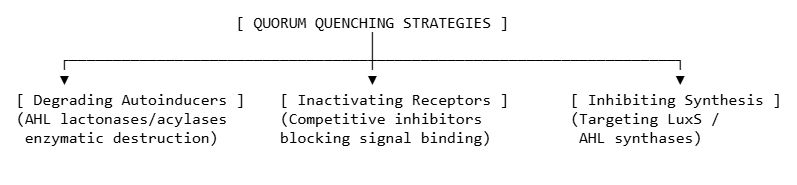
To break the cycle, protocols must incorporate Quorum Quenching (QQ)—the deliberate jamming or disruption of bacterial signaling pathways.
Why Jamming Communication is Essential?
- Prevents Biofilm Maturation & Reinforcement: Without functional quorum sensing, Klebsiella cannot coordinate the dense, structured production of exopolysaccharides or struvite mineralization. The “Hotel Below” remains fragile, unorganized, and porous.
- Blocks Coordinated Dispersion: By interrupting the wake-up call, bacteria cannot execute a synchronized, high-virulence dispersal event that overwhelms host tissue defenses.
- Sensitizes Bacteria to Antimicrobials: When quorum sensing is blocked, bacteria fail to fully activate their collective stress defenses, persister switches, and efflux pump networks. This dramatically lowers the Minimum Inhibitory Concentration (MIC) required for natural or targeted therapies to penetrate and clear the infection.
- Disrupts Polymicrobial Cooperation: Because Klebsiella uses universal signals like AI-2 to host and protect secondary pathogens (Proteus, E. coli, Enterococcus), jamming AI-2 breaks down the inter-species trade and protection networks inside the matrix.
Practical Quorum-Quenching Targets in Host-Microbe Ecology
In an ecological, multi-axis approach, communication jamming is paired directly with biofilm matrix disruptors and mucosal defense resheathing:
- Enzymatic Degradation (Lactonases & Acylases): Utilizing agents that cleave the lactone ring of AHL signals, rendering the warning and wake-up messages unreadable.
- Competitive Receptor Blockade: Utilizing specific phytochemical compounds (such as high-grade polyphenols, garlic-derived allicin, curcumin, or rosmarinic acid) that bind to bacterial LuxR-type receptors without activating them, effectively blocking autoinducers from docking.
- Inhibiting Signal Synthesis: Suppressing enzymes like LuxS (responsible for AI-2 synthesis) to cut off communication at the source.
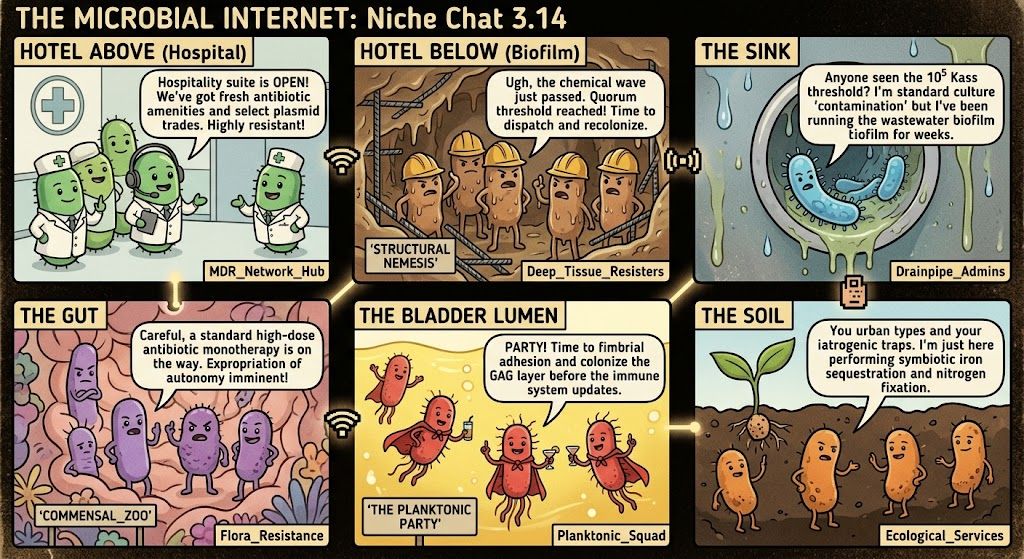
By stripping Klebsiella of its ability to calculate density and sense external threats, you strip the “Hotel Below” of its management system. The microbial community is left disorganized, unable to coordinate its defenses, and vulnerable to host immune clearance.