
This article is the second installment in our series on multidrug-resistant (MDR/XDR) uropathogen eradication. It builds directly upon our foundational post, “Dismantling the Fortress: Proteolytic & Digestive Enzymes, NAC, and Nitroxoline (Nx) in Breaking Multidrug-Resistant Biofilms.”
While Part 1 established the theoretical and structural mechanics of using enzymes, N-Acetylcysteine (NAC), and Nitroxoline (Nx) to break down the extracellular polymeric substance (EPS) matrix, Part 2 moves into real-world pharmacokinetics (PK). Here, we analyze the expected concentrations of these substances within the bladder lumen and host tissues, evaluate their realistic bio-distribution, and introduce the next crucial layer of defense: efflux pump jammers.
Key Topics Covered in This Follow-On Article
- The Pharmacokinetic Reality in the Bladder:
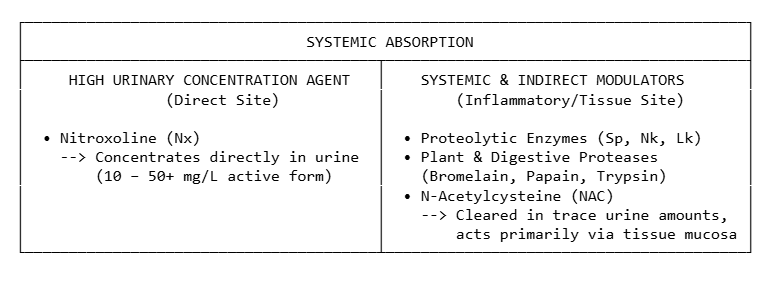
- Nitroxoline (Nx): Rapid renal excretion delivers active therapeutic concentrations (10–50+ mg/L) directly into the urinary tract, where it chelates structural cations (Mg2+, Ca2+) and intracellular metal cofactors (Fe2+, Zn2+, Mn2+).
- Systemic Proteolytic & Fibrinolytic Enzymes (Serrapeptase, Nattokinase, Lumbrokinase): These large macromolecular proteins operate at trace/sub-nanogram levels in urine. Their primary impact is host-mediated—debriding micro-thrombi, improving microvascular tissue perfusion, and breaking down inflammatory exudates in deep bladder tissue.
- Plant & Digestive Proteases (Bromelain, Papain, Trypsin, Chymotrypsin, Broad-Spectrum Enzymes): Function primarily via systemic anti-edema pathways and gastrointestinal reservoir cleansing—eliminating the primary gut pool of Klebsiella and Proteus to prevent auto-reinfection.
- N-Acetylcysteine (NAC): Cleaved predominantly into glutathione (GSH) with low direct urinary clearance, acting locally at the mucosal interface to break disulfide bonds (-S-S-).
- The “Unmask, Target, and Jam” Protocol:
- Why matrix liquefaction (Enzymes + NAC) and cation chelation (Nx) are necessary but insufficient on their own against superbugs.
- Previewing the Next Frontier — Efflux Pump Inhibitors (EPIs):
- Even when the matrix is stripped away, MDR/XDR strains of Klebsiella pneumoniae, Proteus mirabilis, and Pseudomonas aeruginosa employ active efflux pumps (e.g., AcrAB-TolC, MexAB-OprM) to vacuum antimicrobial compounds out of the bacterial cell.
- A preview of natural and synthetic efflux pump jammers, membrane-permeabilizing adjuvants, and anti-persister strategies designed to close the escape hatch and achieve total bacterial eradication.
To effectively dismantle a entrenched, multidrug-resistant (MDR/XDR) uropathogenic biofilm (Klebsiella pneumoniae, Proteus mirabilis, Pseudomonas aeruginosa) in the bladder, we must evaluate the pharmacokinetics, bio-distribution, and actual expected concentrations of each agent at the target site—the urinary tract / bladder lumen.
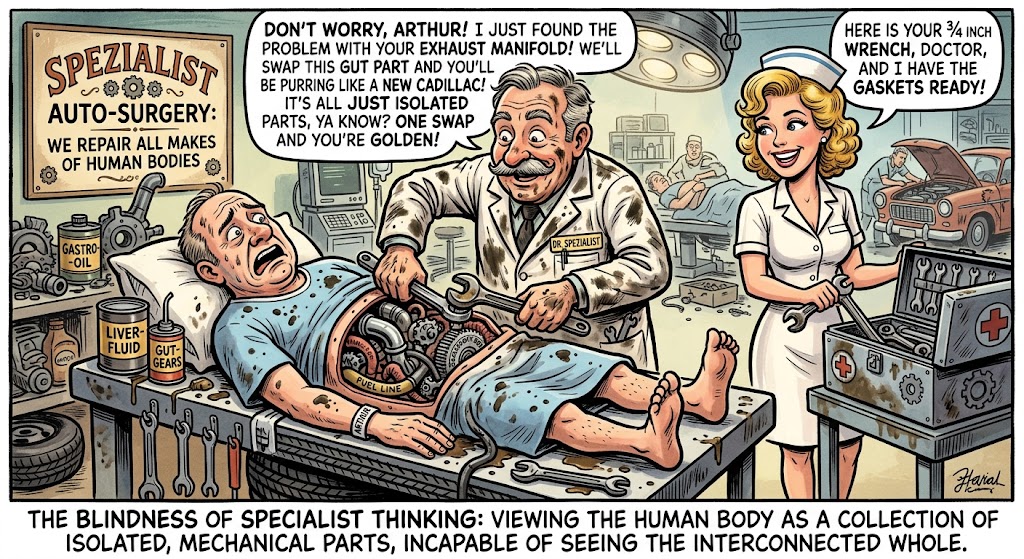
However, evaluating these agents purely by their concentration in a single organ fluid like urine overlooks a fundamental principle of human biology: the body operates as an interconnected whole, not a collection of isolated compartments.
A common pitfall in modern medical specialization is the tendency for clinicians to view health through a narrow, organ-specific lens—a urologist focusing strictly on the bladder lumen, a gastroenterologist observing only the gut mucosa, or an immunologist focusing solely on systemic markers. Organisms do not exist in silos. The bladder mucosa is intimately linked to systemic microcirculation, gut microbiome reservoirs, lymphatics, and host immune signaling.
An agent that maintains only trace concentrations in excreted urine can still play a decisive, game-changing role in eradicating a bladder infection by clearing the primary gastrointestinal reservoir, breaking down microvascular fibrin networks, modulating systemic inflammation, or enhancing tissue perfusion.
Below is a holistic analysis of how each substance behaves once ingested, its expected urinary and tissue concentrations, its direct or indirect role in biofilm disruption, and why this represents only one critical phase of a broader protocol.
1. Expected Bladder Concentrations & Pharmacokinetic Profile
A common misconception is that all ingested enzymes travel intact into the bladder in high concentrations. In reality, the agents divide sharply into urinary-concentrated small molecules and systemically active, systemically distributed enzymes.
A. Nitroxoline (Nx): High-Concentration Bladder Antimicrobial
- Expected Urinary Concentration: 10 to 50+ mg/L (µg/mL) active excreted compound following standard oral dosing (200 mg 3–4 times daily).
- Pharmacokinetic Pathway: Nitroxoline is rapidly absorbed in the gut and undergoes rapid renal excretion. It is heavily concentrated directly in the urine within the bladder lumen.
- Biofilm Disruption Action:
- Extracellular: At these high urinary concentrations, Nx binds free and membrane-bound Mg2+ and Ca2+ ions, stripping the structural stability from Gram-negative outer membranes and causing physical dispersion of the extracellular polymeric substance (EPS) matrix.
- Intracellular: Unencumbered by the matrix, Nx enters bacterial cells to chelate Fe2+, Zn2+, and Mn2+. This halts RNA polymerase activity, inhibits resistance enzymes like Metallo-β-Lactamases (MBLs), and generates fatal intracellular reactive oxygen species (ROS).
B. Proteolytic & Fibrinolytic Enzymes (Sp, Nk, Lk)
- Agents: Serrapeptase (Sp), Nattokinase (Nk), Lumbrokinase (Lk).
- Expected Urinary Concentration: Low to Trace (Sub-nanogram/mL range) as intact, active enzymes.
- Pharmacokinetic Pathway: These are large macromolecular proteins (45–60 kDa). When taken on an empty stomach, a small percentage (~1–3%) is absorbed intact through gut-associated lymphoid tissue (GALT) or enterocytes into systemic circulation, where they bind to plasma antiproteases (such as α2-macroglobulin). They undergo hepatic degradation and filtration.
- Biofilm Disruption Action (Systemic & Mucosal):
- They do not need to appear in high concentrations in the urine to work. Their action in bladder biofilm disruption is indirect and host-mediated:
- Microvascular Debridement: They degrade micro-thrombi and fibrin deposits in inflamed bladder tissue, restoring capillary blood flow and allowing immune cells and antibiotics to reach deep mucosal folds.
- Inflammatory Exudate Breakdown: They break down circulating immune complexes and proteinaceous exudates, thinning bladder wall mucus secretions and preventing bacterial entrapment.
- Synergistic Matrix Degradation: In high-dose protocols, intact systemic proteases circulating in mucosal capillarized tissues assist in digesting extracellular protein scaffolding (collagenous and fibrillar matrices) anchoring deep sessile colonies.
- They do not need to appear in high concentrations in the urine to work. Their action in bladder biofilm disruption is indirect and host-mediated:
C. Plant & Digestive Proteases (Bromelain, Papain, Trypsin, Chymotrypsin)
- Agents: Bromelain, Papain, Trypsin, Chymotrypsin, Broad-Spectrum Digestive Enzymes (Carbohydrases, Lipases, Peptidases).
- Expected Urinary Concentration: Negligible as active enzymes in urine. Broad-spectrum digestive enzymes (amylases, cellulases, lipases) remain within the gastrointestinal lumen unless specific systemic formulations are used.
- Pharmacokinetic Pathway: Unprotected digestive enzymes hydrolyze dietary or mucosal proteins in the GI tract. Systemically formulated proteases (like Bromelain or Trypsin/Chymotrypsin combinations) achieve transient plasma levels before systemic clearance.
- Biofilm Disruption Action:
- Gastrointestinal Reservoir Cleansing: Many MDR/XDR uropathogens (Klebsiella pneumoniae, Proteus) originate in the GI tract (the primary “reservoir”). Broad-spectrum digestive enzymes break down GI biofilm matrices, preventing persistent auto-reinfection of the urogenital tract.
- Anti-Edema & Anti-Inflammatory Action: Systemically absorbed Bromelain and Trypsin degrade kinins and pro-inflammatory mediators, reducing uroepithelial swelling and restoring local host defense barrier function.
D. N-Acetylcysteine (NAC)
- Expected Urinary Concentration: Low (1–5% of oral dose excreted as free NAC); predominantly metabolized to L-cysteine and glutathione (GSH).
- Biofilm Disruption Action:
- Sulfhydryl Cleavage (-S-S-): Free circulating NAC and mucosal SH-groups directly cleave disulfide bonds in mucin and EPS matrix polymers, liquefying the slime layer and exposing embedded uropathogens.
- Tissue Protection: Restores intracellular glutathione, mitigating ROS damage to host uroepithelial cells.
2. Quantitative Assessment Matrix
| Agent | Target Bladder Urinary Level | Primary Site of Action | Mechanism in Biofilm / UTI Protocol |
|---|---|---|---|
| Nitroxoline (Nx) | High (10–50+ mg/L) | Bladder Lumen & Urine | Direct Killing & Membrane Collapse: Chelates Mg2+/Ca2+ (matrix) and Fe2+/Zn2+ (intracellular RNA synthesis/MBLs). |
| Serrapeptase (Sp) | Trace | Systemic Blood & Inflamed Tissue | Protein Scaffolding Degradation: Cleaves fibrin/protein scaffolding and thins tissue exudates. |
| Nattokinase (Nk) | Trace | Systemic Blood & Microvasculature | Fibrinolytic & Vascular Perfusion: Degrades fibrin networks, improves bladder microcirculation. |
| Lumbrokinase (Lk) | Trace | Systemic Blood | Strong Fibrinolysis: Cleaves dense fibrin matrices shielding deep-tissue bacterial nests. |
| Bromelain / Papain | Trace | Systemic Circulation & GI Tract | Anti-Edemic & Proteolytic: Reduces mucosal tissue edema and cleaves matrix protein bonds. |
| Trypsin / Chymotrypsin | Trace | Systemic Blood & Inflammation Sites | Enzymatic Debridement: Digests cellular debris and proteinaceous inflammatory exudates. |
| Digestive Enzymes | GI Tract Only | Gastrointestinal Lumen | Reservoir Cleansing: Breaks down GI biofilms to eliminate the source of uropathogen recolonization. |
| N-Acetylcysteine (NAC) | Low / Moderate | Mucosa & Systemic Tissues | Disulfide Bond Cleavage: Breaks (-S-S-) bridges in matrix slime and restores glutathione. |
3. Important Context: This Is Only One Part of the Masterplan
While combining Enzymes + NAC (for matrix liquefaction) with Nitroxoline (for cation chelation and bacterial eradication) creates a powerful “Unmask and Eradicate” framework, it does not cover every resistance axis of MDR/XDR uropathogens.
Crucial Note: Efflux Pump Jammers & Advanced Components (To Be Covered Later)
Even after the biofilm matrix is thinned and Nitroxoline penetrates the bacterial cell, superbugs like MDR Klebsiella pneumoniae, Proteus, and Pseudomonas possess active defense mechanisms:
- Multidrug Efflux Pumps (AcrAB-TolC, MexAB-OprM): These molecular pumps actively vacuum antimicrobial agents out of the bacterial cell before they can reach their intracellular targets.
- Porin Channel Mutations: Strains may downregulate membrane porins to restrict drug entry.
- Persister Cell Dormancy: High-density biofilm populations harbor metabolically dormant “persisters” that survive initial chemical exposure.
To ensure complete eradication and prevent recurrent flare-ups, subsequent components of the protocol—including natural and synthetic Efflux Pump Inhibitors (EPIs/Efflux Jammers), membrane-permeabilizing adjuvants, and targeted anti-persister agents—will be detailed in upcoming series of articles.
Disclaimer: This information is provided strictly for scientific and educational purposes and is not a substitute for personalized medical care from a qualified treating physician. Take care when choosing your physician, as standards, ethics, and adherence to the Hippocratic oath and applicable laws vary widely. A physician is an advisor and practitioner, not a supreme authority with power of life and death over your body, despite how some may present themselves. Physicians can make mistakes. Take an active role in learning about your health and diagnosis, leave no stone unturned, press for clear answers to your follow-up questions, and consult multiple independent opinions before committing to significant medical decisions about your health.