
Massive Klebsiella pneumoniae biofilm can shed on its own even without any external biochemical intervention, but this “spontaneous shedding” never results in true eradication—in fact, it often worsens the clinical situation.
In microbiology, spontaneous shedding is known as biofilm detachment or active dispersal. However, understanding how and why it occurs highlights the critical difference between bacterial dissemination and therapeutic eradication.
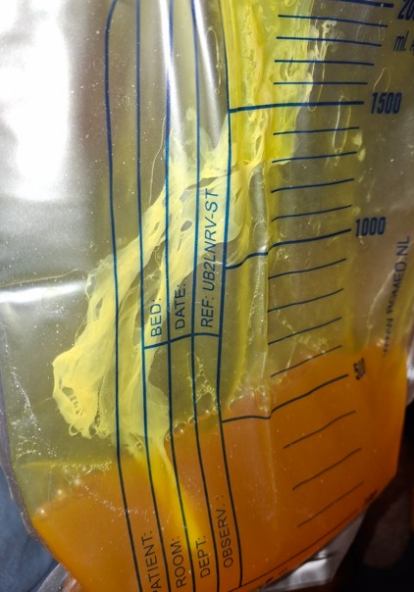
1. Mechanisms of Spontaneous Biofilm Shedding
A Klebsiella pneumoniae biofilm can shed or fragment through three primary non-interventional mechanisms:
A. Mechanical & Hydrodynamic Shear Stress (Passive Sloughing)
- Fluid Flow: In the bladder, urine accumulation and periodic voiding exert physical shear forces on the biofilm.
- Sloughing: As the biofilm grows into a massive structure, its outer layers become structurally unstable. Hydrodynamic forces strip off large chunks or “streamers” of the EPS matrix and embedded bacteria.
B. Endogenous Active Dispersal (Genetically Regulated)
- Quorum Sensing & Nutrient Starvation: When a biofilm reaches a massive density, deep-seated bacteria face severe nutrient and oxygen deprivation.
- Self-Produced Degradative Enzymes: In response to stress or quorum-sensing signals, Klebsiella upregulates endogenous enzymes (such as glycoside hydrolases or alginate lyases) to degrade its own matrix internally. This allows bacteria to break free and escape the overpopulated colony in search of new colonization sites.
C. Structural Overgrowth & Core Necrosis
- Inner Layer Death: In a thick, mature biofilm, the innermost layers attached to the urothelium die due to lack of metabolic exchange. As the basal anchor weakens, large sections of the mature biofilm peel away or detach spontaneously.
2. Why Spontaneous Shedding Is Dangerous (Dissemination vs. Eradication)
While a patient might see fragments or “cloudy debris” in their urine and assume the biofilm is clearing, spontaneous shedding without active antimicrobial intervention presents severe risks:
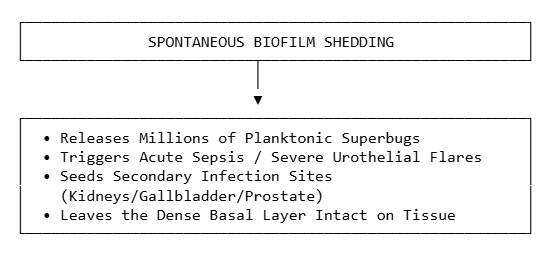
- Releasing Planktonic Superbugs: Chunks of shed biofilm release millions of free-floating (planktonic) bacteria back into the bladder lumen. Without a bactericidal agent like Nitroxoline (Nx) active in the urine, these released bacteria rapidly infect fresh epithelial cells.
- Acute Sepsis & Systemic Flares: Large-scale sloughing exposes bacterial endotoxins (LPS) directly to the bladder wall and microcirculation, frequently triggering sudden high fever, chills, severe dysuria, or systemic inflammatory response (SIRS).
- Leaving the Basal Layer Intact: Physical shear forces typically strip away only the upper, looser layers of the biofilm. The dense, highly resistant basal layer remains firmly anchored to the urothelium, where it immediately begins synthesizing new exopolysaccharides to rebuild the fortress.
3. Spontaneous Shedding vs. Controlled Biochemical Disruption
| Feature | Spontaneous Shedding | Controlled Biochemical Protocol (Enzymes + NAC + Nx) |
|---|---|---|
| Trigger | Fluid shear stress, nutrient starvation, structural overcrowding. | Systemic proteases, digestive enzymes, and disulfide cleavage (-S-S-) by NAC. |
| Matrix Integrity | Random chunks peel off; basal anchoring layer stays intact on tissue. | Enzymatic degradation liquefies both outer slime and structural protein/sugar scaffolding. |
| Bacterial Fate | Dispersed bacteria survive, re-adhere, and spread infection. | Unmasked bacteria are executed by Nitroxoline’s cation chelation (Mg2+, Ca2+, Fe2+, Zn2+). |
| Clinical Result | Recurrent infection cycles, tissue damage, and risk of bacteremia. | Total matrix collapse and systematic eradication of sessile and planktonic populations. |
Summary
Klebsiella pneumoniae can shed its biofilm spontaneously due to physical shear forces or internal starvation signals, but this is a bacterial survival and spreading mechanism, not a cure.
Without deliberate biochemical action plan—using proteolytic enzymes and NAC to systematically liquefy the Extracellular Polymeric Substance (EPS) biofilm matrix, Nitroxoline to neutralize exposed planktonic and biofilm-embedded uropathogens via metal chelation, bacterial Efflux Pumps Inhibitors (EPI) to restore intracellular drug accumulation and prevent rapid resistance, and agents that repair the bladder’s protective glycosaminoglycan (GAG) layer—spontaneous shedding simply resets the biofilm cycle and risks spreading the infection deeper into the urogenital tract.
Coordinating agents that alter matrix integrity and microbial load requires careful timing, as destabilizing a large biofilm load can temporarily increase inflammatory signaling or release bacterial byproducts into local tissues.
The next post, The Urothelial Battleground: Tissue Scrubbing, GAG Layer Breakdown, and the Biofilm-Blood Axis will explore physical, chemical, and vascular dynamics of the urothelial battleground in a war of attrition with Klebsiella, exploring how structural tissue destruction, GAG layer collapse, and pathogen-driven vascular exploitation redefine the management of chronic, multidrug-resistant uropathogenic biofilms.
Disclaimer: This information is provided strictly for scientific and educational purposes and is not a substitute for personalized medical care from a qualified treating physician. Take care when choosing your physician, as standards, ethics, and adherence to the Hippocratic oath and applicable laws vary widely. A physician is an advisor and practitioner, not a supreme authority with power of life and death over your body, despite how some may present themselves. Physicians can make mistakes. Take an active role in learning about your health and diagnosis, leave no stone unturned, press for clear answers to your follow-up questions, and consult multiple independent opinions before committing to significant medical decisions about your health.