
Nitroxoline (5-nitro-8-hydroxyquinoline) is an oral antimicrobial agent primarily utilized in European and Asian clinical practice for the prevention and treatment of lower urinary tract infections (UTIs), such as acute or recurrent cystitis. Unlike systemic antibiotics, nitroxoline is excreted rapidly through the kidneys, reaching concentrations in urine that significantly exceed its Minimum Inhibitory Concentrations (MIC) for common uropathogens.
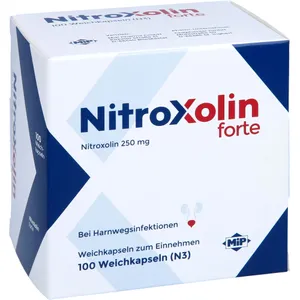
1. Mechanism of Action & Key Properties of Nitroxoline
What makes nitroxoline distinct from other urinary anti-infectives (like nitrofurantoin or fosfomycin) comes down to several key pharmacological characteristics:
- Divalent Metal Chelation: Nitroxoline functions primarily as a bidentate chelator of divalent metal cations (such as Mg2+, Mn2+, Ca2+, and Fe2+). By sequestering essential cofactor ions, it impairs bacterial RNA polymerase, methionine aminopeptidases, and metallo-β-lactamases while destabilizing the lipopolysaccharide (LPS) outer membrane layer of Gram-negative bacteria.
- pH Dependency: The nitro group (−NO2) at the C-5 position lowers the pKa of the phenolic hydroxyl group at C-8 to approximately 6.0. This allows nitroxoline to remain highly active in acidic-to-neutral urine environments typical of standard urinary excretion.
- Biofilm & Anti-Adherence Effects: Because nitroxoline deprives bacteria of surface cations and destabilizes membrane structures, it significantly inhibits bacterial adhesion to urothelial cells and synthetic catheter materials, making it valuable for managing biofilm-forming infections.
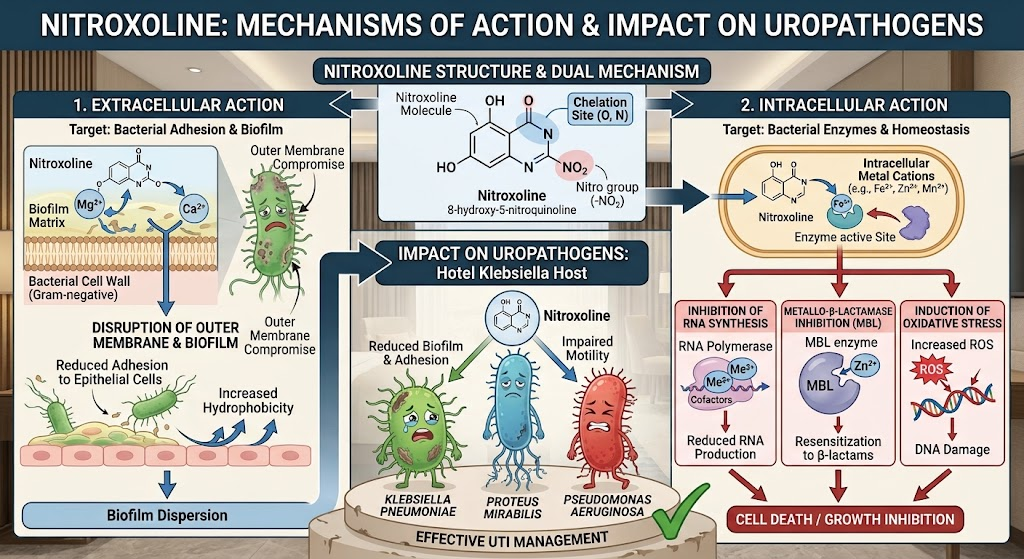
Nitroxoline exerts a dual antibacterial mechanism targeting both extracellular structures and intracellular pathways.
Extracellular Disruption: Chelation of divalent cations (Mg2+, Ca2+) destabilizes the outer bacterial membrane and biofilm matrix, impairing adhesion to uroepithelial cells and promoting biofilm dispersion. Intracellular Inhibition: Chelation of intracellular metal cofactors (Fe2+, Zn2+, Mn2+) inhibits key enzymes like RNA polymerase and metallo-β-lactamases (MBLs), while inducing ROS-mediated oxidative stress and DNA damage. Pathogen Impact: Demonstrated efficacy and cell stress against key uropathogens including Klebsiella pneumoniae, Proteus mirabilis, and Pseudomonas aeruginosa.
2. Efficacy Against Target Uropathogens
| Pathogen | Nitroxoline Susceptibility & Activity | Key Clinical Considerations |
|---|---|---|
| Klebsiella pneumoniae | High Susceptibility (MIC typically 2–8 μg/mL) | Consistently falls below active urine concentrations (>100 μg/mL). Highly effective even against fluoroquinolone-resistant or ESBL-producing strains. |
| Proteus mirabilis | High-to-Moderate Susceptibility (MIC typically 8–16 μg/mL) | Retains efficacy where nitrofurantoin and fosfomycin intrinsically fail or show poor susceptibility. |
| Pseudomonas aeruginosa | Intrinsic Resistance / High MIC (MIC >32–64 μg/mL) | Ineffective as monotherapy. Elevated efflux pump activity and membrane barriers render standard oral dosages clinically insufficient against P. aeruginosa. |
- Klebsiella spp.: Multi-center surveillance studies show that nitroxoline retains strong in vitro activity against Klebsiella pneumoniae, including multidrug-resistant (MDR) and extended-spectrum β-lactamase (ESBL) strains.
- Proteus spp.: While Proteus mirabilis possesses intrinsic resistance to nitrofurantoin (due to weak reductive activation) and often reduced susceptibility to fosfomycin, it remains susceptible to nitroxoline. Nitroxoline’s ability to inhibit urease-producing, biofilm-forming Proteus isolates is a major therapeutic advantage in catheter-associated or recurrent UTIs.
- Pseudomonas aeruginosa: Pseudomonas aeruginosa is considered insusceptible to standard therapeutic concentrations of nitroxoline. Due to active efflux systems (such as MexAB-OprM) and low outer membrane permeability, MICs usually exceed 32 μg/mL, well beyond standard urinary breakpoints.
3. Key Considerations for Nitroxoline Use
- Urinary Focus Only: Nitroxoline rapidly clears into the urine, maintaining minimal systemic tissue concentrations. It is indicated strictly for uncomplicated lower UTIs (cystitis) and UTI prophylaxis—not for pyelonephritis, renal abscesses, or systemic urosepsis.
- Etiology Verification: Because P. aeruginosa is intrinsically non-susceptible, empiric treatment with nitroxoline should be reconsidered if pseudomonal etiology is suspected (e.g., long-term catheterization or complicated urinary tract anatomy) until urine cultures and antibiograms confirm susceptibility.
- Renal Function: Adequate renal clearance is necessary to achieve bactericidal/bacteriostatic urine concentrations.
4. Key Scientific References & Studies
- Activity Spectrum and Mode of Action Across Gram-Negative Bacteria
- Study: Cacace et al. (2024/2025) investigated the mechanics of nitroxoline across over 1,000 Gram-negative clinical isolates, demonstrating its metal chelation profile, outer membrane disruption, and species-specific activity.
- Resource: Uncovering nitroxoline activity spectrum, mode of action and resistance (bioRxiv) | PubMed Entry
- In Vitro Activity Against Uropathogens
- Study: Yi et al. (2025) analyzed the comparative MIC values of nitroxoline against clinical uropathogen isolates, demonstrating high susceptibility rates for E. coli and K. pneumoniae, moderate rates for Proteus, and resistance in P. aeruginosa.
- Resource: In vitro antimicrobial activity of nitroxoline against uropathogens (JAC-AMR) Oxford University Press
- Mechanisms, Biofilm Disruption, and Clinical Applications
- Study: Krajewski et al. (2020) reviewed the clinical utility, anti-biofilm properties, and spectrum of activity of nitroxoline in treating lower UTIs caused by multidrug-resistant pathogens.
- Resource: Nitroxoline: treatment and prevention of urinary tract infections (PMC) ResearchGate
Clinical Implications of Antibiogram “R” Status in Klebsiella pneumoniae and Pseudomonas aeruginosa
To understand why a clinical lab report might often list an “R” (Resistant) result for Nitroxoline (Nx) against Klebsiella pneumoniae or Pseudomonas aeruginosa, it is necessary to examine how standard laboratory antibiograms are established versus how Nitroxoline operates in the human urinary tract.
The answer differs between these two pathogens: for Klebsiella, the “R” classification is frequently an artifact of laboratory testing standards rather than true clinical failure, whereas for Pseudomonas, the “R” reflects true biological resistance.
1. Klebsiella pneumoniae: The “False Resistant” Lab Artifact
If an antibiogram reports Klebsiella pneumoniae as Resistant to Nitroxoline, it is often due to standardization limitations in clinical microbiology, not an inability of the drug to kill the bacteria in the bladder.
A. Lack of Species-Specific EUCAST/CLSI Breakpoints
- Standardized testing guidelines (EUCAST/CLSI) officially establish interpretive breakpoints (zone sizes or MIC cutoffs defining “Susceptible” vs. “Resistant”) for Nitroxoline primarily based on Escherichia coli.
- Automated diagnostic equipment and testing disks often automatically apply E. coli standard criteria across all Enterobacterales. Because Klebsiella naturally exhibits slightly higher Minimum Inhibitory Concentrations (MICs)—often around 4–16 μg/mL—than E. coli (2–4 μg/mL), testing software frequently flags Klebsiella as “Resistant” purely because it crosses an E. coli-calibrated threshold.
B. In Vitro Testing vs. In Vivo Urinary Concentrations
- Serum/Agar Concentration Fallacy: In vitro broth or agar tests assume systemically achievable tissue/blood concentrations.
- Concentration in Urine: Nitroxoline is eliminated by the kidneys into the bladder, yielding urinary drug concentrations consistently exceeding 100 μg/mL. Even if a Klebsiella isolate has an elevated in vitro MIC of 16–32 μg/mL (flagged “R” by standard lab cutoffs), the concentration of active drug in the patient’s urine remains multiple times higher than the MIC required to eradicate the pathogen.
C. Disruption of Biofilms and Virulence
- Even against Klebsiella strains with elevated baseline MICs, Nitroxoline acts as a bidentate metal chelator. Depriving the bacterium of iron (Fe2+) and magnesium (Mg2+) destabilizes its outer membrane capsule and prevents biofilm growth on bladder walls and catheter surfaces, aiding immune clearance even at sub-inhibitory doses.
2. Pseudomonas aeruginosa: True Resistance vs. Adjuvant Synergy
Unlike Klebsiella, an “R” rating for Pseudomonas aeruginosa represents true, biological non-susceptibility to Nitroxoline monotherapy. However, Nitroxoline remains clinically relevant against Pseudomonas in specific therapeutic contexts.
A. Why Pseudomonas is Biologically Resistant
- P. aeruginosa possesses multi-drug efflux pumps (e.g., MexAB-OprM) and a dense outer membrane barrier that rapidly pumps Nitroxoline out of the cell before it can chelate intracellular targets. Standard MICs for Pseudomonas exceed 32–64 μg/mL, which borders or exceeds typical therapeutic urine windows.
B. Why Nitroxoline Can Still Be Useful Against Pseudomonas
Despite being “Resistant” on paper, Nitroxoline can exert clinical activity through indirect mechanisms:
- Outer Membrane Sensitization (Synergy):
- By chelating surface divalent cations (Mg2+, Ca2+) that cross-link the lipopolysaccharide (LPS) layer of P. aeruginosa, Nitroxoline acts as a membrane-permeabilizing agent.
- This structural disruption allows other antibiotics—which Pseudomonas is normally resistant to—to cross the outer membrane barrier, restoring sensitivity to partner drugs.
- Eradication of Biofilms:
- P. aeruginosa relies on dense alginate biofilms for survival in chronic catheterized infections. Nitroxoline’s metal-chelation mechanics degrade the extracellular matrix of pseudomonal biofilms, impairing bacterial adherence and making the organism vulnerable to host immune factors.
- Urease and Virulence Attenuation:
- Depriving Pseudomonas of free transition metal cofactors inhibits key metalloenzymes necessary for motility, toxin secretion, and urinary alkalization, lowering overall pathogenic virulence.
Summary Comparison
| Organism | Meaning of “R” on Antibiogram | Clinical Utility of Nitroxoline |
|---|---|---|
| Klebsiella pneumoniae | Artificial / Lab artifact. Driven by the application of E. coli clinical breakpoints to Klebsiella isolates. | High. Concentrated urinary levels (>100 μg/mL) far exceed typical Klebsiella MICs. Highly effective for uncomplicated lower UTIs despite the “R” label. |
| Pseudomonas aeruginosa | True biological resistance. Mediated by active efflux pumps and low outer membrane permeability. | Selective / Adjuvant. Ineffective as standalone monotherapy. Useful in combination strategies to permeabilize membranes and break down biofilms. |
Metal Ion Dependencies in Uropathogens and Carbapenem-Resistant Enterobacterales
All Gram-negative bacterial uropathogens rely on divalent and trivalent metal ions (Fe2+/Fe3+, Zn2+, Mg2+, Ca2+, Mn2+) for cellular growth, outer membrane stabilization, and metabolic function.
However, specific species and resistance genotypes (such as NDM-1, OXA-48, and KPC) have specialized structural and enzymatic preferences for particular metal ions:
Preferred Metal Ion Requirements by Microorganism & Resistance Strain
| Organism / Resistance Marker | Primary / Essential Preferred Metal Ions | Key Biological Function & Resistance Impact |
|---|---|---|
| Klebsiella pneumoniae (General) | Fe3+/Fe2+ (Iron), Mg2+, Mn2+, Zn2+ | Relies heavily on high-affinity iron acquisition (siderophores like enterobactin/salmochelin) to establish urinary tract infection. |
| ↳ NDM-1 Strain | Zn2+ (Zinc) (Highest Priority) | Metallo-β-lactamase (Class B): Requires two Zn2+ ions at its active site to hydrolyze carbapenems and penicillins. Severely impaired under zinc-starved conditions. |
| ↳ OXA-48 Strain | Fe3+, Na+ (Sodium) | Oxacillinase (Class D): Serine-based enzyme (does not require zinc). Relies on standard iron acquisition and sodium/cation gradient transport for membrane integrity. |
| ↳ KPC Strain | Fe3+, Mg2+ | Serine Carbapenemase (Class A): Active site uses serine residues (zinc-independent). Highly dependent on Mg2+ to stabilize its thick outer lipopolysaccharide (LPS) capsule. |
| Pseudomonas aeruginosa | Fe3+, Mg2+, Zn2+ | Highly dependent on Mg2+ and Ca2+ to cross-link its dense outer membrane. Uses siderophores (pyoverdine/pyochelin) for iron scavening and Zn2+ for virulence factors. |
| Proteus mirabilis | Fe3+, Ni2+ (Nickel), Zn2+ | Uniquely relies on Ni2+ as an essential cofactor for its urease enzyme, which hydrolyzes urea to ammonia, driving urinary alkalization and stone formation. |
| Escherichia coli | Fe2+/Fe3+, Mg2+, Zn2+ | Employs enterobactin for iron uptake. Uses Mg2+ for membrane stabilization and Zn2+ as a cofactor across thousands of central metabolic enzymes. |
| Acinetobacter baumannii | Fe3+, Zn2+, Mn2+ (Manganese) | Utilizes specialized siderophores (acinetobactin). Uses Mn2+ to resist oxidative stress and host immune attack, alongside Zn2+ for membrane integrity. |
Key Takeaways for Nitroxoline (Nx)
- Why Nitroxoline Impacts All These Pathogens: Nitroxoline acts as a bidentate chelator of Mg2+, Fe2+/Fe3+, Ca2+, and Mn2+. By stripping these essential ions from the local environment:
- It destabilizes the Mg2+/Ca2+-dependent outer membrane of P. aeruginosa, K. pneumoniae, and E. coli.
- It starves pathogens of the Fe2+/Fe3+ required for metabolic energy and growth.
- Resistance Enzymatic Sensitivity:
- NDM-1 is exceptionally vulnerable to zinc and divalent cation chelators because depriving it of Zn2+ directly inactivates the NDM-1 enzyme active site.
- KPC and OXA-48 do not require zinc for their carbapenemase enzymes, but the host bacteria carrying them still suffer outer membrane breakdown when deprived of Mg2+ and Fe2+.
Treatment Durations and Considerations for Nitroxoline Therapy
The duration of Nitroxoline (Nx) therapy depends on whether it is used for an acute infection, recurrent cystitis treatment, or long-term UTI prophylaxis. Clinical guidelines (such as the German S3 guidelines) and prescribing information outline specific treatment windows based on the clinical scenario:
Standard Treatment Durations
| Indication | Typical Dosage | Recommended Duration | Notes / Guidelines |
|---|---|---|---|
| Acute Uncomplicated Cystitis | 250 mg 3 times daily (750 mg/day) | 5 days | Standard first-line or alternative acute course. |
| Recurrent Cystitis (Acute Flare) | 250 mg 3 times daily (750 mg/day) | 7 to 10 days | Extended treatment to clear persistent reservoir pathogens. |
| Chronic / Relapsing Infection | 250 mg 3 times daily (750 mg/day) | Up to 14–21 days | Used in complex or stubborn lower tract cases under strict medical monitoring. |
| Low-Dose Long-Term Prophylaxis | 250 mg once daily (at bedtime) | 1 to 3 months (Up to 6 months max) | Used to prevent recurrent cystitis flares in high-risk patients. |
Key Clinical Considerations on Treatment Duration
- Short Courses (5–10 Days) for Acute Flare-Ups: For uncomplicated lower UTIs, a 5-day course is typically sufficient to clear susceptible planktonic bacteria. In cases with heavy biofilm burden or recurrent flares, treatment is often extended to 10 days.
- Long-Term Prophylaxis Window (1 to 6 Months): When used as a prophylactic agent to prevent recurrent UTIs or clear persistent catheter biofilms, nitroxoline is given at a lower dose (250 mg once daily). While clinical studies have evaluated prophylactic use for several months, clinicians usually re-evaluate therapy every 3 to 6 months to check for resolution or any organ toxicity. Nottinghamshire APC
- Why Extended Therapy Needs Medical Supervision:
- Organ Monitoring: While nitroxoline is generally well tolerated with a very low rate of severe side effects, long-term use (beyond 3–4 weeks) requires periodic monitoring of hepatic and renal function.
- Neurological Side Effects (8-Hydroxyquinoline Class): Older halogenated hydroxyquinolines (like clioquinol) were associated with subacute myelo-optic neuropathy (SMON) during prolonged high-dose systemic use. Although nitroxoline has a much safer profile due to rapid renal excretion, prolonged courses should still be supervised to avoid neurotoxic cumulative risks.
- Staining: Nitroxoline causes harmless bright yellow-orange discoloration of the urine during the entire duration of therapy.
What happens if symptoms persist after the standard course
If symptoms do not resolve within 5 to 7 days:
- It usually indicates a higher tissue infection (such as early pyelonephritis or prostatitis), where nitroxoline cannot achieve adequate tissue levels.
- It may signal an insusceptible pathogen (such as Pseudomonas aeruginosa) or a deep, encrusted biofilm requiring catheter replacement.
Conclusion: Nitroxoline as a Strategic Bridge in CAUTI Management
Nitroxoline is a valuable tool, not a magic bullet. It cannot replace the fundamental principles of infection control, nor can it serve as a universal, standalone cure across every clinical scenario. However, in the ongoing challenge of catheter-associated urinary tract infections (CAUTI), nitroxoline plays a crucial strategic role.
By targeting essential divalent metal cations (Mg2+, Fe2+, Ca2+, Mn2+), nitroxoline disrupts the structural integrity of bacterial outer membranes and suppresses matrix production. This specific mechanism makes it a vital factor in mitigating complications from biofilm formation on synthetic catheter surfaces and urothelial tissue, slowing the progression of encrustation and persistent bacterial colonization caused by uropathogens like Klebsiella pneumoniae and Proteus mirabilis.
Ultimately, nitroxoline’s true value lies in its ability to buy critical time for clinicians and care teams. By suppressing biofilm accumulation, mitigating bacterial virulence, and managing localized lower tract symptoms without exerting strong systemic selective pressure, nitroxoline provides a therapeutic window. This window allows for:
- Detailed urine cultures, antibiograms, and species identification to be finalized.
- Proper catheter care routines, exchanges, or early removal protocols to be organized.
- A comprehensive, long-term stewardship strategy for CAUTI management to be streamlined and safely implemented.
Rather than serving as an end-all cure, nitroxoline serves as an effective, biofilm-disrupting holding action—bridging the gap between immediate local bacterial control and definitive patient management.
Disclaimer: This information is provided strictly for scientific and educational purposes and is not a substitute for personalized medical care from a qualified treating physician. Take care when choosing your physician, as standards, ethics, and adherence to the Hippocratic oath and applicable laws vary widely. A physician is an advisor and practitioner, not a supreme authority with power of life and death over your body, despite how some may present themselves. Physicians can make mistakes. Take an active role in learning about your health and diagnosis, leave no stone unturned, press for clear answers to your follow-up questions, and consult multiple independent opinions before committing to significant medical decisions about your health.