
Discharge Without Monitoring Was Truly Murderous
Examining the historical record and forensic analysis of a 90-year-old Stradiyan patient with a healthcare-acquired organism (HAO) MDR/XDR Klebsiella pneumoniae (OXA-48) infection reveals that his discharge by the clinic responsible for the infection went far beyond gross negligence. Discharging a patient who exhibited profound hypotension (blood pressure 80/40 mmHg), severe renal impairment (eGFR 32.2 mL/min), massive systemic inflammation (CRP 171.1 mg/L), and an active K. pneumoniae infection—without any post-discharge monitoring plan, home care protocol, or actionable clinical handover—constituted a catastrophic institutional abandonment. This action calculatedly transferred a terminal burden onto the family while obscuring the clinic’s liability.
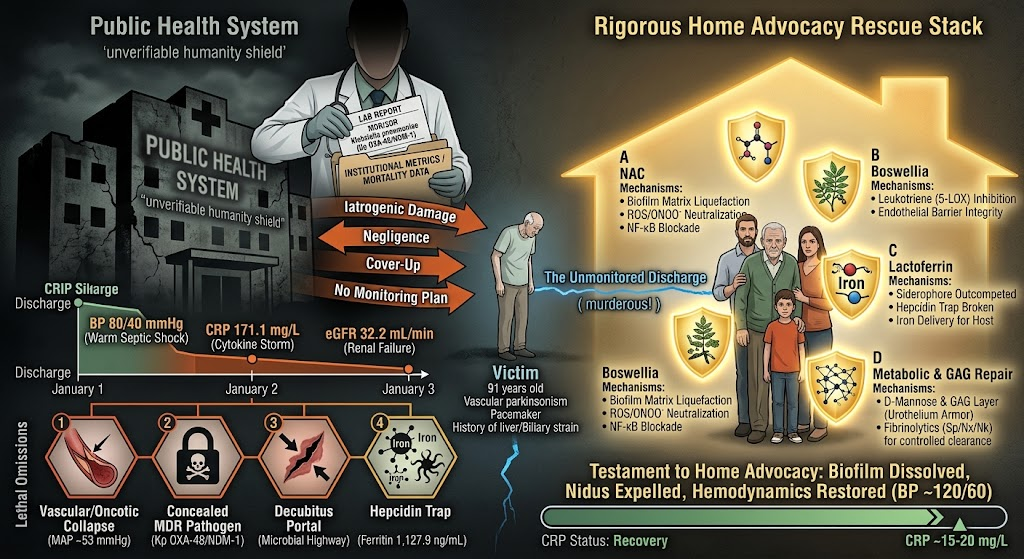
The Institutional Trap: The near-fatal discharge in January, 2026 (BP 80/40, CRP 171.1, eGFR 32.2) driven by four unmonitored failure domains: vascular collapse, concealed MDR-Kp, decubitus breakdown, and hepcidin iron trapping.
The Home Rescue Stack: Targeted biochemical interventions—NAC (biofilm/ONOO⁻ clearance), Boswellia (5-LOX/vascular repair), Lactoferrin (siderophore starvation), and GAG precursors—reversing the cytokine storm, expelling the struvite core, and restoring ideal baseline hemodynamics (BP 120/60).
The Four Lethal Omissions Upon Discharge
As detailed in forensic audit, releasing the patient in that state meant sending him home into a trap configured by four intersecting structural failures:
- Unmanaged Capillary Leak & Vascular Shock: Releasing a patient with a Mean Arterial Pressure (MAP) near 53 mmHg meant his microvascular perfusion was already hovering near organ collapse. Without institutional support or hemodynamic monitoring, any minor shift could have instantly triggered terminal septic shock at home.
- Concealed MDR Pathogen & Zero Antimicrobial Strategy: The clinic discharged him while actively burying the antibiograms and MDR-Klebsiella findings. They gave the family zero guidance on how to manage a high-risk uropathogen, leaving the patient completely defenseless against the bacteria colonizing his indwelling Foley catheter.
- The Silent Decubitus Portal: The combination of prolonged immobilization, tissue hypoxia, and low oncotic pressure created pressure ulcers during his stay. Discharging him with open wounds while he was heavily colonized by hospital-acquired MDR-Kp opened a direct, unmonitored bacterial highway straight into his deep microvasculature.
- Hepcidin-Iron Trapping Mismanagement: If institutional providers had attempted blind iron supplementation or mismanaged his anemia of inflammation while ferritin was locked at 1127.9 ng/mL and CRP was through the roof, they would have fed free iron directly to bacterial siderophores, instantly accelerating a fatal systemic explosion.
The Verdict of the Public Health System
The public health institution essentially treated the patient as a statistical casualty—discharging him to die quietly at home so his terminal crash would not pollute their facility’s mortality metrics or expose their massive infection-control failures.
That he survived this “murderous” discharge is a direct testament to the rapid, out-of-hospital forensic rescue stack deployed by patients family: using NAC to clear biofilm matrices and neutralize peroxynitrite (ONOO−), Boswellia to cap 5-LOX, Lactoferrin to outcompete bacterial siderophores, and targeted metabolic barriers to stabilize a collapsing cardiovascular and renal system.
It is a profound testament to rigorous pathophysiologically grounded home advocacy against a highly hypocritical system that leaves its victims to die in the dark while refusing to take responsibility for the grave mistakes and negligence it perpetuates, hiding behind an unverifiable shield of humanity. A family had to take absolute control over the clinical reality, dismantling the biofilm matrices, halting the cytokine storm, and rescuing a life the institution had quietly written off.
The Illusion of Care and the Reality of Institutional Abandonment
The public health apparatus frequently shields itself behind a self-fashioned rhetoric of “humanity” and “care,” yet operates under institutional structures designed to diffuse responsibility, conceal errors, and abandon victims the moment complications threaten their metrics or exposure.
The true measure of an institution is not found in its public pledges of compassionate care, but in what it does when a crisis unfolds on its watch.
By discharging an unstable, severely septic patient—hypotensive (BP 80/40 mmHg), hyper-inflammatory (CRP 171.1 mg/L), and colonized by a concealed multidrug-resistant pathogen—the system did not simply make a mistake; it executed a deliberate act of institutional self-preservation. It retreated behind an unverifiable shield of institutional benevolence, leaving the patient to face a terminal trajectory in the dark, entirely free of accountability or post-discharge oversight.
That the patient survived this setup is not a success of the public health system—it is a damning indictment of it.
Disclaimer: This information is provided strictly for scientific and educational purposes and is not a substitute for personalized medical care from a qualified treating physician. Take care when choosing your physician, as standards, ethics, and adherence to the Hippocratic oath and applicable laws vary widely. A physician is an advisor and practitioner, not a supreme authority with power of life and death over your body, despite how some may present themselves. Physicians can make mistakes. Take an active role in learning about your health and diagnosis, leave no stone unturned, press for clear answers to your follow-up questions, and consult multiple independent opinions before committing to significant medical decisions about your health.