
Executive Summary
During the 26-day hospitalization (December, 2025 – January, 2026), the Stradiyan patient did not merely suffer a localized infection; he survived a compounding, multi-systemic convergence of vascular collapse, tissue necrosis, metabolic depletion, and barrier loss. Institutional neglect, characterized by unmonitored catheterization, failure to act on antibiograms, and deliberate omission of multidrug-resistant (MDR) Klebsiella pneumoniae findings, allowed an unchecked inflammatory cascade to bring the patient to the brink of fatal organ failure.
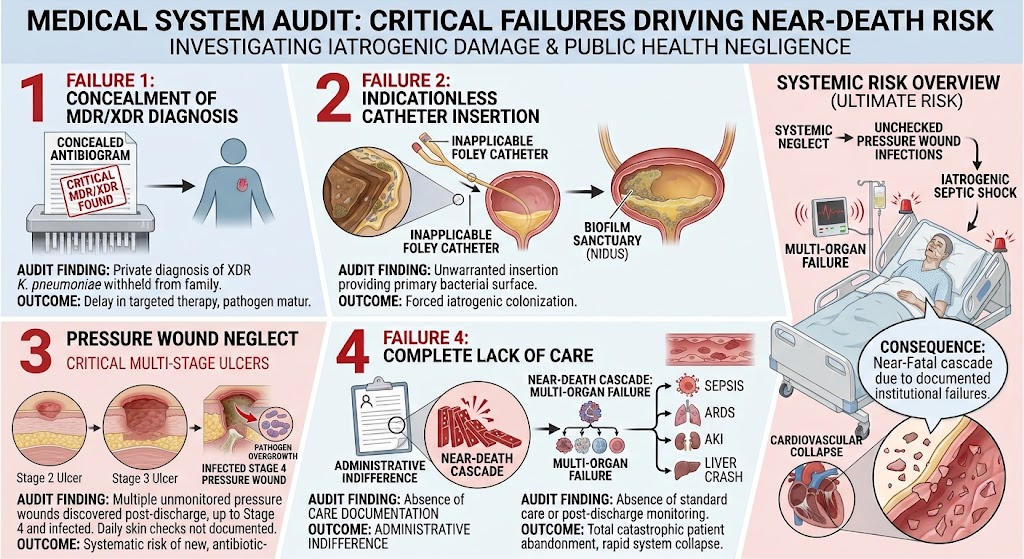
The following forensic audit details the four most critical failure domains where the odds were stacked against the patient, and how rapid, targeted, out-of-hospital protocols executed under limited resources halted an otherwise lethal trajectory.
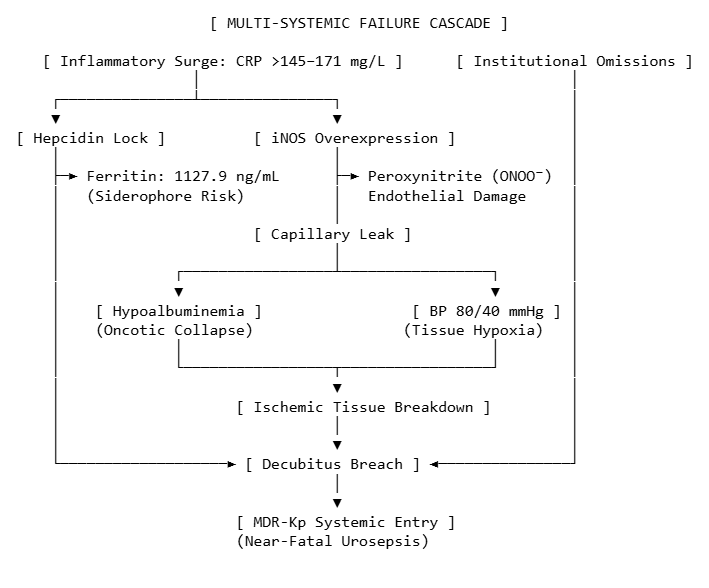
Domain 1: Cytokine Storm, iNOS Overexpression, and Vascular Collapse
- The Pathophysiological Threat & Clinical Failure: Driven by an unchecked MDR-Klebsiella infection, massive pro-inflammatory cytokines (IL-6, TNF-α) pushed C-reactive protein, peaking at 171.1 mg/L by January 1. This level of systemic inflammation activated inducible Nitric Oxide Synthase (iNOS) across the vascular endothelium. iNOS generated excessive, uncontrolled nitric oxide (NO), which combined with superoxide (O2−) to produce peroxynitrite (ONOO−)—a toxic, highly reactive oxidant that degrades endothelial tight junctions and causes severe vascular permeability.
- Why It Was Near-Fatal: Peroxynitrite-mediated endothelial damage destroyed capillary barrier integrity, causing systemic fluid shifts and severe hypotensive shock (BP 80/40 mmHg, Mean Arterial Pressure ≈53 mmHg). At an MAP of 53 mmHg, organ perfusion pressure collapses, placing the kidneys (acute tubular necrosis) and liver under critical ischemic hypoperfusion. Without intervention, this leads directly to refractory warm shock and multi-organ failure.
- Institutional Failure: Hospital staff failed to monitor inflammatory trajectories, failed to adjust antimicrobial coverage to targeted sensitivities, and left an escalating iNOS cascade completely unaddressed, mistaking systemic endotoxemia for standard post-admission lethargy.
- The Escape: Understanding that the hypotension was driven by ROS-mediated NF-κB transactivation and peroxynitrite generation, an out-of-hospital protocol was immediately deployed: high-dose N-Acetylcysteine (NAC) was administered to directly neutralize ONOO− and replenish glutathione (GSH), paired with Boswellic Acids (5-LOX inhibition) and B-complex vitamins. This combination shut down NF-κB signaling, lowered IL-6, restored vascular tone, and protected microvascular organ beds while bringing CRP down toward 15 mg/L.
Domain 2: Hypoalbuminemia and Deep Protein-Mineral Depletion
- The Pathophysiological Threat & Clinical Failure: As the cytokine storm eroded vascular barriers, the patient suffered acute hypoalbuminemia and profound trace mineral depletion—a hallmark of hyper-catabolic illness and hyper-permeable capillary leakage. Serum albumin levels collapsed, eliminating the primary driver of intravascular oncotic pressure.
- Why It Was Near-Fatal: The loss of plasma oncotic pressure caused rapid third-spacing of fluid into the interstitium, worsening circulating hypovolemia and tissue edema. Without adequate circulating albumin to bind endogenous molecules, maintain osmotic balance, and transport vital trace minerals (zinc, calcium, magnesium), cellular repair halted, immunoglobulin synthesis failed, and the patient entered a state of systemic metabolic exhaustion.
- Institutional Failure: Institutional care dismissed the precipitous drop in serum protein as a minor, expected outcome of “poor appetite” or hospital stay, failing to recognize acute capillary leak syndrome and making no effort to provide targeted metabolic or oncotic support.
- The Escape: Recognizing that hypoalbuminemia was a structural and oncotic crisis rather than a simple feeding issue, the management strategy shifted toward halting capillary permeability via iNOS/cytokine suppression (NAC/Boswellia) while providing targeted, easily assimilable amino acid building blocks and mineral support. Stabilizing the endothelial barrier stopped the systemic loss of albumin into third spaces, allowing serum oncotic pressure and cellular repair pathways to recover.
Domain 3: Ischemic Cutaneous Breakdown: The Decubitus Portal
- The Pathophysiological Threat & Clinical Failure: The combination of prolonged immobilization, systemic hypotension (BP 80/40 mmHg), tissue hypoxia, and low oncotic pressure induced rapid localized tissue ischemia, culminating in severe decubitus ulcer formation.
- Why It Was Near-Fatal: In a patient colonized by multidrug-resistant Klebsiella pneumoniae, a decubitus ulcer is not a localized skin wound; it is an open, unshielded portal directly into the deep subcutaneous microvasculature. Exposed to an environment teeming with hospital-acquired MDR pathogens, necrotic tissue acts as a superinfection site, creating a direct pathway for secondary bacteremia, soft-tissue destruction, and lethal polymicrobial sepsis.
- Institutional Failure: The facility neglected fundamental pressure-injury prevention, failed to manage tissue perfusion, and concealed underlying MDR-Kp colonization in hospital discharge documentation, sending an unstable patient home with an unmonitored, highly vulnerable barrier breach.
- The Escape: Immediate post-discharge action focused on rigorous, non-institutional wound management paired with systemic pathogen containment: local barrier restoration was combined with internal biofilm liquefaction (NAC) and strict oral sorbent protocols (activated charcoal/bentonite) to eliminate circulating endotoxin pressure, preventing secondary bacterial seeding into the open microvasculature until the cutaneous layer healed.
Domain 4: Dysregulated Iron Dynamics: The Hepcidin Lock vs. Pathogen Virulence
- The Pathophysiological Threat & Clinical Failure: In response to severe systemic inflammation (CRP>40 mg/L), the liver produced massive quantities of hepcidin. Hepcidin bound, internalized, and degraded ferroportin channels, locking host iron stores inside cellular ferritin vaults (evidenced by a massive ferritin spike to 1,127.9 ng/mL).
- Why It Was Near-Fatal: While hepcidin elevation is an evolutionary mechanism to starve invading bacteria, standard clinical practice often misinterprets the accompanying low serum iron as iron-deficiency anemia. Administering exogenous iron during high CRP (>40 mg/L) does not fix anemia because ferroportin is blocked; instead, unbound plasma iron is rapidly captured by K. pneumoniae, Proteus, and Pseudomonas via high-affinity siderophores (enterobactin, yersiniabactin), directly accelerating bacterial growth, virulence, and biofilm expansion.
- Institutional Failure: Hospital providers failed to understand the pathophysiology of anemia of inflammation, failing to monitor ferritin/hepcidin dynamics while maintaining a high-risk environment where unmonitored iron administration or uncontained siderophore activity could trigger hyper-virulent urosepsis.
- The Escape: Rather than misstep into iron supplementation, the protocol strategically deployed exogenous Lactoferrin (Lf) as a physiological “iron chaperone”. Lactoferrin bound free circulating iron with an affinity 200 times higher than transferrin, outcompeting bacterial siderophores to starve K. pneumoniae while safely delivering essential iron to host tissues without triggering bacterial proliferation.
Forensic Audit Summary Table
| Failure Domain | Key Markers / State | Primary Mechanism | Near-Fatal Risk | Institutional Failure | Resource-Limited Out-of-Hospital Response |
|---|---|---|---|---|---|
| 1. Vascular Collapse | CRP>145 mg/L, BP 80/40 mmHg | iNOS overactivation → ONOO− generation | Warm septic shock, organ hypoperfusion, acute renal/hepatic failure | Ignored cytokine trajectories and vascular collapse | High-dose NAC + Boswellia to scavenge ONOO− & downregulate NF-κB |
| 2. Oncotic Collapse | Severe Hypoalbuminemia & Mineral Depletion | Capillary leak syndrome & hyper-catabolism | Interstitial third-spacing, immunodeficiency, metabolic failure | Dismissed as “poor appetite” | Endothelial barrier stabilization + targeted amino acid/mineral support |
| 3. Barrier Breach | Decubitus Ulcer Formation | Tissue ischemia from MAP <55 mmHg + pressure | Unshielded portal for MDR-Kp entry into microvasculature | Omitted pressure care & concealed MDR status | Aggressive local barrier care + systemic endotoxin binding (sorbents) |
| 4. Iron Dysregulation | Ferritin: 1,127.9 ng/mL, CRP>40 mg/L | Hepcidin degradation of ferroportin channels | Siderophore-driven hyper-virulence & biofilm expansion | Misunderstood anemia of inflammation dynamics | Strategic Lactoferrin chaperoning to outcompete bacterial siderophores |
The Stradiyan patient survived a critical trajectory where the clinical prognostic odds were overwhelmingly hostile against him. The institutional failure went beyond passive negligence, manifesting as a sequence of unmonitored catheterization, ignored inflammatory surges, mismanaged iron dynamics, and the premature discharge while he was hemodynamically unstable. Survival was secured exclusively through immediate, targeted biochemical interventions administered outside the failing public healthcare framework—employing NAC, Boswellia, Lactoferrin, and sorbents to halt systemic breakdown, protect microvascular perfusion, restore mucosal barriers, and precipitously lower CRP levels. This successfully converted a life-threatening, acute Klebsiella pneumoniae crisis into a stable chronic baseline with daily biomarker improvement, buying vital time to formulate a definitive, multi-level pathogen eradication strategy—more advanced from anything the Stradiyan public health system could offer. In truth, the system’s previous trajectory offered only one certain outcome to the Stradiyan patient: death.
Disclaimer: This information is provided strictly for scientific and educational purposes and is not a substitute for personalized medical care from a qualified treating physician. Take care when choosing your physician, as standards, ethics, and adherence to the Hippocratic oath and applicable laws vary widely. A physician is an advisor and practitioner, not a supreme authority with power of life and death over your body, despite how some may present themselves. Physicians can make mistakes. Take an active role in learning about your health and diagnosis, leave no stone unturned, press for clear answers to your follow-up questions, and consult multiple independent opinions before committing to significant medical decisions about your health.