
When a complex patient develops severe pressure wounds (decubitus ulcers) during clinical care, standard medical consensus points to a single culprit: mechanical pressure. The prevailing narrative assumes that prolonged bed rest is solely responsible for skin breakdown.
However, clinical reality tells a far more intricate—and frustrating—story.
When tissue integrity collapses, physical pressure is merely the final trigger. Beneath the surface lies a systemic storm driven by nosocomial multi-drug resistant (MDR) infections, acute inflammatory cascades, and severe biochemical depletion induced by careless hospital protocols.
Here is an analysis of how hospital-acquired pathogens like Klebsiella pneumoniae, elevated systemic inflammation (CRP), uncompensated IV diuresis, and nutritional neglect cripple wound healing—and how targeted biochemical replenishment can reverse rapid tissue necrosis.
1. The Pathogen Factor: Klebsiella pneumoniae as a Metabolic Thief
Hospital-acquired multi-drug resistant (MDR) bacteria, such as Klebsiella pneumoniae, do not merely cause localized or respiratory distress; they fundamentally alter systemic metabolism.
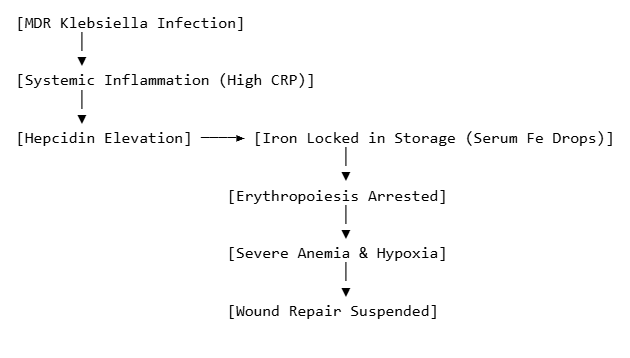
When an MDR strain infects a vulnerable, post-surgical patient, the immune system responds with an intense inflammatory surge, driving C-reactive protein (CRP) to extreme heights. In this hyper-inflammatory state, the liver unleashes hepcidin, the body’s master iron-regulatory hormone.
Hepcidin binds to and degrades ferroportin, effectively locking serum iron into intracellular storage to “starve” the invading bacteria. However, this physiological defense mechanism creates severe collateral damage:
- Arrested Erythropoiesis: Without circulating serum iron, the bone marrow cannot produce new erythrocytes (red blood cells).
- Tissue Hypoxia: Hemoglobin levels plummet, creating profound systemic anemia.
- Impaired Healing: Tissues surrounding a wound become severely hypoxic. Without adequate oxygen delivery, cellular energy production (ATP) halts, collagen cross-linking fails, and structural tissue repair becomes biochemically impossible.
Until systemic inflammation drops (typically below CRP<40 mg/L), iron remains trapped, red blood cell synthesis stays locked, and tissue regeneration remains completely suspended.
2. The Iatrogenic Flush: Biochemical Depletion via Unmanaged Diuresis
While active infections hijack iron metabolism, routine hospital interventions can inadvertently destabilize a patient’s core biochemistry.
A catastrophic contributor to rapid skin and dermal breakdown is the aggressive administration of intravenous (IV) fluids or diuretics without adequate electrolyte, protein, and mineral monitoring:
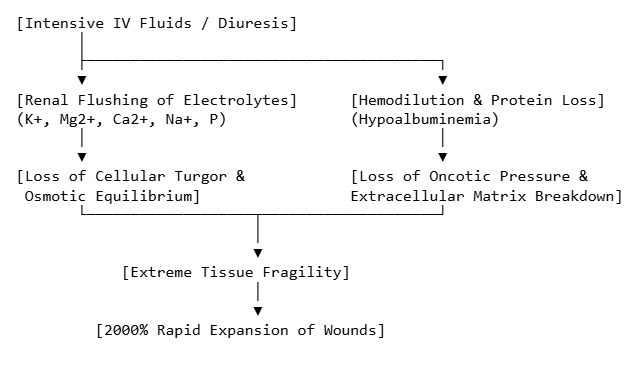
- Electrolyte Stripping: Unmonitored fluid administration flushes critical minerals through the kidneys, rapidly depleting serum Potassium (K+), Magnesium (Mg2+), Calcium (Ca2+), Sodium (Na+), and Phosphorus (P). Drops in potassium to critical levels (e.g., severe hypokalemia <2.5 mmol/L) pose catastrophic cardiac risks, particularly in patients with existing arrhythmias or pacemakers.
- Protein Dilution & Hypoalbuminemia: Intravenous overload without oral or parenteral protein supplementation dilutes serum albumin and total proteins. Albumin maintains oncotic pressure and transports key nutrients. When albumin levels collapse, fluid leaks into the interstitial space, dermal elasticity vanishes, and the structural integrity of the extracellular matrix (ECM) dissolves.
Under these conditions, the skin loses its natural elasticity and structural resilience. Tissues become so exceedingly brittle that minor friction or slight pressure—which would normally be harmless—causes skin sheets to tear, expand, and ulcerate rapidly. In documented clinical observations, this biochemical failure has caused existing Category 2 pressure wounds to expand by 2000% (20-fold) in as few as 10 days.
3. Reversing the Collapse: The Targeted Nutritional Reconstruction Protocol
When standard institutional care drops the ball by treating wounds with superficial dressings while ignoring the underlying biochemical collapse, systemic intervention becomes imperative. Reversing deep decubitus ulceration requires feeding the cellular machinery the exact structural substrates it needs to rebuild tissue from the inside out.
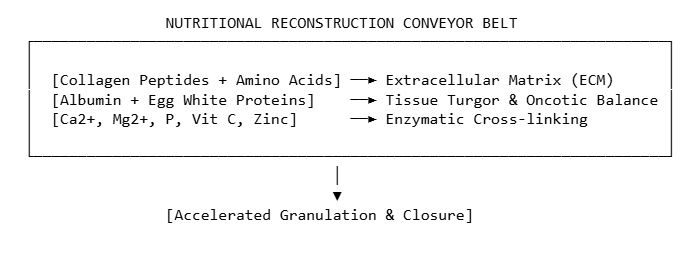
Key Nutritional Pillars for Accelerated Tissue Repair:
- High-Density Structural Amino Acids & Collagen Peptides: Supplying concentrated collagen hydrolysates along with targeted amino acids (L-Proline, L-Glycine, L-Lysine, L-Glutamine) provides immediate substrates for fibroblasts to synthesize new Type I and III collagen fibers, re-establishing the dermal scaffolding.
- Albumin & Complete Protein Replenishment: Utilizing concentrated protein sources (such as bioavailable egg white peptides and targeted amino acid complexes) restores circulating serum albumin. This restores oncotic pressure, reduces localized edema, and delivers vital transport proteins directly to the wound bed.
- Essential Mineral & Electrolyte Co-Factors: Re-establishing physiological levels of Calcium, Magnesium, Phosphorus, and Potassium restores osmotic equilibrium and activates the key enzymatic co-factors required for cross-linking collagen strands and forming stable granulation tissue.
- Biophysical Circulation & Localized Topical Support: Combining systemic nutritional reconstruction with bio-physical support—such as TDP Far-Infrared (FIR) thermal therapy to induce localized vasodilation and boost microvascular blood flow—accelerates nutrient delivery to hypoxic tissue beds. When paired with nutrient-rich topical balms containing natural anti-inflammatory, antimicrobial, and barrier-restoring compounds (such as propolis, panthenol, and curcumin), clean wound closure rates can reach up to 25% per day, fully resolving recalcitrant wounds in a fraction of the expected timeframe.
The Takeaway
Pressure wounds are not simply localized “skin problems” caused by sitting or lying down for too long. They are external manifestations of systemic biochemical failure, institutional nutritional neglect, unmonitored drug/IV side effects, and unaddressed hospital-acquired infections.
By moving beyond passive wound dressings and addressing the true root causes—stopping pathogen-induced iron lock-down, correcting electrolyte and protein depletion, and supplying high-density nutritional building blocks—it is possible to stimulate rapid, complete tissue recovery even in the most complex and compromised patients.