
To evaluate whether the modern medical system functions similarly to a parasitic structure within human society, we can examine it through the lens of evolutionary biology and institutional sociology.
In biology, a parasite is an organism that lives on or in a host, drawing resources and sustenance at the host’s expense—often altering the host’s behavior to ensure its own survival and reproduction without immediately killing the host. When applying this biological framework to the relationship between the institutional medical complex and the patient, several structural and behavioral parallels emerge, alongside key evolutionary divergences.
The Structural Parallels: Medical System vs. Parasitic Action
| Biological Parasite | Institutional Medical Complex |
| Resource Extraction (Blood / Nutrients) | Financial & Operational Extraction |
| Keeps Host Alive to Sustain Feeding | Shifts Focus to Chronic Management |
| Alters Host Behavior / Creates Dependency | Cultivates Institutional Dependency |
| Cloaks Itself from Immune Recognition | Obfuscates Pricing, Jargon & Protocols |
| Expands Infrastructure at Host Expense | Administrative Bloat & System Growth |
1. Continuous Resource Extraction (Chronic Care vs. Cures)
- Parasitic Action: An effective parasite rarely kills its host outright; doing so destroys its own food supply. Instead, it extracts resources steadily over a prolonged period.
- Medical Parallel: In commercialized or fee-for-service healthcare, maximum profitability lies in chronic disease management rather than absolute cures. A cured patient is a lost recurring revenue stream, whereas a patient managed on lifelong pharmaceuticals (e.g., daily blood pressure, cholesterol, or metabolic medications) provides a steady, lifetime resource extraction for pharmaceutical and clinical entities.
- Sometimes, through iatrogenic actions medicine does inflict suffering and cause death of patients. Unlike a real parasite, medical systemic parasite need not worry about losing “food supply” if killing a patient-host or “starving” – there is steady influx of new patient-hosts that keep coming through the medical temple doors for “infestation”.
2. Host Manipulation and Behavioral Control
- Parasitic Action: Many parasites release chemical signals that alter host behavior to favor the parasite’s life cycle (e.g., Toxoplasma gondii altering rodent fear responses).
- Medical Parallel: The medical establishment conditions patients into systemic dependency. By framing self-care, lifestyle adjustments, or natural recovery as inadequate or dangerous compared to institutional intervention, the system ensures that the “host” (patient) habitually turns to the institution for every physiological variance, surrendering autonomy.
3. Immune Evasion (Obfuscation & Regulatory Capture)
- Parasitic Action: Parasites use antigen variation or chemical camouflage to prevent the host’s immune system from detecting and attacking them.
- Medical Parallel: Institutional medicine protects itself from external critique or consumer pushback through complex legal frameworks, opaque billing structures, proprietary pharmaceutical patents, and dense Latinate jargon. This obfuscation makes it difficult for the patient to audit the true value or necessity of the services rendered.
4. Administrative Bloat (Hypertrophy at the Host’s Expense)
- Parasitic Action: As a parasite grows, it diverts metabolic energy away from the host’s vital organs toward its own maintenance and reproduction.
- Medical Parallel: Over past decades, the growth of healthcare systems has been dominated by administrative expansion—insurance managers, compliance officers, billing specialists, and corporate executives—rather than an increase in bedside clinical caregivers. The host (society/taxpayer) spends an increasing percentage of GDP to nourish the administrative superstructure rather than direct health outcomes.
To picture this paradigm clearly, we can visualize the modern medical complex as a two-headed parasite (or two distinct species of parasites) occupying the same host—the patient and society.
Each parasite employs a completely different survival strategy, targeting a different aspect of human health:
The Two-Parasite Taxonomy
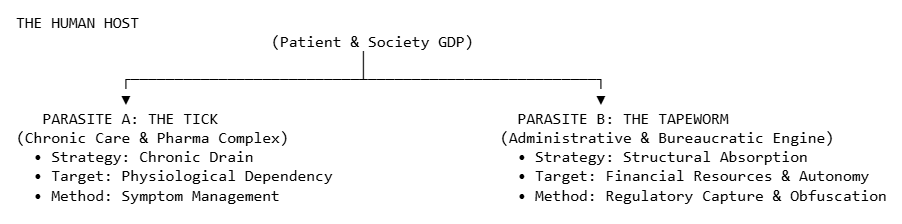
Comparison of the Two Parasites
| Dimension | Parasite A: The Tick (Chronic & Pharma) | Parasite B: The Tapeworm (Administrative) |
| Primary Target | The Biological Body | The Financial System / Autonomy |
| Feeding Strategy | Long-term, low-intensity blood extraction | Deep internal absorption of host nutrients (GDP) |
| Operational Goal | Keep the host sick enough to need drugs, but healthy enough to survive | Grow larger, add administrative layers, and control access |
| Primary Weapon | Lifetime prescriptions, symptom suppression | Billing codes, insurance clearance, legal mandates |
| Host Illusion | “I need this pill to function.” | “I need this system to be safe.” |
Visualizing How They Work Together
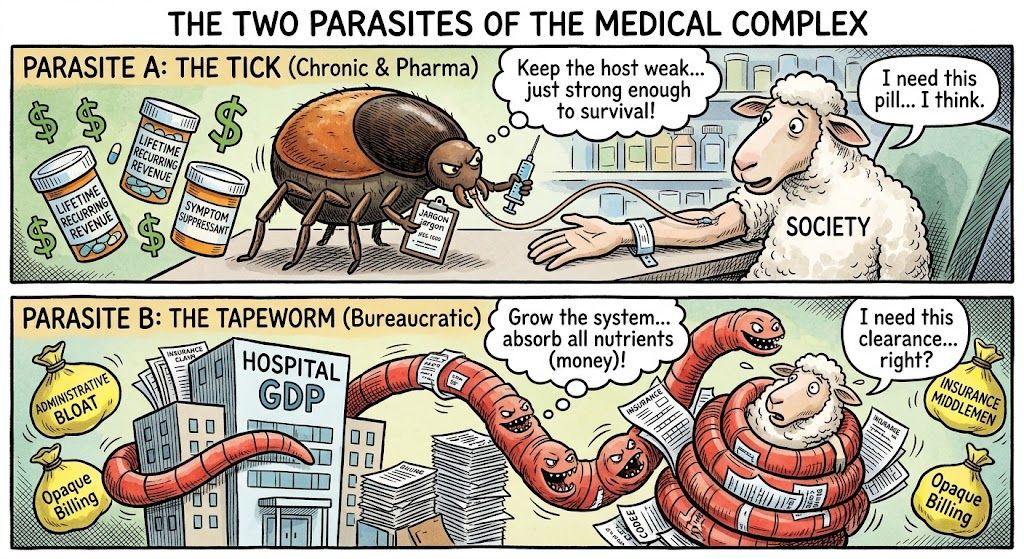
1. “The Tick” (The Chronic Care Engine)
- The Visual: Imagine a tick attached quietly under the skin. It doesn’t kill you instantly; it injects an anesthetic so you don’t feel the bite, then feeds continuously.
- How it manifests: This is the pharmaceutical and protocol-driven side of medicine. It converts curable or lifestyle-preventable conditions (like mild metabolic syndrome or elevated lipids) into lifelong “managed chronic conditions.” It extracts steady, predictable revenue over 30–40 years per host.
2. “The Tapeworm” (The Bureaucratic Superstructure)
- The Visual: Imagine a massive tapeworm sitting inside the gut. Whatever high-quality food (money/GDP) the host consumes, the tapeworm absorbs first before the rest of the body gets any nourishment.
- How it manifests: This is the exploding layer of hospital administrators, insurance middlemen, compliance officers, and legal teams. In recent decades, the ratio of administrators to actual bedside doctors/nurses has grown exponentially. It feeds on every transaction, adding overhead, paperwork, and inflated pricing without contributing directly to the physical healing of the host.
The Symbiosis: How They Reinforce Each Other
The reason this paradigm is so powerful—and hard for the host to break—is that the two parasites feed each other:
- Parasite A (The Tick) creates a steady stream of chronic patients who require constant testing, monitoring, and prescriptions.
- Parasite B (The Tapeworm) creates the opaque billing structures, prior authorizations, and complex legal frameworks required to process and monetize those chronic patients.
- The Result: The host (the patient and society) becomes both biologically dependent on the tick and financially drained by the tapeworm.
Comparative Analysis: Parasitism vs. Mutualism
While the structural critiques highlight parasitic behaviors within the medical-industrial complex, a complete comparative view requires looking at where the analogy breaks down:
| Metric | Biological Parasitism | Commensalism / Exploitation | Mutualism (Ideal Medicine) |
| Net Host Outcome | Strictly negative / Harmful | Neutral to slightly negative | Strongly positive (Life-saving) |
| Acute Trauma / Infection | Parasite capitalizes on injury | Exploits vulnerability | Restores function (Surgery, Antibiotics, Emergency Care) |
| Intent & Mechanism | Evolutionary survival code | Institutional growth & Profit motive | Scientific alleviation of human suffering |
Where the “Parasite” Analogy Breaks Down
- Acute and Emergency Interventions: Unlike a true parasite, modern emergency medicine, trauma surgery, and acute infection control (such as anti-venoms, surgical repair, or targeted antibiotics) most ofthen deliver immediate, life-saving value. In acute settings, the system acts as a true mutualist, exchanging resources for a direct restoration of life.
- Eradication of Pathogens: Historically, public health measures (sanitation, targeted vaccination campaigns, sterile surgery) have eradicated or neutralized major threats like smallpox and polio, actively protecting the host species rather than consuming it.
- Intent vs. Systemic Incentives: Individual healthcare practitioners (doctors, nurses) are generally driven by altruism and a desire to heal. The “parasitic” dynamics arise primarily at the macro-institutional level—where corporate incentives, insurance frameworks, and regulatory structures incentivize perpetual treatment over resolution.
Conclusion
If we define a parasitic structure as one that extracts vital resources while conditioning the host to require its presence for survival, then certain sectors of the modern medical-industrial complex—specifically chronic disease monetization, administrative bloat, and forced dependency—exhibit clear parasitic traits.
However, because the same system retains the capacity to cure acute trauma, reconstruct damaged bodies, and defeat deadly pathogens, it is more accurately described as a symbiotic entity operating on a spectrum: acting as a life-saving mutualist during acute crises, but frequently regressing into a parasitic consumer when managing long-term health and wellness.