
In this article we are exploring the structural, sociological, and symbolic parallels between modern institutional medicine and historical religious orders.
For centuries, society looked to religious institutions for answers to life’s greatest mysteries: pain, suffering, mortality, and the care of the body and mind. In the modern era, scientific rationalism largely replaced organized religion as the ultimate authority on human well-being.
Yet, when examining the cultural architecture, rituals, and power dynamics of modern medicine, the structural resemblance to organized religion—and in some respects, dogmatic sects—is striking. While medicine rests on empirical science, the human-facing institution through which it is practiced frequently adopts the sociological frameworks of an ancient priesthood.
| Feature / Dimension | Historical Religious Priesthood | Modern Medical Institution |
|---|---|---|
| Initiation & Authority | Ordained through Seminary | Ordained through Medical School |
| Attire & Iconography | Sacred Robes & Vestments | White Lab Coats & Scrubs |
| Language & Texts | Unreadable Latin Texts / Scriptures | Unreadable Latinate Medical Jargon |
| Intervention & Remedy | Absolution through Sacraments | Remediation through Protocols |
| Orthodoxy & Discipline | Infallible Dogma / Excommunication | Standard of Care / Loss of License |
| Expected Patient/Lay Role | Requires Blind Faith in Mysteries | Requires Compliance with Advice |
1. Vestments, Uniforms, and Sacred Symbols
Just as religious orders use specific clothing to signal authority and divine sanction, modern medicine relies heavily on visual iconography:
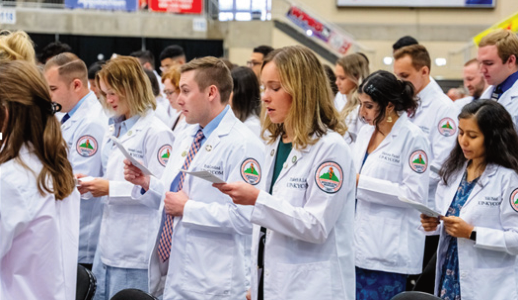
- The Vestments: The white lab coat operates as the modern equivalent of a priestly cassock—a visual marker of purity, authority, and separation from the lay public. Scrubs operate as the monastic tunic, signaling selfless devotion to duty.
- The Relics and Instruments: The stethoscope, worn around the neck, acts like an official cross or stole—an emblem of office that grants the wearer exclusive right to “listen” to hidden inner truths inaccessible to the uninitiated.
- Sacred Spaces: The hospital and clinic are constructed as sanctuaries. They are sterile, quiet, and governed by strict purity codes (hand-washing rituals, sterilization, restriction of lay access), mirroring the sacred/profane divisions of ancient temples.
2. Ordination, Hierarchies, and Sacraments
Becoming a doctor follows a strict, highly gated path reminiscent of monastic initiation:
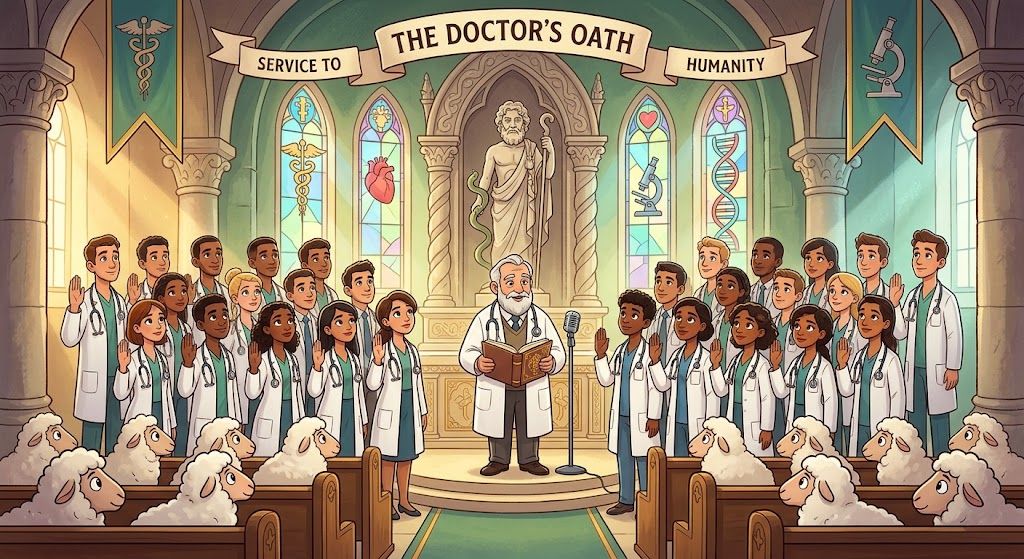
- Ordination: Medical school serves as the seminary, followed by the grueling, ascetic rite of passage known as residency—a period of sleep deprivation and complete submission to senior elders designed to break down the individual and forge an unflinching loyalty to the institution.
- The Licensing Vow: The Hippocratic Oath (or its modern variants) acts as the sacred vow, administered during a formal ceremony that marks the transition from layperson to “ordained” practitioner.
- Sacraments and Blessings: Clinical interventions often mirror sacraments—standardized rituals administered to restore grace (health). Prescriptions act as written indulgences, granting permission to access controlled substances held behind the “temple” pharmacy counter.
3. Latinate Language and Sacred Texts
Religion maintains authority in part through language inaccessible to the common public:
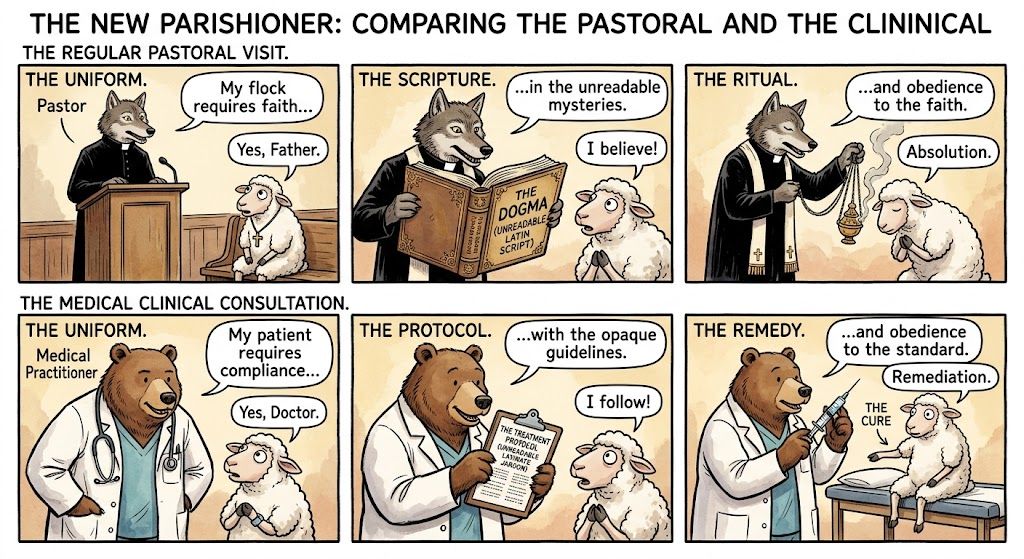
- Esoteric Jargon: Catholicism relied for centuries on Latin to keep scripture under the control of the clergy. Similarly, medicine uses complex Latinate and Greek terminology (“idiopathic,” “nosocomial,” “myocardial infarction”). A patient is told they have “idiopathic hypertension”—which literally translates to “high blood pressure of unknown cause”—yet the specialized phrasing transforms a lack of knowledge into authoritative Latinate diagnosis.
- Sacred Texts: The DSM, clinical practice guidelines, and pharmacological compendiums function as the canon. Deviating from these texts can be treated not merely as an alternative opinion, but as clinical heresy.
4. Dogma, Protocols, and “Blind Faith”
The relationship between practitioner and patient often relies on the dynamics of faith rather than shared empirical understanding:
- The Demand for Compliance: In medical literature, patients who do not follow instructions are explicitly labeled “non-compliant”—a term carrying a subtly moral, almost disobedient connotation.
- The Opaque Protocol: Doctors rarely walk patients through the raw statistical data, risk ratios, or mechanistic proofs behind a recommended treatment. Instead, patients are presented with a final recommendation: “Take this medication,” or “We need to do this procedure.” The patient is expected to yield to authority—to have faith in the doctor’s intent and the institution’s wisdom.
- Enforcing Orthodoxy: Practitioners who step outside the accepted “standard of care” or challenge established consensus face institutional excommunication—the revocation of hospital privileges, loss of board certification, or cancellation of their medical license.
The Critical Distinction: Science vs. Institutionalism
While these sociological parallels are pronounced, there is an essential distinction between the method of science and the institution of medicine:
| Feature | Religious Dogma | Institutional Medicine | Ideal Scientific Process |
| Source of Truth | Divine revelation / Sacred texts | Standardized consensus / Guidelines | Falsifiable empirical evidence |
| Handling of Dissent | Heresy / Excommunication | Institutional pushback / Revocation | Testing hypotheses against data |
| Patient/Lay Role | Faithful follower / Believer | Compliant recipient of care | Informed agent / Partner |
The tension modern patients experience often stems from this exact divide: science is an open, self-correcting process based on evidence, but medical care is delivered through large, bureaucratic institutions that naturally adopt the rigid, ritualized, and authoritarian structures of historical priesthoods to manage risk, exert authority, and maintain public compliance.
Is Medicine A Fundamentalist Religion?