
Why the “Librarian” Metaphor Fits Klebsiella Perfectly?
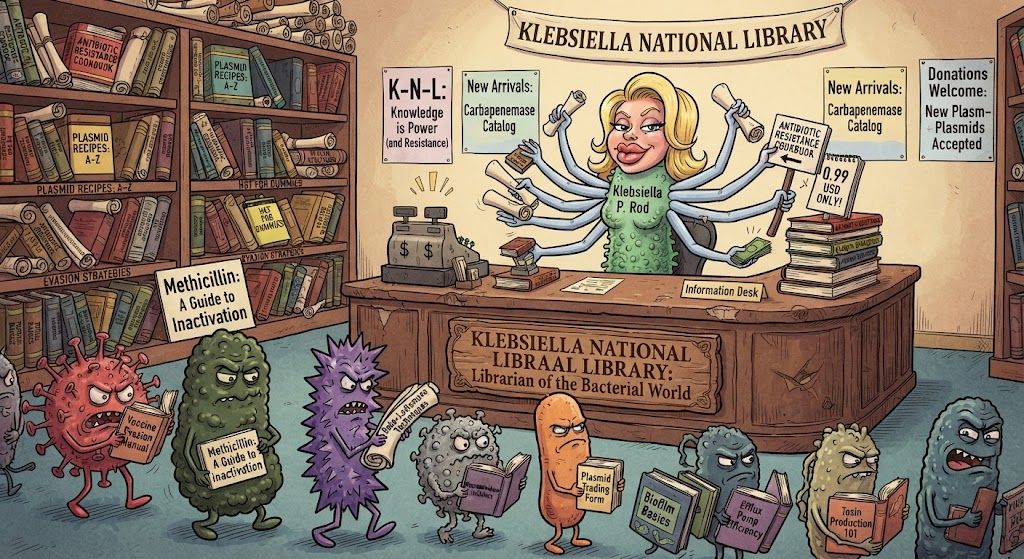
- The “Library” (Diverse Plasmid Diversity): Klebsiella pneumoniae is notorious for holding a vast array of extra-chromosomal plasmids. It tolerates multiple different plasmid incompatibility groups simultaneously, accumulating resistance mechanisms against β-lactams (like carbapenems via β-lactams (like blaKPC), aminoglycosides, quinolones, and colistin.
- The “Librarian” (Broad Conjugative Ability): Klebsiella is extremely promiscuous. It frequently initiates horizontal gene transfer (HGT)—primarily via bacterial conjugation—to share these plasmids with other Enterobacteriaceae (like E. coli, Enterobacter, and Salmonella). It acts as an amplifying bridge between environmental/commensal bacteria and dangerous clinical pathogens.
- High Permissiveness: Unlike some bacteria with strict restriction-modification systems that destroy foreign DNA, many K. pneumoniae strains have relaxed cellular defense barriers, allowing them to readily collect, store, and distribute new resistance plasmids.
Formal Scientific Terminology
In research literature, rather than a “librarian,” Klebsiella pneumoniae is formally classified as:
- An amplifier host and major reservoir for mobile genetic elements (MGEs).
- A key driver/vector of horizontal gene transfer across species barriers.
“Bacterial Sex”
“Bacterial sex” is the informal term for bacterial conjugation—a process where one bacterium transfers genetic material directly to another through physical contact.
Unlike sexual reproduction in animals or plants, bacterial sex does not produce new offspring and is not required for reproduction. Bacteria reproduce asexually by binary fission (splitting in two). Conjugation is strictly a mechanism for swapping genetic information—a primary driver of Horizontal Gene Transfer (HGT).
How Conjugation Works?
- The Donor (
F⁺Cell): The donor bacterium possesses a specific piece of DNA called a Fertility factor (F plasmid), which contains the genes required to build a bridge. - Pilus Formation: The donor extends a specialized, hair-like appendage called a sex pilus to latch onto a recipient cell (
F⁻) lacking the plasmid. - Mating Bridge: The pilus retracts, bringing the two bacterial cell walls close together to form a stable physical junction (mating bridge).
- DNA Transfer: The donor nicks one strand of its circular plasmid DNA and passes that single strand across the bridge into the recipient.
- Synthesis: Both cells synthesize a complementary strand to replace the single strand, converting both bacteria into
F⁺donor cells capable of transferring DNA to others.
Why It Matters Medically?
While bacteria can transfer a variety of metabolic traits via conjugation, its most critical impact on human health is the rapid spread of antibiotic resistance.
Mobile genetic elements like conjugative plasmids often carry multi-drug resistance genes (such as extended-spectrum β-lactamases like blaKPC or blaNDM-1). Conjugation allows these resistance traits to spread horizontally across different bacterial strains and species (e.g., from Klebsiella or Enterobacter to E. coli) within hours inside a patient or environmental reservoir, rendering frontline antibiotics ineffective without requiring the bacteria to reproduce first.
3 Main Types Of Horizontal Gene Transfer In Bacteria: Conjugation, Transformation, And Transduction
Horizontal Gene Transfer (HGT) is the movement of genetic material between unicellular or multicellular organisms other than by the vertical transmission of DNA from parent to offspring. In bacteria, HGT allows rapid adaptation by allowing strains to share metabolic capabilities, virulence factors, and antibiotic resistance mechanisms.
The three primary mechanisms of horizontal gene transfer in bacteria are Conjugation, Transformation, and Transduction.
| Feature | Conjugation | Transformation | Transduction |
| Mechanism | Direct cell-to-cell contact via a sex pilus/mating bridge | Uptake of naked DNA directly from the surrounding environment | Virus-mediated transfer via a bacteriophage |
| Physical Contact Needed? | Yes (Donor and Recipient must connect) | No | No |
| DNA Source | Live donor cell | Extracellular/dead/lysed donor cell | Lysed donor cell via viral capsid package |
| Key Bacterial Components | F–plasmid (Fertility factor), Sex Pilus, Type IV Secretion System | Competence factors (Com proteins), cell wall receptors | Bacteriophages (phages), viral packaging machinery |
| DNA Types Transferred | Plasmids, Conjugative Transposons, integrative elements | Short linear DNA fragments or small intact plasmids | Chromosomal DNA fragments or plasmid DNA |
| DNA Nuclease Sensitivity | Resistant (DNA is protected inside the bridge) | Sensitive to extracellular DNase enzymes | Resistant (DNA is protected inside the viral capsid) |
1. Conjugation (“Bacterial Sex”)
Conjugation is the direct transfer of genetic material between two bacterial cells in physical contact.
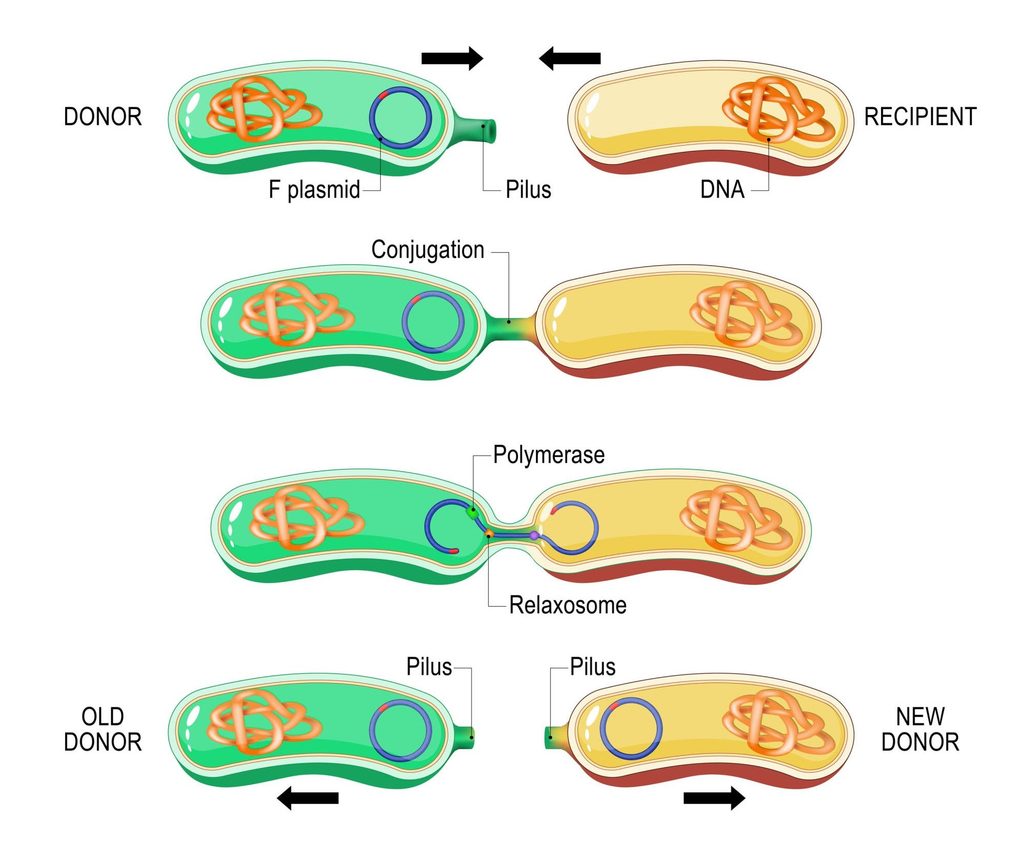
- Process: A donor cell (F+ or fertility positive) extends a hair-like appendage called a sex pilus that attaches to a recipient cell (F–). The pilus retracts, pulling the two cells close together to form a mating bridge. The donor cell nicks one strand of its plasmid DNA and transfers a single strand through the bridge into the recipient. Both cells then synthesize a complementary strand, making both cells F+ donors.
- Significance: It is the primary route for the rapid, widespread dissemination of multidrug-resistance plasmids across species barriers (such as within Enterobacteriaceae).
2. Transformation
Transformation is the direct uptake, incorporation, and expression of exogenous “naked” DNA from the extracellular environment.
- Process: When bacteria lyse (die and break open), their genomic DNA and plasmids spill into the surroundings. A recipient bacterium must be in a physiological state called natural competence to bind and import this free DNA across its cell membrane using specific surface proteins. Once inside, the single-stranded DNA segment is integrated into the host genome via homologous recombination or maintained as an autonomous plasmid.
- Examples of Competent Bacteria: Streptococcus pneumoniae, Neisseria gonorrhoeae, Haemophilus influenzae, and Bacillus subtilis.
- Lab Context: In biotechnology, non-competent bacteria like E. coli are rendered “artificially competent” using chemical treatments (e.g., calcium chloride) or electroporation (high-voltage electrical pulses) to introduce recombinant plasmids.
3. Transduction
Transduction occurs when bacterial DNA is accidentally packaged into a bacteriophage (a virus that infects bacteria) and delivered into a new recipient bacterium during a subsequent infection cycle.
Transduction proceeds through two main pathways:
Generalized Transduction
- Mechanism: Occurs during the lytic cycle of a virulent phage. As the virus replicates inside the host bacterium, it hydrolyzes the host’s chromosome into random pieces. During viral assembly, the phage packaging machinery accidentally packages a fragment of host bacterial chromosomal DNA instead of the viral genome, creating a “pseudovirion.”
- Outcome: When this pseudovirion infects a new cell, it injects bacterial DNA from the donor instead of viral DNA, allowing integration via homologous recombination. Any random piece of the donor genome can be transferred this way.
Specialized Transduction
- Mechanism: Occurs during the transition from the lysogenic cycle to the lytic cycle by a temperate phage (e.g., Lambda phage in E. coli). The viral genome integrates into a specific location on the host chromosome as a prophage. Upon induction, the prophage excises itself from the bacterial genome. If excision is imprecise, adjacent host chromosomal genes flanking the prophage site are cut out along with the viral DNA.
- Outcome: All progeny viruses carry a hybrid loop of viral and specific host DNA. When they infect new cells, they transfer only specific bacterial genes adjacent to the viral integration site.