
In our journey through Ivan Illich’s 1975 masterpiece, Medical Nemesis: The Expropriation of Health, we have traced how modern medicine metastasizes into a source of harm. We examined clinical iatrogenesis—the physical damage caused by endless antibiotic monotherapies that strip host mucosal defenses—and social iatrogenesis—the diagnostic gatekeeping that erases patient reality behind “negative” urine cultures and bureaucratic labels like Interstitial Cystitis.
Now, we arrive at the foundational floor of Illich’s critique: Structural (or Cultural) Iatrogenesis.
While clinical iatrogenesis harms the physical body and social iatrogenesis invalidates the patient’s voice, structural iatrogenesis inflicts the deepest damage of all: it paralyzes the human capacity to understand, cope with, and take responsibility for one’s own body.
For caregivers, patient advocates, and individuals battling deep-seated, multi-drug resistant (MDR) uropathogens like Klebsiella pneumoniae, structural iatrogenesis is the invisible cage that keeps people trapped in cycles of chronic illness.
What is Structural Iatrogenesis?
Illich defined structural iatrogenesis as the ultimate stage of medicalization, wherein the industrial medical complex commodifies health to such an extent that individuals lose the cultural, practical, and intellectual tools required to care for themselves.
When a society succumbs to structural iatrogenesis:
- Pain, suffering, and biological imbalance are no longer viewed as natural signals requiring deep ecological understanding, but as technical malfunctions requiring elite, institutional intervention.
- The individual surrenders their internal locus of control, believing that only a credentialed authority armed with a prescription pad possesses the right or ability to influence health outcomes.
- Self-education and independent biological inquiry are branded as dangerous, foolish, or arrogant (“don’t confuse your Google search with my medical degree”).
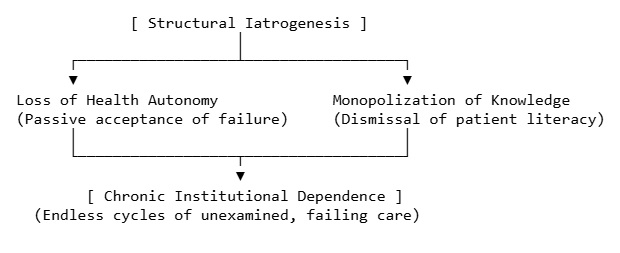
In the context of chronic infection, structural iatrogenesis creates a dangerous learned helplessness. Patients are conditioned to wait passively for the next specialist appointment or the next generation of antibiotics, even as their baseline tissue integrity and microbiome crumble around them.
The Expropriation of Biological Autonomy in Chronic Infection
When dealing with a pathogen like Klebsiella pneumoniae, structural iatrogenesis is particularly deadly because Klebsiella does not play by simple rules.
As we highlight across Hotel Klebsiella, Klebsiella constructs intricate “hospitality suites”—Intracellular Bacterial Communities (IBCs), quiescent tissue reservoirs, and thick exopolysaccharide matrices that shield whole polymicrobial communities from systemic antibiotics. Clearing such an infection requires a multi-axis strategy: anti-biofilm agents, mucosal barrier resheathing, GAG-layer reconstruction, iron-starvation protocols, and host immune calibration.
Yet, structural iatrogenesis trains patients and clinicians alike to ignore this host-microbe ecology. Instead, it enforces a rigid, top-down narrative:
- The Monopoly of Interventions: You are taught that chemical eradication is the only valid form of care. Non-pharmaceutical bio-mechanics—such as biofilm disruption, targeted urinary alkalinization/acidification, or glycosaminoglycan support—are dismissed as unscientific simply because they operate outside standard pharmaceutical billing codes.
- The Eradication of Personal Literacy: Patients are discouraged from studying microbiology, reading primary literature, or tracking their own biochemical metrics. They are told to leave the thinking to the institution—the very institution whose blunt protocols created the MDR problem in the first place.
- The Loss of Agency: When a treatment fails, the patient feels powerless. Rather than analyzing why the protocol failed biologically (e.g., poor tissue penetration, unaddressed IBCs), the patient accepts that they are simply “unlucky” or “incurable.”
Dethroning the Monopoly: Self-Advocacy as Biological Necessity
Ivan Illich did not advocate for anti-intellectualism or the rejection of scientific rigor. On the contrary, he argued for democratizing knowledge and reclaiming health sovereignty.
In the fight against persistent uropathogens, self-advocacy and health autonomy are not optional wellness luxuries—they are strict biological necessities for survival. Breaking free from structural iatrogenesis requires a radical mental shift:
- From Passive Subject to Active Host Architect: Stop viewing your body as a passive battlefield where doctors drop chemical bombs. View yourself as the architect of a living host-microbe ecosystem. You have direct control over your environment, diet, targeted supplementation, hygiene protocols, and stress biology.
- Mastering the Mechanics: You do not need a medical license to understand quorum sensing, fimbrial adhesion, or GAG-layer permeability. When you understand the biochemistry of Klebsiella, you can no longer be pacified by generic advice or dismissed by outdated guidelines.
- Building a Partnership, Not a Subservience: Real advocacy means treating healthcare providers as specialized consultants rather than infallible rulers. A good practitioner welcomes an informed, literate patient who brings precise biological questions to the table.
The Ivan Illich Memorial Corner: An Uncompromising Manual
Hotel Klebsiella exists precisely to break the cycle of structural iatrogenesis.
We do not offer quick fixes or generic advice. We offer a rigorous, intellectually grounded, and practically uncompromising manual for those who refuse to let institutional inertia dictate their health outcome or the fate of their loved ones.
Illich wrote that “health designates a process of adaptation… it is the ability to cope with changing environments, with growing up and with aging, with healing when damaged, with suffering, and with the peaceful expectation of death.”
Reclaiming your health from chronic infection begins when you stop outsourcing your understanding of your own body. By combining deep biological literacy with courageous self-advocacy, you dismantle the iatrogenic trap—and take back control of your recovery.
How have you fought to regain your autonomy in the face of rigid institutional protocols? What tools or mindsets helped you move from passive patient to informed advocate?