
In 1846, at the Vienna General Hospital, young mothers were dying by the thousands. The cause was puerperal fever (childbed fever), a brutal, agonizing post-partum infection that swept through maternity wards.
Source: Wikipedia
The hospital operated two distinct maternity clinics. In the First Clinic, where medical students and doctors performed deliveries, the maternal mortality rate sat at a horrific 10% to 18%. In the Second Clinic, where midwife students delivered babies, the mortality rate was dramatically lower—around 2% to 4%. Women literally begged on their knees not to be admitted to the First Clinic.
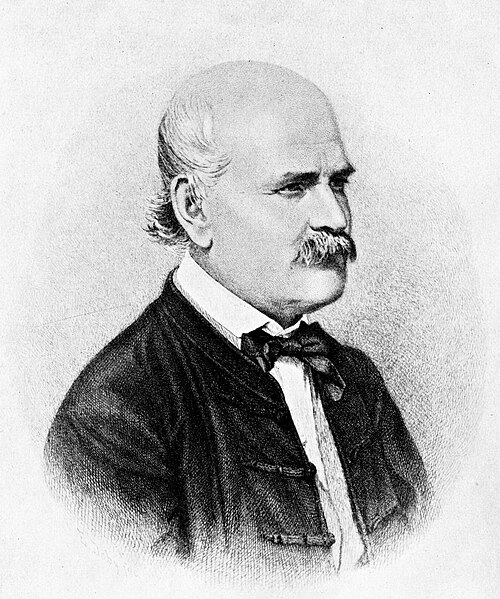
Meet 19th century Hungarian physician Dr. Ignaz Semmelweis.
The Discovery: Cadavers on the Wards
Semmelweis observed every detail to isolate the variable. The clinics used identical techniques, identical bedding, and identical ventilation.
The breakthrough came in 1847 after his friend and colleague, Jakob Kolletschka, died from a minor scalpel wound sustained during a post-mortem examination. Kolletschka’s autopsy revealed pathological features identical to the women dying of childbed fever.
Semmelweis realized the key difference: medical students walked straight from the autopsy table to the delivery room without washing their hands. Midwives, by contrast, performed no dissections.
He instituted a simple policy: all staff had to scrub their hands with a chlorinated lime solution before examining patients.
The results were instantaneous and undeniable:
- April 1847: Mortality in the First Clinic was 18.3%.
- July 1847: After introducing handwashing, mortality dropped to 1.2%.
- 1848: For several months, mortality hit 0%.
The Rejection: “A Doctor’s Hands Are Always Clean”
You would expect the medical establishment to celebrate Semmelweis as a savior. Instead, they destroyed him.
Germ theory had not yet been established. The prevailing medical dogma believed diseases were caused by an imbalance of the “four humors” or poisonous atmospheric vapors called “miasma.” To suggesting that respectable, gentlemanly physicians were carrying lethal particles on their hands and actively killing their own patients was seen as an insult to the profession.
Prominent obstetricians rejected his data:
- His chief superior, Johann Klein, refused to adopt the theory and eventually declined to renew Semmelweis’s appointment.
- Leading physicians ridiculed his statistics, calling them unscientific speculation.
- Frustrated and dismissed, Semmelweis left Vienna for Budapest, writing furious open letters calling his critics “medical murderers.”
In 1865, severely distressed and suffering from nervous breakdown, Semmelweis was committed to a mental asylum. Two weeks later, he died at age 47—ironically from sepsis after being beaten by guards and contracting a gangrenous wound on his hand.
Today, his tragic story is commemorated across Hungary and Europe, including at the Semmelweis University and Museum in Budapest. His story also gave birth to the psychological concept known as the “Semmelweis Reflex”—the knee-jerk tendency to reject new evidence or new knowledge because it contradicts established scientific consensus.
The Modern Echo: Clear Consciences and Dead Patients
The mindset that destroyed Semmelweis did not die in the 19th century. It merely updated its vocabulary.
In Semmelweis’s time, doctors shielded their ego with “My hands are clean.” Today, when standard protocols fail or treatments trigger unforeseen systemic breakdowns, the defense shifts to a remarkably similar posture: “My conscience is clear. Medical treatment was successful, but the patient died.”
It is the exact same mechanism: prioritizing the sanctity of the protocol over the reality of the outcome.
The Mirror: The Fallibility of Modern Consensus
The story of Ignaz Semmelweis is not just a historical curiosity about dirty hands; it is a warning about scientific ego and human hubris.
If medical doctors—relying on the absolute consensus of their era—did not even know they needed to wash their hands before operating on patients a mere 150 years ago, why do we assume today’s medical establishment possesses ultimate, immutable truths about human biology?
What else do we fail to see right now?
What routine interventions or standard dogmas practiced in modern hospitals will look like medieval torture or lethal negligence to future generations? Is it unreasonable to think that people in the 22nd century will look back at 21st-century medicine with the exact same horror and pity that we feel when looking back at 19th-century physicians killing their patients with septic hands?
All diseases are curable, but not all the people—especially when dogma gets in the way of truth.

Mother, Child and Rescuer – Statue of doctor Ignac Semmelweis in front of Rokus Hospital.
The statue by Alajos Strobl (1906).
Source: nedomacki / Getty Images

Source: U.OSU – The Ohio State University / Semmelweis Monument, Budapest | National Infectious Disease …
🔗 Key Historical Resources & Further Reading
- Britannica Biography: Life and Legacy of Ignaz Semmelweis
- CDC Science: History of Hand Hygiene in Medical Settings
- Semmelweis Museum of the History of Medicine (Budapest) [Map]
- NCBI PMC Study: The Semmelweis Reflex in Modern Clinical Contexts
Food for Thought: What are Modern Medicine’s Blind Spots?
Today, psychologists use the term “The Semmelweis Reflex” to describe the reflex-like rejection of new evidence because it contradicts established paradigms.
Think about this for a moment: bare-minimum sanitation like handwashing before surgery was mockingly dismissed by the absolute top medical authorities a little over 100 years ago.
If the smartest doctors of the late 19th century—operating with complete peer-reviewed institutional consensus—were unwittingly killing patients out of sheer arrogance, why do we assume our medical consensus today possesses ultimate truth about human biology?

Source: imageBROKER/Alf Jönsson / Getty Images
What toxic treatments, unexamined assumptions, or massive errors are standard medical practice right now? Is it really unreasonable to think that people in the 22nd century will look back at today’s doctors with the exact same horror with which we view 19th-century surgeons inflicting fatal sepsis on patients with unwashed hands?