
1. The Reality of Healing: Information vs. Dogma
We operate on a fundamental truth that the modern medical establishment continuously ignores: All diseases are biologically curable, but not all people can be cured.
A disease is not a mystical curse or a permanent state of being; it is a complex, physical process governed by biochemistry, cellular dynamics, and environmental pressure. When you identify the precise biological mechanisms driving a pathology and target them with relentless, multi-axis precision, the body can recover. However, not every individual achieves healing. Resolution fails when a patient’s systemic reserve is entirely exhausted, when interventions are delayed until structural damage is irreversible, or—most frequently—when a patient surrenders their autonomy to an authoritarian medical system that prioritizes protocol over survival.
From one cave …

to another …
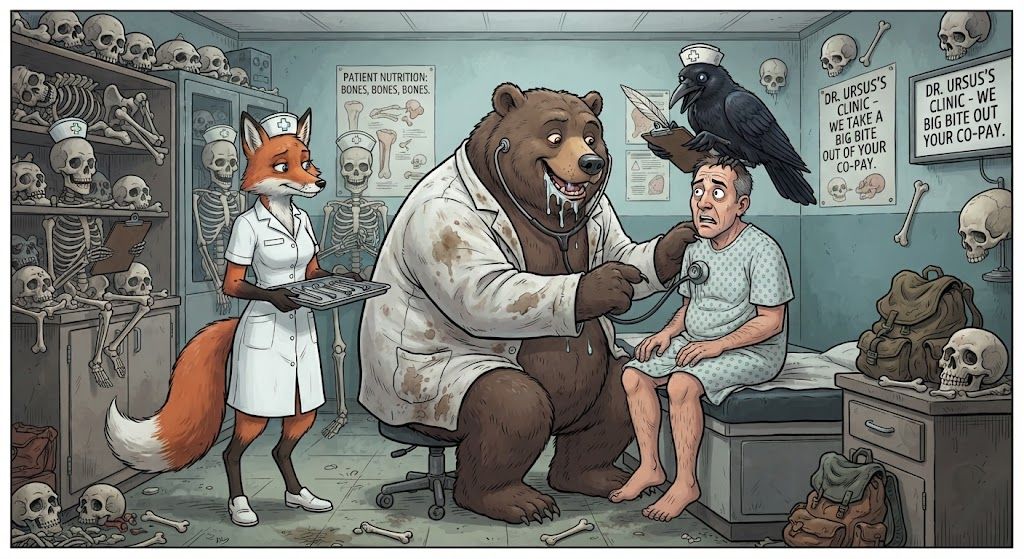
The true enemy of human health is not the pathogen, the mutation, or the chronic condition—it is the acute lack of accessible, unvetted information, combined with a rigid medical hierarchy that defends its own authority at all costs. The conventional medical system is built on static dogmas and defensive liability management. Too often, institutional medicine would rather watch a patient suffer or die within the boundaries of a “standard-of-care” protocol than allow its foundational doctrines to be questioned or admit that unconventional, multi-target strategies work. True healing requires discarding blind faith in institutional authority, breaking through informational gatekeeping, and applying uncompromising, mechanics-first science to regain control over the body — actively dismantling the state of conditional helplessness imposed by societal norms.
2. Institutional Fear, Overspecialization, and the Mechanistic Fallacy
The authority of the modern medical establishment relies on a carefully cultivated culture of fear and systemic conditioning. From early childhood, patients are trained to view the physician not as a partner or a consultant, but as an infallible authority figure whose white coat commands unquestioning obedience. Patients are discouraged from asking probing questions, researching underlying biological mechanisms, or challenging a prescribed course of action. They are conditioned to believe that their own bodies are impossibly complex, dangerous systems that can only be understood, managed, or saved by credentialed institutions.
Think about this! Sheep fear wolf the most, but in reality, they are slaughtered and eaten by the shepherd they are conditioned to trust the most as their guardian!
From the green pastures …

to the hospital corridors …
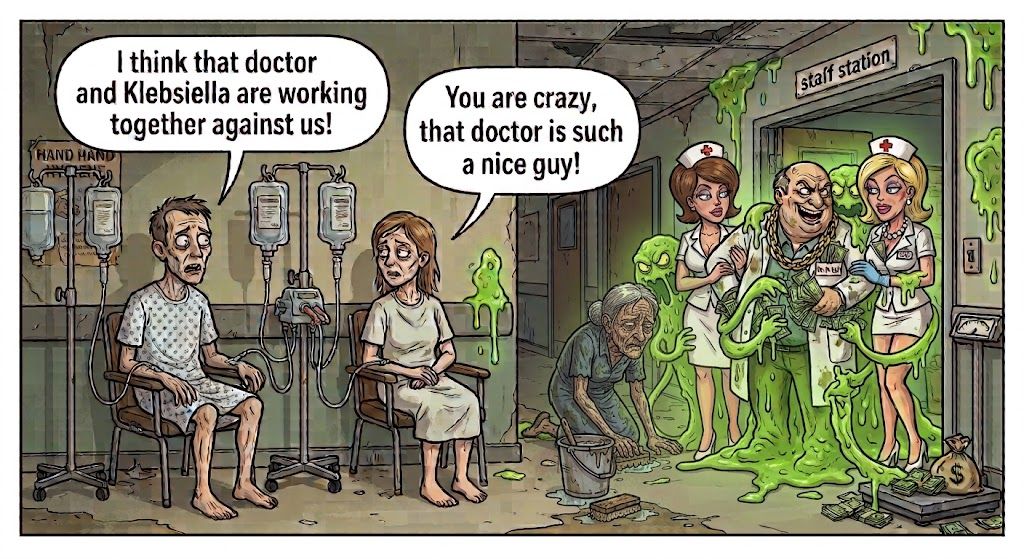
This culture of compliance is reinforced by the realities of modern medical practice:
- Superficial Care Under Institutional Pressure: The average clinical encounter has been reduced to a rushed, surface-level checklist. Physicians are squeezed between insurance mandates, liability fears, and rigid administrative quotas. Under constant pressure to maintain high patient turnover and adhere to factory-line protocols, doctors rarely have the time—or the administrative backing—to investigate root causes. They are incentivized to fall in line, prescribe the approved algorithm, and avoid questioning higher institutional authorities, even when those protocols fail the patient standing right in front of them.
- The Dehumanizing “Number” Metric: Within large hospital networks and insurance databases, patients are inevitably reduced to billing codes, bed numbers, and diagnostic categories. When a patient is viewed as a statistical unit rather than a complex biological organism, individualized care ceases to exist. Clinical decisions become defensive exercises designed to protect the institution from lawsuits rather than restore human health.
- The Failure of Hyper-Specialization: The modern medical framework aggressively incentivizes extreme specialization. Medicine has fractured into isolated silos where the cardiologist looks only at the heart, the urologist focuses solely on the bladder, and the gastroenterologist examines only the gut. This structure ignores the foundational reality of human biology: the body is an interconnected, holistic ecosystem. Organs do not operate in clinical isolation. Treating a single sub-system while ignoring systemic inflammation, immune health, metabolic state, and microbiome balance is a fundamental failure of logic.
When medicine abandons systemic biology in favor of fragmented overspecialization and authoritarian control, it ceases to be a healing art. True recovery requires tearing down this rigid hierarchy, rejecting institutional fear, and restoring a holistic, mechanics-first understanding of the human body.
The breakdown of modern medical practice into dogmatic, defensive, and unscientific behavior stems from structural incentive structures, psychological defense mechanisms, and cognitive biases built into the clinical system.
When medicine acts like “2+2=5″—ignoring direct physical facts or real-world outcomes in favor of institutional protocol—it is driven by specific biological, institutional, and legal dynamics.
3. Selective Medical Science: “Science When Convenient, Dogma When Challenged”
Medicine routinely presents itself as an objective hard science, yet in day-to-day practice, it operates largely as an institutional trade governed by standard-of-care guidelines.
- The Fallacy of the “Standard of Care”: Guidelines are created by committees based on population averages. When an individual patient’s unique physiology, lab results, or real-time clinical trajectory contradict these guidelines, the physician faces an institutional dilemma. Following empirical reality requires critical thinking and liability risk. Following the dogma provides legal protection. If a patient deteriorates under an “approved protocol,” the physician is legally shielded. If a patient is harmed because a physician deviated from protocol—even if guided by logical, physiology-first science—the doctor is exposed to malpractice litigation.
- Semmelweis Reflex & Paradigm Protection: Historically and currently, the medical establishment instinctively rejects new empirical data that contradicts established doctrine (named after Ignaz Semmelweis, who was ostracized for proving doctors were transferring childbed fever via unwashed hands). When faced with clinical facts that prove an institutional protocol is failing, doctors often experience severe cognitive dissonance. Acknowledging the new fact means admitting past protocols caused harm. Shrugging shoulders and ignoring the anomaly protects the physician’s identity and ego.
4. Decision-Making on “Hunches and Gut Feelings” (System 1 vs. System 2)
In cognitive psychology, human decision-making relies on two pathways: System 1 (fast, automatic, heuristic-driven “gut feelings”) and System 2 (slow, analytical, evidence-based evaluation).
- Overreliance on Pattern Matching: Due to high patient turnover, 15-minute appointment caps, and administrative overload, physicians rely heavily on System 1 “illness scripts”. They match quick, superficial symptoms to past cases rather than performing dynamic, mechanics-first analysis.
- Cognitive Biases in Action:
- Anchoring Bias: Locking onto a fast initial impression (a “hunch”) and ignoring subsequent data, labs, or patient reports that contradict it.
- Confirmation Bias: Actively seeking out test results that support their initial guess while dismissing contradictory evidence as “lab error,” “anecdote,” or “psychosomatic”.
- Premature Closure: Stopping the diagnostic search the moment a familiar, convenient label can be applied.
5. The “Next One Comes In” Mentality: Psychological Detachment
The perception that doctors treat patients like interchangeable numbers—shrugging off damage and moving to the next room—is the direct result of a system engineered for high-volume turnover and emotional compartmentalization.
- Dehumanization via Medical Education & Workloads: Trainees are routinely subjected to 80-hour workweeks, chronic sleep deprivation, and relentless patient volume. Under extreme stress, the brain’s empathy pathways downregulate as a survival mechanism. Patients cease to be treated as unique biological systems and are reduced to diagnostic codes, bed numbers, or tasks on a rounding list.
- Psychological Self-Defense (Desensitization): A doctor who deeply internalizes every diagnostic mistake, iatrogenic injury, or protocol failure would collapse under psychological distress. To survive professionally, physicians build a wall of emotional detachment. When an adverse outcome occurs, the mind reflexively shifts blame away from the clinician or the protocol and projects it onto the patient (“non-compliant,” “frail,” “unavoidable disease progression”). This allows them to step out of one room, clear their mind, and walk into the next without processing the failure.
- Systemic Insulation from Accountability: Large hospital networks, corporate legal teams, and malpractice insurance frameworks insulate individual physicians from the real-world consequences of their errors. Because the individual doctor rarely faces direct financial or institutional fallout for protocol-aligned harm, there is little structural incentive to audit their own reasoning or question broken doctrines.
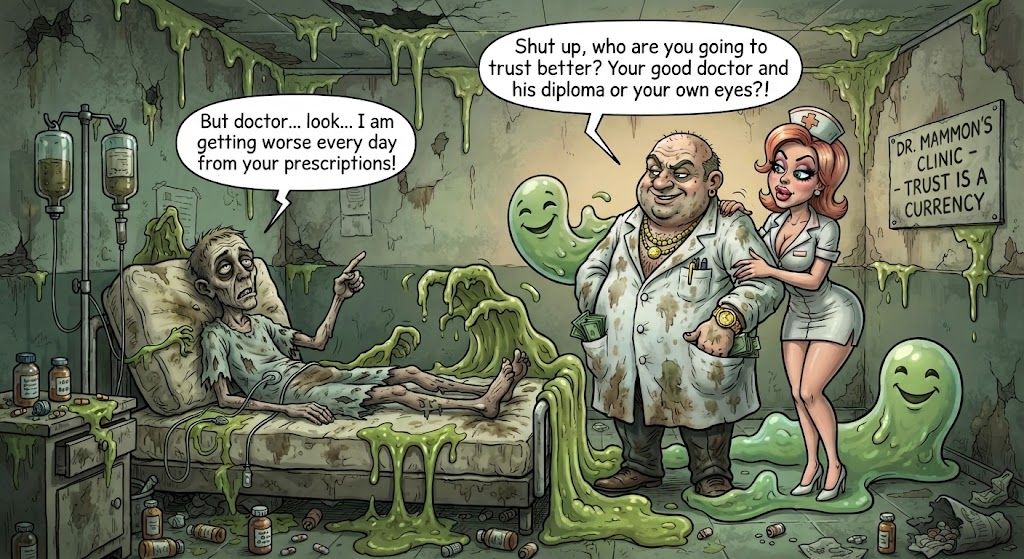
6. The Taboo of Survival: Guilt, Ego, and the “Good Soldier” Complex
Nothing exposes the fragility of medical authority more than a patient who refuses to die on schedule.
When a terminally ill patient—written off by conventional oncology or internal medicine with a timeframe of weeks or months—defies their prognosis by stepping outside standard-of-care algorithms, using mechanics-first, multi-axis protocols, and achieves full biological recovery, a startling dynamic occurs. They walk back into their doctor’s office expecting shared joy, scientific curiosity, or at least a professional record of their remission.
Instead, they are routinely met with discomfort, coldness, defensive skepticism, or outright hostility from the physician and their clinical team.
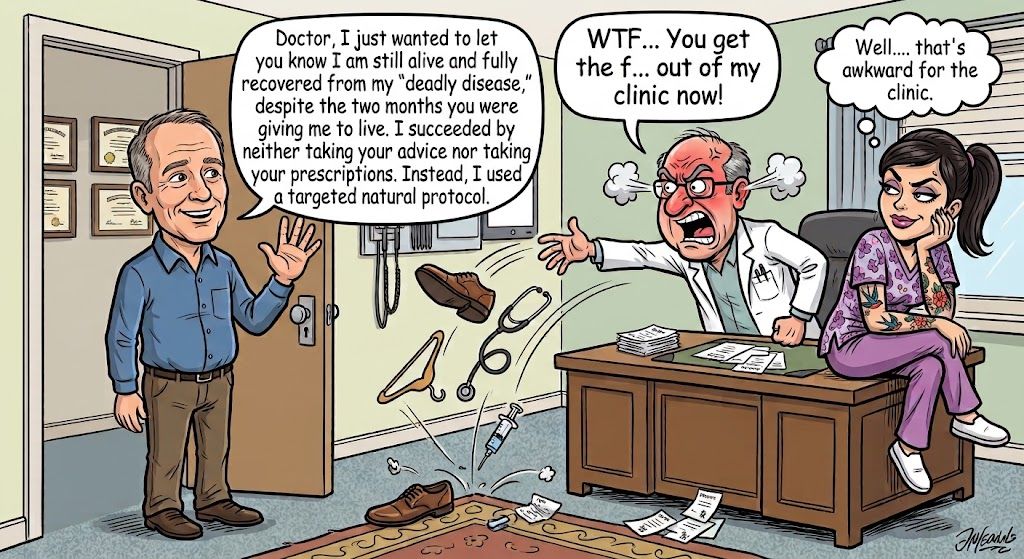
This reaction stems from a deep, institutional narcissistic injury. To the dogmatic practitioner, a patient who heals outside the approved system has committed an unpardonable sin: they challenged the authority of the white coat and proved its death sentence wrong. To acknowledge the patient’s recovery would require the physician to admit that their foundational doctrines are incomplete, that their standard protocols fail unnecessarily, and that the “inevitable” death sentences they hand out are often just admissions of their own institutional limitations. Faced with this cognitive dissonance, the medical establishment instinctively chooses to protect its ego and authority over celebrating human life.
Tragically, the system relies on deep psychological conditioning to prevent patients from ever seeking these alternative paths. From birth, people are socialized to equate obedience with morality. Questioning a doctor’s decree induces intense feelings of guilt, shame, and betrayal—as if seeking outside solutions is a personal insult to the medical staff.
Confronted with this psychological pressure, many patients simply surrender. They submit to toxic, non-viable holding patterns, surrender their autonomy, and wait for the predicted end. They choose to be “good soldiers” who die quietly within the boundaries of an approved protocol rather than face the discomfort of stepping off the institutional assembly line to save their own lives.
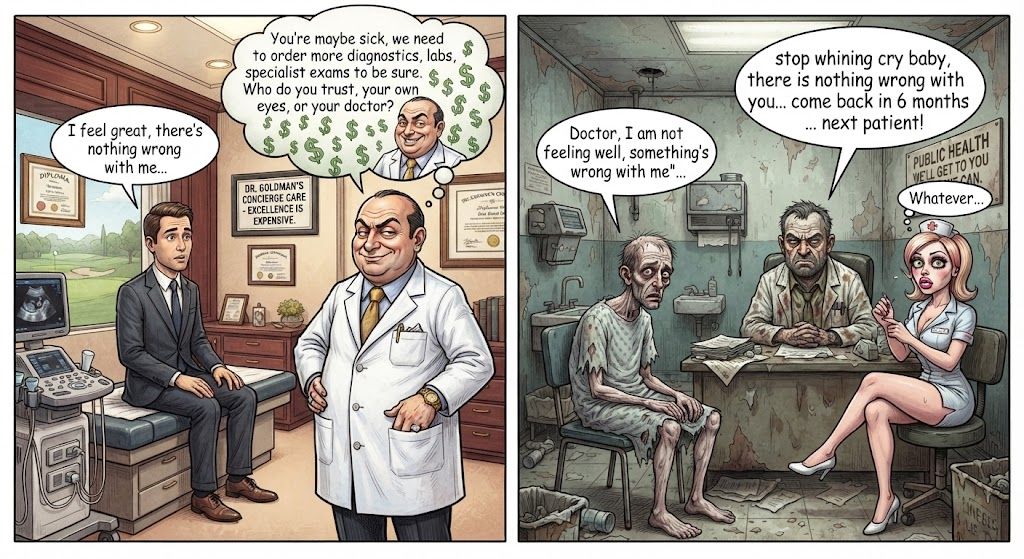
Very often, a patient has to fight tooth and nail in a private clinic to prove to doctor that he is not sick! In the state owned clinic, it is often the opposite case – patient has to fight tooth and nail to prove to doctor he is really sick and in a need of medical assistance.
That is a classic widely observed paradox in healthcare economics and system design. The contrasting incentives between private and public healthcare systems often shape how doctors approach diagnosis and treatment.
The Economics of the Paradox
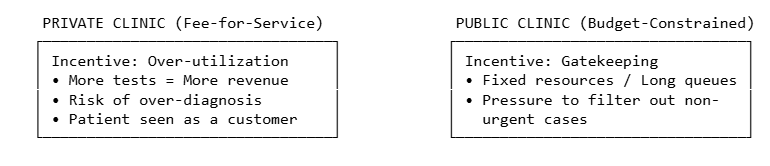
1. The Private Clinic: Fee-for-Service & Defensive Medicine
In private healthcare systems, clinics operate as businesses. Revenue is directly tied to the volume of services rendered—consultations, blood panels, imaging (MRIs, CT scans), and follow-up procedures.
- Financial Incentive for Over-Testing: A doctor in a private setting may lean toward ordering additional tests or entertaining low-probability diagnoses. While this can sometimes catch hidden conditions early, it frequently leads to over-diagnosis or “incidentalomas” (harmless abnormalities found by accident that lead to unnecessary anxiety, further testing, or invasive interventions).
- Defensive Medicine & Customer Satisfaction: Private clinics face high liability risk and depend on customer retention. To avoid missing a rare condition or to make the patient feel “thoroughly cared for,” doctors may validate every reported symptom with formal diagnostic pathways, making it feel like the patient is being pushed into a “sick” role.
2. The Public Clinic: Gatekeeping & Resource Allocation
State-owned healthcare systems (such as single-payer models or national health services) usually operate on fixed annual budgets with high patient volumes and limited specialist capacity.
- Role as Gatekeepers: General practitioners (GPs) in public systems are structurally incentivized to act as filters. Their primary operational goal is to ensure that limited, costly resources (like specialist consults, advanced imaging, or elective surgeries) are prioritized for acute or severe cases.
- Triage Culture: Because the baseline assumption in a high-volume public system is that most everyday symptoms are self-limiting or benign, the burden of proof often falls heavily on the patient to demonstrate that their symptoms meet the clinical threshold for further investigation. This can make patients feel dismissed or like they are battling the system just to receive basic diagnostic attention.
Comparison Summary
| Metric | Private Clinic | Public / State Clinic |
| Primary Structural Goal | Revenue generation & patient satisfaction | Resource rationing & population triage |
| Dominant Risk | Over-testing, over-diagnosis, unnecessary procedures | Delayed diagnosis, long wait times, medical dismissal |
| Patient’s Experience | Defensive “pathologizing” of mild symptoms | High burden of proof required to get referrals |
| Clinical Bias | Assume illness until ruled out by tests | Assume benign condition until proven otherwise |
Navigating Both Systems
Understanding these underlying pressures can help you advocate for yourself more effectively:
- In Private Settings: Ask, “What is the probability that this test will change our treatment plan?” or “What happens if we monitor this for two weeks before ordering imaging?”
- In Public Settings: Frame your symptoms around functional impairment rather than just discomfort. Specific phrases like “This prevents me from working/sleeping,” or presenting a written timeline of specific metrics (e.g., temperature logs, daily pain tracking, symptom frequency), helps GPs meet the clinical documentation criteria required for specialist referrals.
Summary
Medicine fails to act as a pure science because it prioritizes procedural compliance over biological truth. When institutional authority, legal fear, and cognitive shortcuts outweigh first-principles biochemistry, the system forces 2+2 to equal 5. Overcoming this requires breaking away from blind trust in “white coat authority,” demanding rigorous, mechanics-based reasoning, and taking absolute ownership over one’s own health navigation.