
The gastrointestinal tract serves as the primary reservoir for multidrug-resistant (MDR) and carbapenem-resistant Klebsiella pneumoniae (CRKP). Intestinal colonization routinely precedes extra-intestinal clinical infections (such as bacteremia, ventilator-associated pneumonia, and urinary sepsis).
As a result, eradicating intestinal carriage—known as decolonization—has been extensively researched as a strategy to prevent long-term recurrent infections. However, evidence shows a sharp divergence between short-term microbiological suppression and durable long-term eradication.
1. Oral Non-Absorbable Antibiotics (SDD Regimens)
Historically, Selective Digestive Decontamination (SDD) using oral regimens (such as oral Gentamicin, oral Colistin, or Neomycin/Polymyxin B combinations) was the most widely tested strategy.
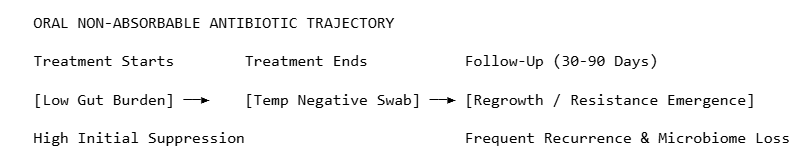
- Short-Term Efficacy: Oral non-absorbable regimens achieve high rates of clearance (60% to 80%) during or immediately after treatment (within 7 to 14 days).
- Long-Term Efficacy (30–90+ Days): Sustained decolonization drops dramatically, often falling below 20%–30% by Day 90.
- Major Risks & Guidelines Consensus:
- Resistance Selection: A major risk of oral antibiotic decolonization is the selection of secondary resistance (e.g., development of aminoglycoside or colistin resistance in previously susceptible strains).
- ESCMID Guidelines Position: The European Society of Clinical Microbiology and Infectious Diseases (ESCMID) and EUCIC guidelines explicitly recommend against routine routine oral decolonization for MDR Gram-negative bacteria due to the lack of long-term infection reduction, transient efficacy, and high risk of selecting resistant clones.
2. Fecal Microbiota Transplantation (FMT)
To overcome the microbiome disruption caused by antibiotics, Fecal Microbiota Transplantation (FMT)—administered via oral capsules, nasoduodenal tubes, or colonoscopy—has been evaluated to restore colonization resistance against CRKP.
- Mechanism: FMT introduces a diverse commensal microbiota that competes for metabolic niches (e.g., short-chain fatty acid production, nutrient depletion) and directly inhibits Klebsiella proliferation via bacteriocins and mucosal immunity.
- Clinical Evidence:
- Observational Studies & Cohorts: Initial open-label studies reported clearance rates of 50% to 70% for carbapenemase-producing Enterobacterales (KPC, NDM, OXA-48) at 1 to 3 months post-FMT.
- Randomized Controlled Trials (RCTs): Clinical trials (such as the KAPEDIS phase II RCT and studies by Bar-Yoseph et al.) demonstrate moderate long-term success. However, efficacy heavily depends on avoiding subsequent systemic antibiotic administration.
- The “Antibiotic Wipeout” Problem: If a patient receives broad-spectrum systemic antibiotics (e.g., for a surgical or respiratory indication) after FMT, the transplanted healthy microbiome is eradicated, leading to rapid re-colonization by endogenous or environmental CRKP.
3. Emerging Targeted Strategies
Because broad antibiotics disrupt the microbiome and FMT carries infection risks in severely immunocompromised hosts, alternative targeted therapies are in active development:
A. Bacteriophage Therapy
- Mechanism: Using specific lytic phages that target particular capsular serotypes (e.g., K1, K2, K64) or outer membrane proteins of K. pneumoniae without disturbing the surrounding commensal flora.
- Evidence Level: Preclinical animal models and humanized mouse studies show that single-phage therapy often leads to rapid resistance via capsule loss or mutation. Dual-phage cocktails targeting both capsule and LPS show promise in suppressing intestinal loads, but remain experimental.
B. Targeted Synbiotics & Microbiome Therapeutics
- Mechanism: Administering defined consortia of live biotherapeutic products (e.g., specific Bacteroides species or engineered probiotics) paired with non-digestible fibers (prebiotics).
- Evidence: Proof-of-concept studies show modest reductions in Klebsiella gut density, but clinical trial evidence for preventing clinical infections remains limited.
4. Spontaneous Decolonization vs. Active Intervention
Longitudinal natural history studies show that spontaneous decolonization occurs naturally over time if reinfection and antibiotic selective pressure are eliminated:
| Time Point Post-Discharge | Spontaneous Clearance Rate (No Active Decolonization) |
| 1 Month | ~30% – 45% |
| 3 Months | ~50% – 60% |
| 6 Months | ~65% – 75% |
Key Predictors of Successful Natural Clearance:
- Outpatient discharge (leaving the hospital environment)
- Complete cessation of systemic broad-spectrum antibiotics
- Absence of indwelling medical devices (urinary catheters, gastrostomy tubes, central lines)
- Absence of chronic open wounds or structural organ abnormalities
Summary of Evidence
Current medical evidence indicates that active antibiotic decolonization does not reliably prevent long-term recurrent infections and carries significant risks of resistance development. The most evidence-based, sustainable strategy relies on:
- Systemic Antibiotic Stewardship: Discontinuing unnecessary broad-spectrum agents to allow natural microbiome recovery.
- Strict Device & Source Removal: Removing foreign bodies (catheters, lines) that promote persistent systemic re-seeding.
- Investigational FMT / Microbiome Restoration: Reserved primarily for high-risk patients (e.g., bone marrow transplant candidates) in controlled trial settings where temporary suppression provides a critical safety window.
Deciphering the gastrointestinal carriage of Klebsiella pneumoniae