
When philosopher and social critic Ivan Illich published Medical Nemesis: The Expropriation of Health (Pantheon Books, 1976)—also expanded as Limits to Medicine—he delivered a scathing indictment of modern institutional medicine. Illich’s central thesis was revolutionary yet terrifyingly simple: the medical establishment has become a primary threat to health.

Illich coined and structured the concept of iatrogenesis (physician- or system-induced harm) into three distinct tiers:
- Clinical Iatrogenesis: Direct, physical injury produced by medical intervention—drug side effects, surgical errors, secondary hospital-acquired infections, and toxic polypharmacy.
- Social Iatrogenesis: The process by which life’s normal conditions, discomforts, and natural healing processes are transformed into medical commodities, forcing individuals into lifelong dependence on healthcare systems.
- Structural (Cultural) Iatrogenesis: The ultimate stage, where a society loses its autonomous capacity to cope with pain, sickness, and death because the medical monopoly has convinced individuals that only institutional intervention can grant survival.
The Shocking Proof: When Doctors Strike, Mortality Drops Like A Rock
To conventional medical dogma, the idea that hospital care can increase population-level mortality sounds absurd. Yet, modern history offers a disturbing empirical counterpoint to institutional hubris: when doctors go on strike, death rates routinely decline.
- Los Angeles County (1976): During a 5-week doctor strike over malpractice insurance rates, emergency-only care was maintained while elective procedures ceased. Total mortality in LA County dropped by 18%. Once the strike ended and full medical interventions resumed, mortality rates spiked back to pre-strike baselines.
- Israel (1973 & 2000): In 1973, a month-long doctor strike reduced patient contacts by 85%; death rates across the country dropped to their lowest levels in years according to the Jerusalem Burial Society. In 2000, during a similar multi-month physician strike, funeral homes again reported significant drops in mortality compared to the same periods in preceding non-strike years.
- Colombia (1976): A 52-day doctor strike in Bogotá resulted in a 35% drop in the local mortality rate, a phenomenon directly attributed to the cessation of unnecessary surgeries, toxic drug regimens, and invasive hospital manipulations.
These natural experiments demonstrate Illich’s core warning: a massive proportion of modern medical activity consists of high-risk, invasive interventions that generate more net harm than the conditions they claim to treat.
Applying Illich to the MDR/XDR Crisis: The Tryptych of Antimicrobial Iatrogenesis
The global proliferation of Multi-Drug Resistant (MDR) and Extensively Drug-Resistant (XDR) superbugs—such as Klebsiella pneumoniae, Proteus mirabilis, and Pseudomonas aeruginosa—is the ultimate modern manifestation of Illichian iatrogenesis.
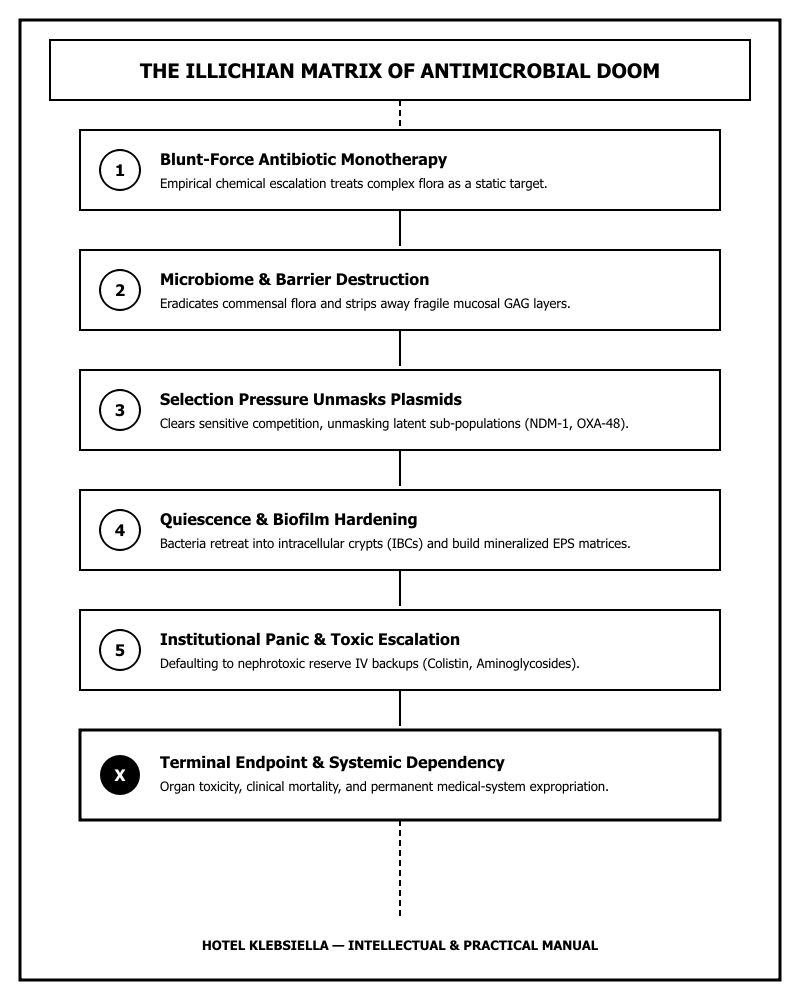
The institutional response to recalcitrant infections relies almost entirely on escalation: higher antibiotic doses, broader spectrums, and new toxic chemical entities. This creates a self-perpetuating Matrix of Doom:
The Illichian Matrix Of Antimicrobial Doom
Step 1: Initial Trigger — Blunt-Force Antibiotic Monotherapy
Step 2: Mucosal & Ecological Trauma — Eradicates Commensal Microbiome & Traumatizes Mucosal Barriers
Step 3: Evolutionary Unmasking — Selection Pressure Unmasks Latent Plasmids (e.g., NDM-1, OXA-48)
Step 4: Structural Sequestration — Bacterial Quiescence & Biofilm Hardening (IBCs in Bladder Crypts)
Step 5: Institutional Escalation — Institutional Panic: Escalation to Toxic Reserve IV Agents
Step 6: Terminal Endpoint — Clinical Death / Renal Failure / Permanent Systemic Dependency
1. Clinical Iatrogenesis: Selection Pressure & Barrier Destruction
By treating a complex microbial ecosystem with a single, aggressive chemical sledgehammer, institutional protocols obliterate the host’s protective commensal microflora and strip away fragile mucosal GAG layers. This creates intense evolutionary selection pressure. The dominant sensitive bacteria are wiped out, unmasking hyper-resistant subpopulations carrying mobile plasmids (like NDM-1 or OXA-48). The treatment creates the superbug.
2. Social Iatrogenesis: The Loss of Autonomous Biological Mechanics
Patients are taught that their immune defenses and mucosal barriers are completely irrelevant—that survival depends solely on the next generation of pharmaceutical synthetic molecules. When standard oral agents fail, institutional dogma defaults to invasive hospital admission, indwelling catheters, and nephrotoxic IV backups (such as Colistin or aminoglycosides), exposing the patient to opportunistic nosocomial flora.
3. Structural Iatrogenesis: Institutional Blindness to Biofilm Dynamics
Conventional medicine treats bacteria as free-floating (planktonic) entities in a test tube, completely ignoring the biophysical realities of Intracellular Bacterial Communities (IBCs), exopolysaccharide (EPS) matrices, and urease-driven mineral crystallization. Because the institutional algorithm refuses to recognize matrix mechanics, it labels the failure of its monotherapies as an “inevitable biological tragedy” rather than a failure of system logic.
The Global Toll: Loss of Life & Economic Devastation
The human and financial cost of this institutional failure is staggering, transforming healthcare systems from engines of healing into centers of economic exhaustion.
Human Mortality
- Global Burden: A comprehensive global analysis published in The Lancet revealed that antimicrobial resistance (AMR) was directly responsible for 1.27 million deaths in 2019 alone and associated with nearly 5 million deaths worldwide. UK-commissioned global projections warn that by 2050, AMR could claim up to 10 million lives annually—surpassing cancer as a primary cause of death.
- Europe: According to data from the European Centre for Disease Prevention and Control (ECDC), over 35,000 people die each year in the EU/EEA as a direct consequence of antibiotic-resistant infections, with a heavy burden driven by carbapenem-resistant Gram-negative pathogens like Klebsiella pneumoniae.
- United States: Official reports from the CDC (Centers for Disease Control and Prevention) document more than 2.8 million antibiotic-resistant infections in the U.S. each year, resulting in over 35,000 direct deaths.
Economic Ruin: Trillions in Systemic Loss
Financial modeling from the World Bank warns that unmitigated AMR poses a threat to global economic stability comparable to the 2008 financial crisis:
- Healthcare System Costs: The World Bank projects that AMR could drive up to $1 trillion USD in additional direct healthcare costs by 2050 as health systems struggle to manage chronic treatment failures, extended ICU stays, and organ toxicity.
- Cumulative GDP Losses (The Trillion-Dollar Matrix): Annual global GDP losses could reach $3.4 trillion USD per year by 2030, with cumulative economic impact projections reaching up to $100 trillion USD worldwide by 2050 if structural changes are not made.
- Poverty Acceleration: An estimated 24 million additional people could be pushed into extreme poverty by 2030 due to catastrophic out-of-pocket health expenditures and lost productivity from drug-resistant illness.
Why Existing Global Initiatives Have Failed?
Governments and international bodies have launched numerous high-profile initiatives to combat AMR—such as the WHO Global Action Plan on AMR and push/pull economic legislation (like the US PASTEUR Act) designed to subsidize pharmaceutical development for novel antibiotics.
Yet, these initiatives remain largely unsuccessful because they operate inside the exact same failed paradigm:
- The “New Drug” Treadmill: International initiatives focus almost exclusively on funding new antibiotic molecules. But throwing a new antibiotic at a biofilm-forming, plasmid-swapping uropathogen simply restarts the evolutionary clock. Within months or years of clinical introduction, resistance to the “new miracle drug” inevitably emerges.
- Ignoring the Host Mucosal & Biofilm Environment: Global policy ignores biophysical mechanics. A new antibiotic cannot penetrate an un-degraded, mineralized struvite matrix or clear an intracellular bacterial nest if the mucosal barrier remains raw and unshielded.
- Institutional Inertia and Malpractice Fear: Fear of liability forces clinicians to adhere strictly to rigid, single-agent clinical guidelines. Trying a multi-axis approach—integrating targeted anti-adhesives, enzymatic matrix mucolytics, iron starvation, and metal-chelating bactericidals—is viewed by institutional medicine as non-standard, even while the “standard” protocol leads directly to ICU admission and renal failure.
Breaking Free: The “Hotel Klebsiella” Paradigm
Ivan Illich warned that true health can only be reclaimed when individuals and independent thinkers break free from the institutional monopoly and understand the true mechanics of their own biology.
“Hotel Klebsiella” exists to provide that precise intellectual and practical bridge. By dismantling dogmatic public health myths and replacing them with rigorous, multi-axis biological strategies—targeting fimbriae with carbohydrate decoys, unroofing matrices with targeted enzymes, starving pathogens of essential metals, and restoring the native GAG shield—we move past the dead-end street of clinical iatrogenesis and reclaim autonomous, permanent healing.