
In our previous exploration of Ivan Illich’s 1975 landmark work, Medical Nemesis: The Expropriation of Health, we examined clinical iatrogenesis—how high-dose, repetitive antibiotic monotherapies destroy mucosal barriers and actively foster multi-drug resistant (MDR) bacterial reservoirs like Klebsiella pneumoniae.
However, the physical harm inflicted by pharmaceutical escalation is only the first tier of the problem. Illich described a second, more insidious layer: Social Iatrogenesis.
Social iatrogenesis occurs when the medical establishment expands its monopoly to redefine human experience, turning ordinary suffering into a domain reserved exclusively for institutional management, while simultaneously imposing administrative and diagnostic definitions that invalidate the patient’s lived physical reality.
For sufferers of chronic, recurrent, and embedded urinary tract infections (rUTIs), social iatrogenesis is not an abstract sociological theory—it is a daily diagnostic barrier.
The Diagnostic Monopoly: How “Standard Rules” Erase Sickness
At the heart of social iatrogenesis is the institutional requirement that a condition must fit rigid, centralized bureaucratic parameters to be recognized as “real.”
In mainstream urology, this gatekeeping is enforced through two primary mechanisms:
- The Kass Criterion (10⁵ CFU/mL): Established in the 1950s for acute pyelonephritis in pregnant women, this arbitrary threshold (100,000 colony-forming units per milliliter) remains the gold standard for defining a “true” UTI, despite decades of research demonstrating that lower bacterial counts or slow-growing intracellular pathogens cause severe lower urinary tract inflammation.
- Standard Midstream Urine (MSU) Cultures: Standard agar plate cultures are optimized to detect rapidly growing, planktonic, aerobic bacteria (primarily E. coli). They are fundamentally blind to fastidious organisms, anaerobic species, viable-but-non-culturable (VBNC) states, and bacteria shed intermittently from deeply embedded intracellular bacterial communities (IBCs).
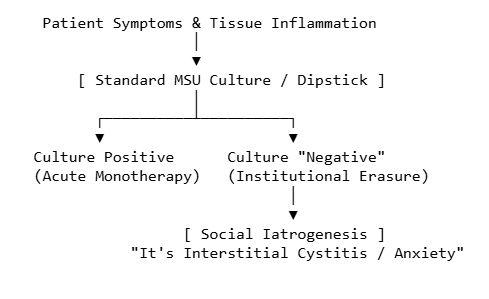
When a patient experiences debilitating bladder pain, urinary frequency, and systemic inflammation, but their MSU culture returns “negative” or “mixed flora / contamination,” social iatrogenesis immediately takes hold.
Medicalizing Failure: From “Infection” to “Functional Syndrome”
When institutional tools fail to detect complex host-microbe mechanics, the medical apparatus rarely admits the limitations of its diagnostic hardware. Instead, it redefines the patient.
Under Illich’s framework, social iatrogenesis operates by shifting the burden of diagnostic failure onto the sufferer:
- Diagnostic Relabeling: The patient’s active microbial infection is converted into a vague, incurable “functional syndrome”—such as Interstitial Cystitis (IC), Bladder Pain Syndrome (BPS), or Overactive Bladder (OAB).
- Psychologization: When symptoms persist without a positive culture, the clinical response frequently pivots toward anxiety, somatic symptom disorder, or stress. The physical pathology is effectively dismissed as imaginary or self-induced.
- The Dependency Trap: The patient is funneled away from curative antimicrobial/ecological strategies and into lifelong management protocols—instillations, nerve modulators, pain medications, and invasive procedures that manage symptoms without addressing the underlying persistent bacterial reservoir.
Illich summarized this institutional reflex precisely: medicine creates a system where the patient is forbidden to suffer unless their suffering is validated by an approved institutional metric. If the metric fails, the patient’s reality is invalidated.
Deconstructing the “Contamination” Narrative
One of the most clear examples of social iatrogenesis in chronic UTI management is the dismissal of polymicrobial or low-count results as “epithelial contamination.”
Klebsiella pneumoniae and other sophisticated uropathogens frequently alter the local urothelial architecture, causing cell exfoliation and biofilm sloughing. When a laboratory report reads “Mixed growth—likely skin flora contamination,” it often represents the natural shedding of a complex, polymicrobial mucosal biofilm.
By categorizing these biological signals as administrative “errors” or “dirty samples,” institutional protocols justify withholding targeted treatment, leaving the patient stranded between persistent tissue damage and medical rejection.
Breaking Free: Restoring Biological Literacy and Health Sovereignty
How do we counter social iatrogenesis in the management of persistent uropathogens?
Illich argued that the antidote to social iatrogenesis is not better medical bureaucracy, but demystification and the restoration of individual autonomy through knowledge.
At Hotel Klebsiella, breaking the diagnostic monopoly requires three key shifts:
- Rejecting Arbitrary Thresholds: Understanding that bacterial persistence inside urothelial cells (IBCs) and quiescent tissue reservoirs does not conform to 70-year-old planktonic culture standards.
- Utilizing Advanced Diagnostics Wisely: Leveraging broader diagnostic modalities—such as High-Sensitivity Quantitative PCR (qPCR), Next-Generation Sequencing (NGS), and microscopic sediment analysis—while recognizing that clinical symptoms and tissue markers always take precedence over a single laboratory report.
- Reclaiming Host Ecology: Shifting the objective from seeking institutional validation for every flare-up to actively restoring host barrier integrity, GAG-layer protection, and anti-biofilm dynamics.
The Ivan Illich Memorial Corner
Social iatrogenesis thrives in the dark—where diagnostic limitations are hidden behind authoritative dismissals. By bringing biological precision to host-microbe ecology, we strip away institutional dogmas and return agency where it belongs: to the informed advocate and the empowered patient. Have you been told your culture was “negative” or “contaminated” while living with undeniable symptoms? How did you navigate the diagnostic wall?